

by NOVA

Sep 14, 2026
Pick your zigbee radio type by naming the class in front of you: an adapter stack, a network role, a band, or a finished hub-required module.
A Zigbee radio type is not one dropdown with one right answer. Home Assistant ZHA uses the phrase for a coordinator adapter stack. A mesh diagram uses it for coordinator, router, and end device.
A channel page may only state Zigbee 3.0, a hub, and a band. Mixing those classes is how a quote ships the wrong hardware.
This page sorts those classes for a distributor or installer. A controller walkthrough stays out. The live pieces on Zigbee disadvantages, Zigbee application paths, and Matter versus Thread already cover those neighboring jobs.
The phrase names an adapter-stack class in ZHA, and a buyer still has to classify role, band, and form separately.
On the ZHA network information page, radio type is the stack used by the coordinator. The setup dialog lists EZSP, ZNP, deCONZ, ZiGate, and XBee. A Reddit user with a TI dongle asked the same question in those words: “What Radio Type do I select?” The useful reply pointed at the TI stack, not at a mesh role.
That is the neighboring phrase pick your zigbee adapter type. The phrase covers the same setup choice: which coordinator radio library talks to the stick or built-in module. The wall device later joined to that network sits in a different class.
For a channel assortment, the phrase still has a second job. A catalog line can be a coordinator adapter, a relay module, a sleepy sensor, or a vendor hub. If the quote only says “Zigbee,” the warehouse cannot tell those apart.
Start with the class the speaker meant, then read the page for the classes it actually states.
One coordinator forms the network, routers relay and stay awake, and end devices do not route.
ZHA documentation states that a Zigbee network can have only one Zigbee coordinator. Zigbee2MQTT describes the same three device types: the coordinator forms the network, routers move traffic and may not sleep, and end devices do not route. An end device talks through one parent, usually the closest coordinator or router when it joined.
| Class | What it does on the network | Power habit | Parent and children |
|---|---|---|---|
| Zigbee coordinator | Forms the network and can also route | Stays powered | One per network; can parent children |
| Zigbee router | Relays traffic and can accept joins | May not sleep | Can be a child of another router and a parent |
| Zigbee end device | Sends and receives for itself only | May sleep and poll a parent | One parent; no children |
Sleepy and non-sleepy are still end-device classes. A sleepy end device powers the radio down and polls its parent. A non-sleepy end device stays powered and still does not route.
Digi’s radio guide adds a blunt rule: a device operates as one of the three types, not as all three at once.
Important: A finished dimmer module is not automatically a router. Role pages often use plugs and switches as router examples, but a product page that never names coordinator, router, or end device has not stated a mesh role — Zigbee2MQTT network guide and the live MS-105Z page.
A missing parent is a field problem, not a slogan. Zigbee2MQTT notes that if a parent router goes offline, traffic to its children stops until those end devices find another parent. Some end devices never look, and then they stay isolated until they are paired again.
That is why a battery sensor cannot stand in for a Zigbee router.
EZSP, ZNP, and deCONZ name coordinator hardware stacks, not the mesh job of a wall module.
EZSP is the Silicon Labs EmberZNet stack in ZHA. ZNP is the Texas Instruments stack. deCONZ is the dresden elektronik stack used by ConBee and RaspBee.
ZiGate and XBee are further adapter classes in the same dialog. None of those names is a synonym for router or end device.
A community thread titled “What is the Zigbee radio type for Zigbee wired MOES smart gateway?” got a direct reply: “None, you can’t use this gateway with ZHA or Zigbee2MQTT.” The speaker was trying to file a finished vendor hub under a ZHA radio-type list. The list is for a coordinator adapter the software can open. A closed hub that already runs its own network is a different form.
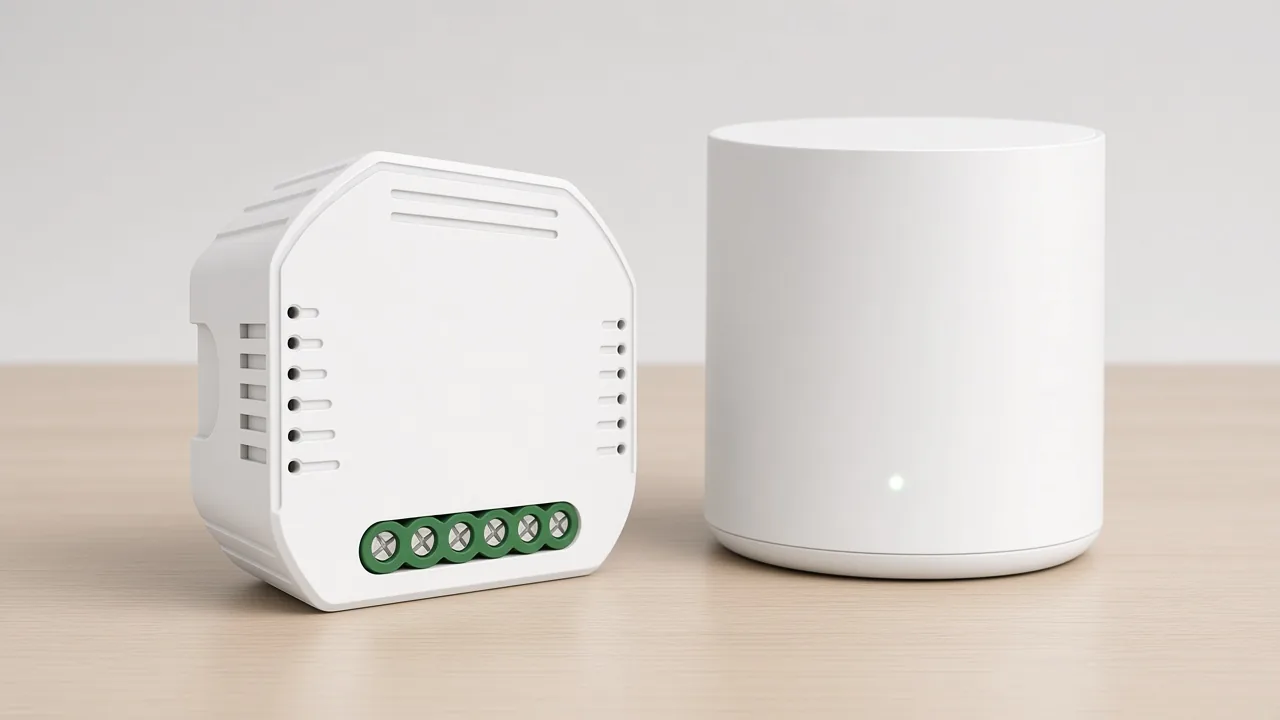
Keep the Yellow radio thread in the same bucket. Users there select EZSP because the built-in radio is an EmberZNet coordinator. They also have to know whether that radio is running Zigbee firmware or Thread firmware.
Thread is a separate layer. The comparison of Matter and Thread jobs already lives on the Matter article. This page only marks the boundary between a radio-type class and that comparison.
For procurement, write two fields instead of one adjective. Field one is the adapter stack if someone is choosing a coordinator stick for ZHA. Field two is the network role if someone is stocking sensors and relays.
A line that fills only field one will not describe a hidden dimmer module.
Zigbee 3.0 is a protocol name. Green Power is a special end-device class, and the MS-105Z page does not claim it.
ZHA examples and the live dimmer page both use Zigbee 3.0 as the protocol generation. That name sits above the adapter-stack list and beside the role list. Neither name chooses EZSP versus ZNP, and neither name proves a device will route.
Green Power, in the Zigbee2MQTT network guide, is a special end-device class. Those devices are built to use very little energy. Ordinary Zigbee radios do not understand their messages until a Green Power proxy translates them.
The Green Power device must be in range of a proxy. The guide’s examples are other brands’ switches and bulbs, not this dimmer module.
Leave “Zigbee Pro versus Green Power” off a MOES model line unless that model’s page says it. The MS-105Z page says Zigbee 3.0. Green Power, a proxy role, and a Pro stack name are absent from that page.
Quote the protocol the page names, and leave the other classes off the SKU.
Texas Instruments’ Z-Stack overview adds a useful split: the device type does not by itself restrict the application that runs on the radio. A dimmer function can exist on more than one role. Function and role are two rows, not one.
Zigbee devices generally use the 2.4 GHz band. IEEE 802.15.4 also includes Sub-GHz bands, and only a band printed on the page belongs on a SKU.
Zigbee2MQTT notes that Zigbee devices generally use the 2.4 GHz band, while IEEE 802.15.4 also includes 800 MHz and 900 MHz bands whose use varies by country.
That is a class split, not a country shipping chart. A Sub-GHz radio and a 2.4 GHz radio are not interchangeable just because both can carry a Zigbee-family stack. Z-Wave’s usual sub-gigahertz habit, mentioned on the same overview page, is a different protocol family and not a Zigbee SKU attribute.
The live MS-105Z page lists the frequency band as 2.400-2.483GHz.
That line places this module in the 2.4 GHz class. No regional Sub-GHz twin follows from that line, and a buyer should not copy a band from a chip datasheet the page never cites. If a future variant page states another band, classify that variant from its own table.
People also ask what radio frequency Zigbee uses. The honest short answer is the general 2.4 GHz class, plus the page-stated band on the SKU you actually quote. Skip a map of national channels until a standards page you can link names those channels for the product in the quote.
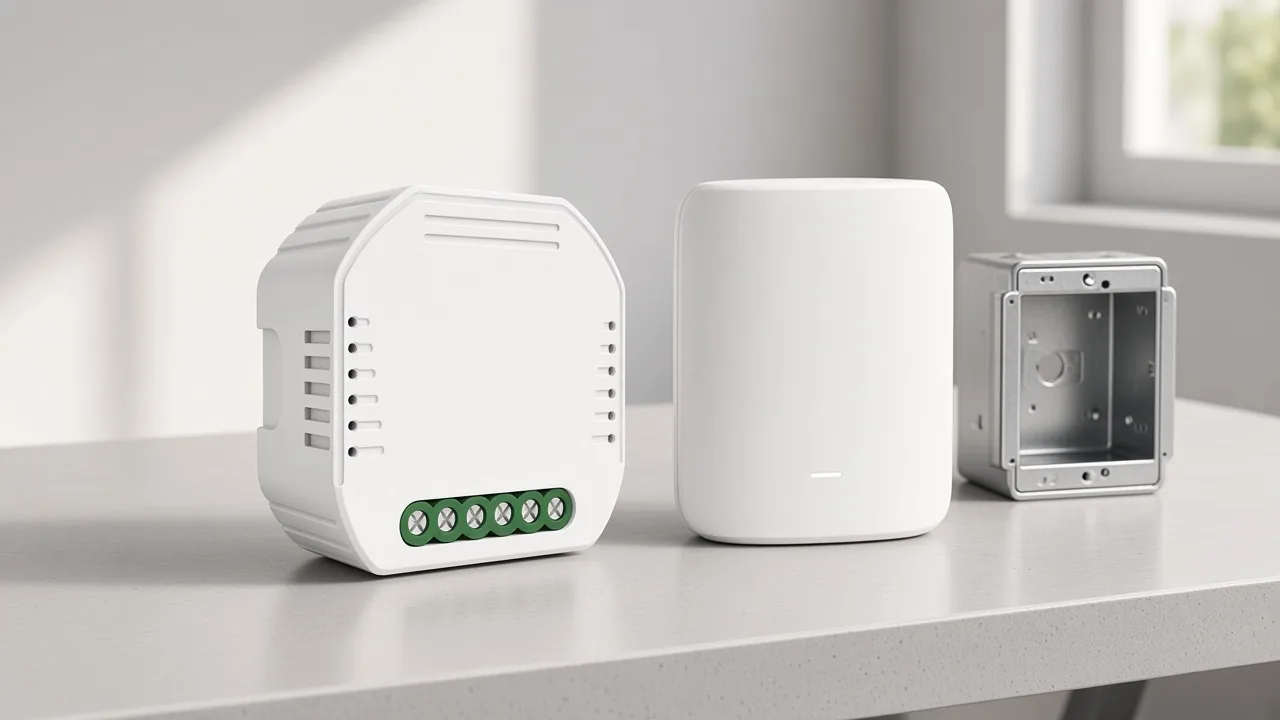
MS-105Z is a Zigbee 3.0 dimmer module that needs a Tuya ZigBee hub and lists a 2.4 GHz band, not a mesh role.
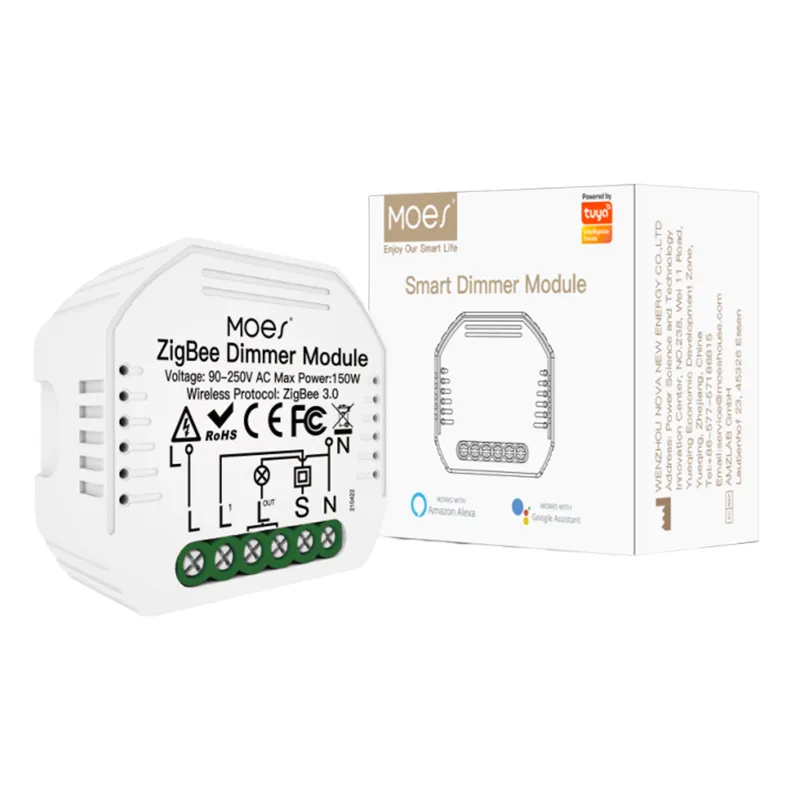
The MOES Tuya ZigBee 3.0 Smart Dimmer Switch Relay Module (MS-105Z) sits under Smart Modules. The page calls it a ZigBee 3.0 dimmer module, says a Tuya ZigBee hub is required, and lists the band already quoted above. Voice and app control on that page depend on that hub being connected.
Channel buyers file this as the hub-required finished-module class, rather than a ZHA stick or a coordinator opened with EZSP.
People often call that hub a zigbee gateway. The module page uses “Tuya ZigBee hub” and “ZigBee gateway” for the same job: the module joins the hub’s network instead of bringing its own coordinator adapter. Stocking the module without a matching hub leaves the radio class incomplete.
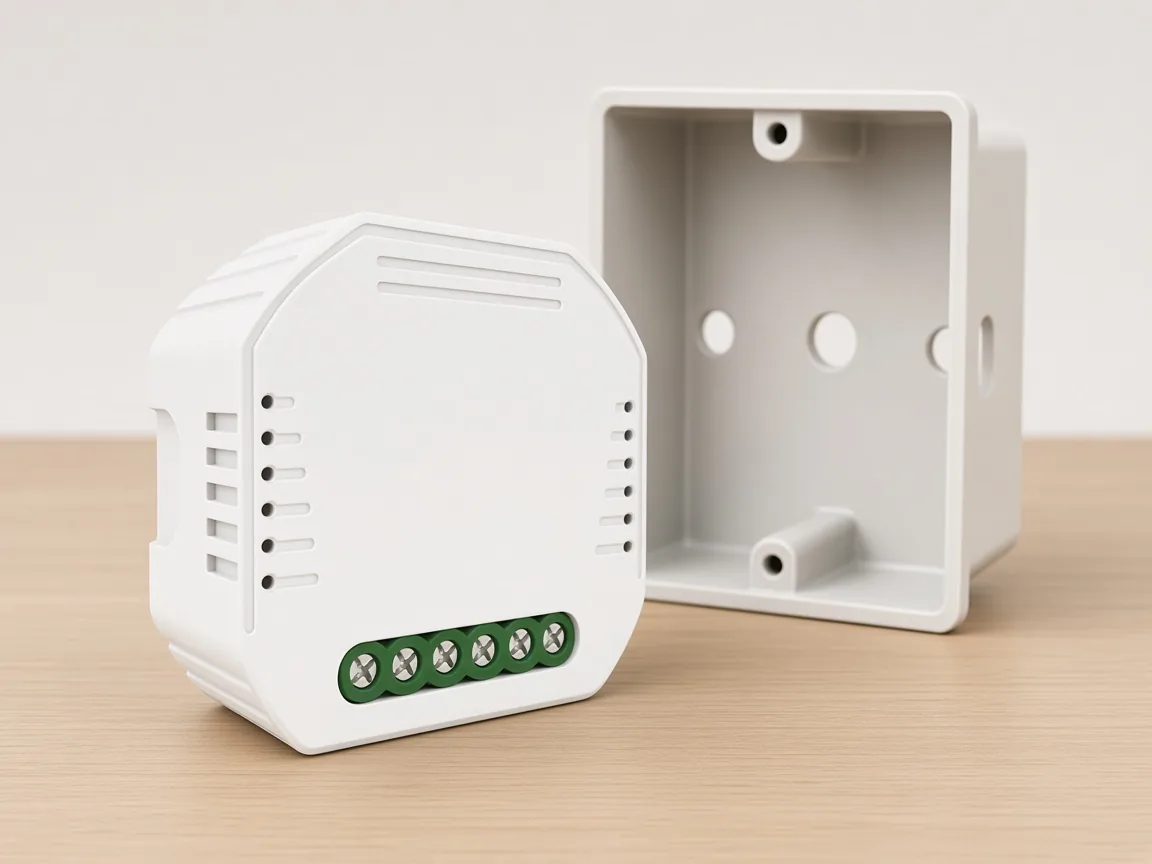
Form comes last in this map. MS-105Z is a small module meant to hide in a wall box with a traditional reset switch, not a finished wall plate and not a system-on-chip sold as a bare radio. The page also allows 1-way and 2-way dimming on a compatible circuit, which is a load-control form, still separate from coordinator, router, and end device.
| Page field | What the live MS-105Z page states | Class it fills |
|---|---|---|
| Protocol | ZigBee 3.0 | Protocol generation, not an adapter stack |
| Companion | Tuya ZigBee hub required | Hub-required finished module |
| Frequency band | 2.400-2.483GHz | 2.4 GHz class |
| Transmit power | <+20dBm | Page-stated radio power, not a range promise |
| Supply and load | 90-250 V AC; 75 W at 110 V and 150 W at 220 V; page also lists 50 and 60 hertz | Mains module, not a role |
| Size and enclosure | 52×47×18 mm; IP20 | Hidden module form |
| Mesh role | Not stated | Do not invent coordinator, router, or end device |
The upward assortment for modules and hubs is Smart Modules. Use that path when the quote needs a hub beside this module. Use the product page when the quote needs the band, the hub sentence, and the load figures above.
Do not stretch those figures onto another MOES model because the family name matches.
This recommendation is a class example. It fits a buyer who already wants a hub-required Zigbee 3.0 dimmer module and can read the page fields. A buyer who needs a ZHA coordinator radio type, a Green Power proxy, or a Sub-GHz radio should look elsewhere.
No. ZHA documentation states that a Zigbee network can have only one Zigbee coordinator. Extra sticks become extra networks, or they are flashed as routers, but they are not a second coordinator on the same network.
No. End devices do not route, and routers may not sleep. A battery sensor is the usual end-device pattern.
A few mains devices are also end devices, so mains power alone is not the role test. The page still has to name the role.
No. EZSP is an adapter stack for certain coordinator radios in ZHA. A Zigbee router is a network role that relays traffic and stays awake.
You can have an EZSP coordinator and many routers on one network. The names do not swap.
No. Green Power is a special end-device class that needs a proxy. The MS-105Z page names Zigbee 3.0 and a Tuya ZigBee hub.
Green Power stays off the SKU.
Zigbee devices generally use the 2.4 GHz band. IEEE 802.15.4 also includes Sub-GHz bands, including the 800 MHz and 900 MHz bands in the Zigbee2MQTT overview. The MS-105Z page states 2.400-2.483GHz, so that module stays in the 2.4 GHz class.
Coordinator adapters, routers, end devices, vendor hubs, and hidden modules can all use Zigbee. The useful split is form plus role. A dimmer module, a sleepy sensor, and a coordinator stick are not the same line on a quote even when they share Zigbee 3.0.
Not by default. A community reply about a wired MOES gateway said it cannot be used with ZHA or Zigbee2MQTT, and told the user to buy a dongle instead.
That objection is about treating a closed hub as a coordinator adapter. It is not a chip statement about MS-105Z.
No. Matter and Thread are a different layer split, already compared on the Matter article. This page classifies Zigbee radio types: adapter stack, network role, band, and finished module.
Use the other article when the quote is actually about those layers.


OTHER SMART DEVICES
Jun 13,2026
OTHER SMART DEVICES
Jun 12,2026
TUYA SMART HOME PRODUCTS
Jun 12,2026
 +86 137 3639 3028