

by NOVA

Sep 15, 2026
Lock power inverter sizing with documented inputs: maximum simultaneous continuous load, the largest credible surge event, DC voltage class, AC output, battery and PV path limits, waveform, efficiency documentation, and ambient derating—not a single sticker kilowatt guess. Distributors and EPC teams get an RFQ checklist first, then a scoped MOES hybrid example.
Deep hybrid selection stays on the hybrid solar inverter buyers guide.
Twelve-volt discovery fields stay on the twelve-volt solar inverter RFQ inputs article.
Architecture comparison stays on the on-grid vs off-grid B2B comparison.
Browse stock under Solar Inverter, Hybrid Inverter, and Off Grid Inverter.
For channel quotes, power inverter sizing is a paperwork job before it is a catalog job.
A power inverter converts DC from a battery bank—and, on many solar hybrids, from a PV charge path—into AC that loads can use.
U.S. Department of Energy education puts the same idea plainly: the inverter is the device that turns DC into AC, and waveform quality matters for how that power behaves with appliances and the wider electrical system.
Consumer calculators stop at “add the watts.” Channel buyers get burned when the quote never asks which loads run together, how long a surge lasts, which inverter DC voltage class the bank uses, or whether the room will roast the continuous rating.
Treat sizing as a lock list:
If those fields are blank, the SKU conversation is theater.
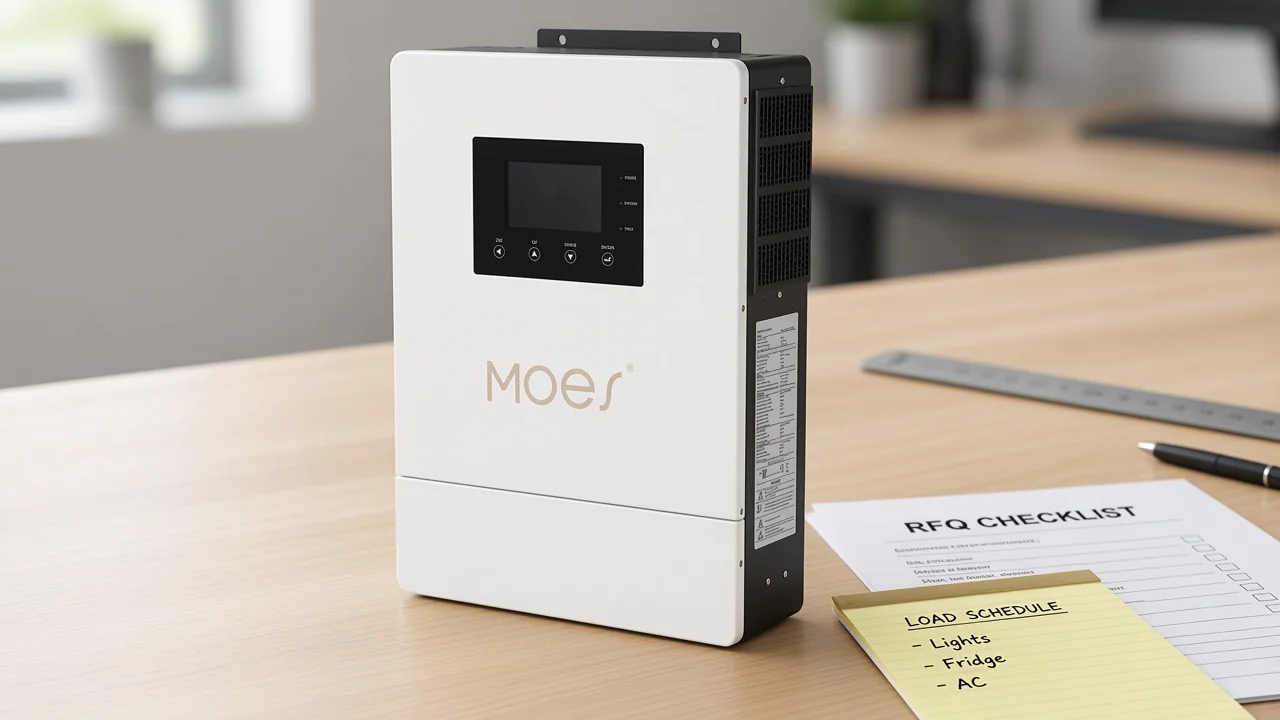
Start with a load list that reflects how the site actually runs, not a pile of nameplates for every device the customer owns.
For each item, capture running (continuous) watts, startup (surge) watts when motors are involved, and whether it runs often, sometimes, or rarely with other loads.
DOE small-scale sizing guidance still begins the same way: quantify appliance demand before you talk equipment class.
Separate daily energy (Wh/day energy) from inverter continuous watts. Energy drives battery and array conversations. Continuous watts drive the inverter floor.
A cabin quote that adds every tool in the shed will oversize capital and DC cabling. A quote that forgets the microwave can share a circuit with the fridge will undersize and create callbacks.
Channel habits that work:
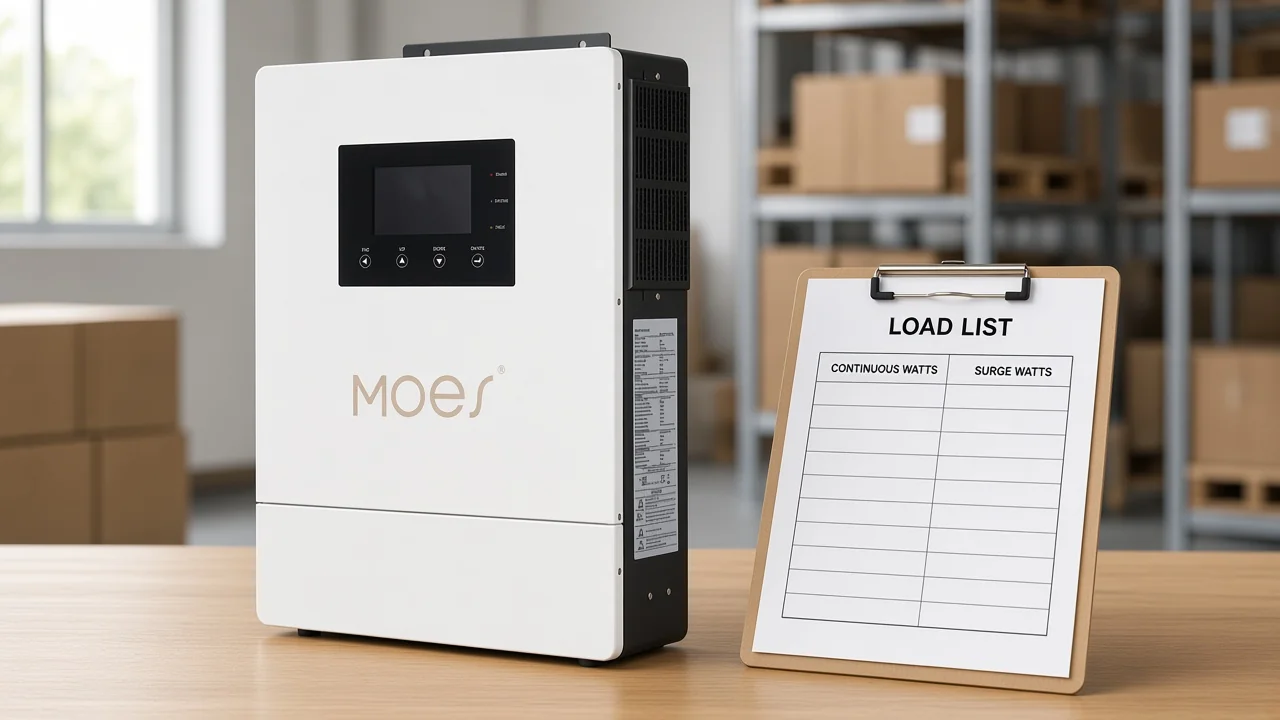
Continuous watts are the sustained AC output the inverter can deliver without becoming a heater with a fan.
That number is mainly a thermal limit. Education guides repeatedly warn against buying on peak marketing watts while leaving continuous rating vague.
Industry practice often adds a margin—commonly discussed as roughly twenty to twenty-five percent above realistic simultaneous continuous load, or continuous rating around one hundred twenty-five percent of that load—so the unit is not sitting on the edge of trip and heat.
Treat those percentages as negotiation language for the RFQ, not as a MOES guarantee or a universal formula stamped on every project.
If the realistic simultaneous continuous load is already near the nameplate, the quote is fragile before any motor starts.
Ask suppliers for:
Do not accept a surge number as a substitute for continuous capacity. A sustained microwave load does not care about a three-second overload curve.
Important: Continuous and surge are different limits. Sustained loads must fit continuous rating; surge is short. — source: https://outboundpower.com/blogs/news/how-to-size-a-power-inverter
Confusing continuous vs surge watts is the fastest way to ship a quote that fails on day one.
Surge / peak watts are the short burst needed when compressors, pumps, and many tools start.
AI Overview and technical education pages describe the same pattern: motors often need several times running watts for a brief window, and the inverter’s surge rating must cover the highest relevant event—especially if two motors can start together.
That is only half the story.
Reddit installers keep asking whether battery cables and fuses should be sized to continuous or surge amps.
The practical answer in those threads is usually: protect the wire for continuous thermal duty, understand that brief inrush is a time-current problem, and still size the inverter continuous rating for simultaneous RMS loads.
When a fridge “trips” an inverter that looked big on paper, the failure is often voltage sag from cable resistance, weak batteries, or BMS peak limits—not a missing sticker watt.
RFQ fields for surge honesty:
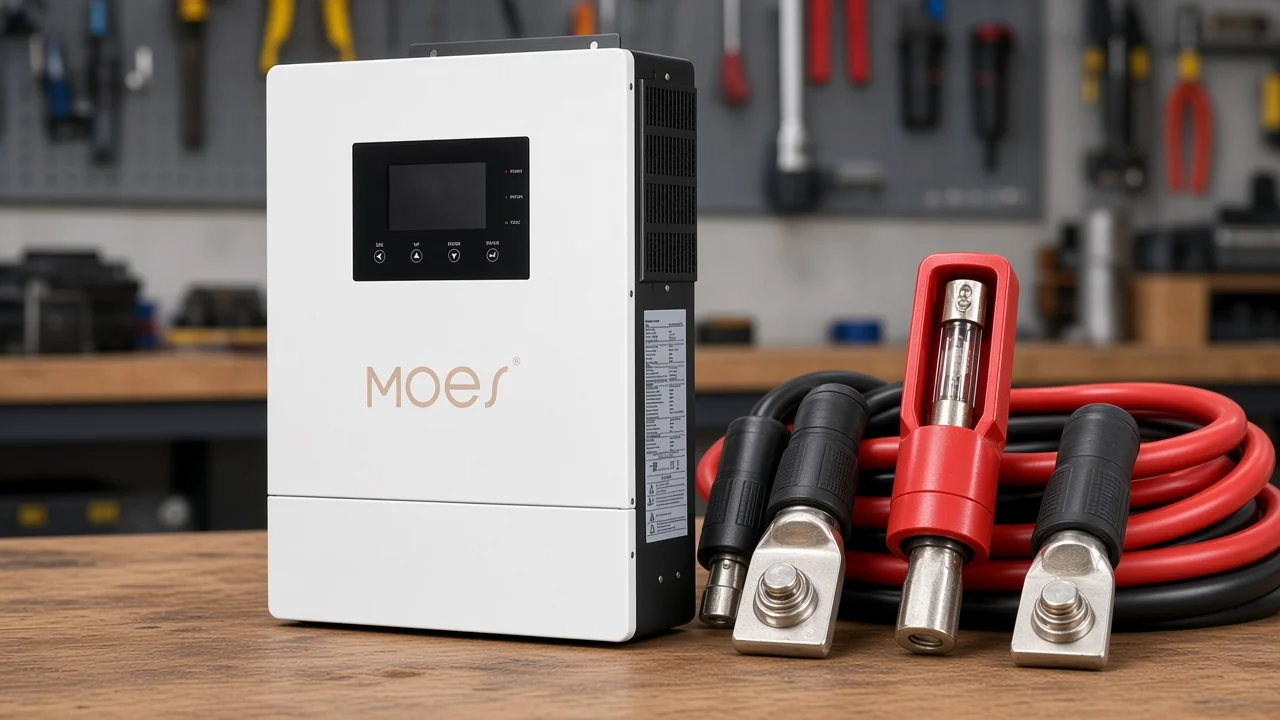
Tip: A large surge label is irrelevant if the battery, BMS, fuse, or cable limits current first. Put the DC path on the RFQ before you argue about peak watts. — source: https://www.reddit.com/r/vandwellers/comments/mpv7hy/do_i_size_my_fuse_and_cables_for_an_inverter/
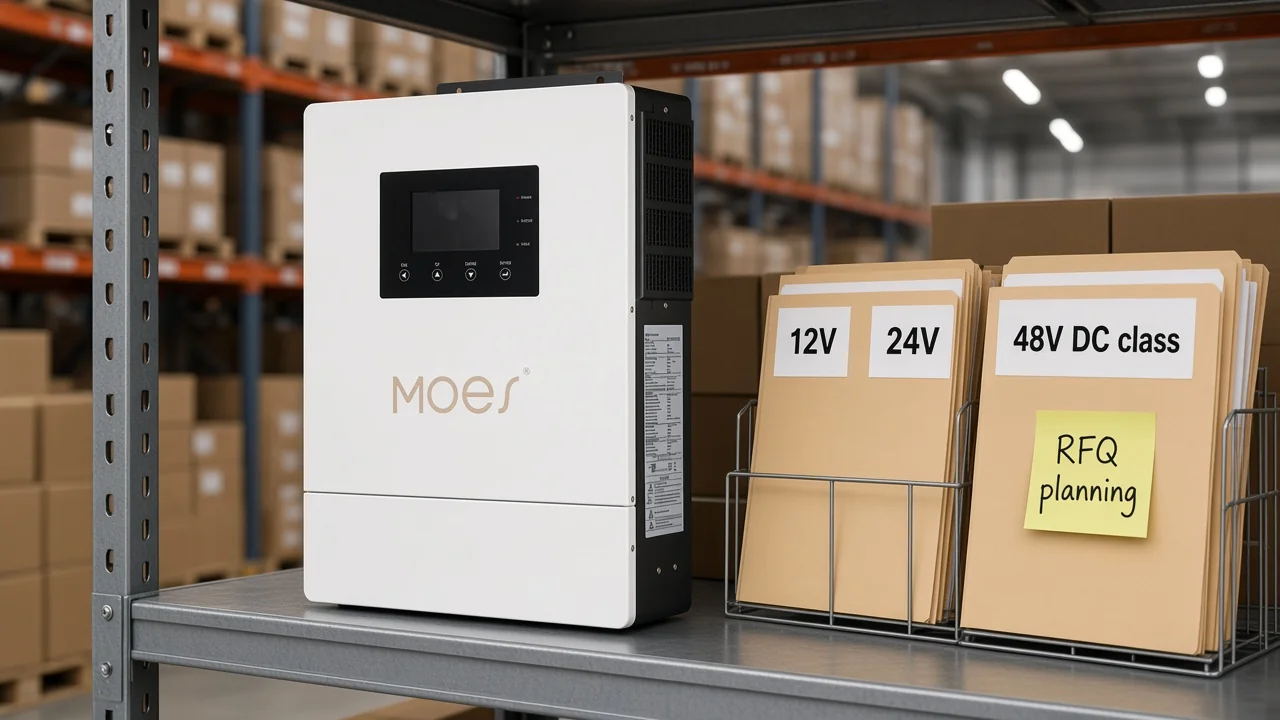
DC voltage is a sizing multiplier, not a fashion choice. Channel RFQs should name the inverter DC voltage 12V 24V 48V class explicitly before SKU talk.
The same AC watts demand higher DC current at twelve volts than at twenty-four or forty-eight volts.
Technical education examples show current roughly halving when voltage doubles, which is why higher continuous classes often move to twenty-four or forty-eight volt banks to reduce cable stress, fuse size, and voltage drop.
Retail sizing guides also insist the inverter input voltage must match the bank.
For channel inventory:
Lock inverter DC voltage class before you talk continuous kilowatts. Otherwise cable and BMS rows will be rewritten after the purchase order.
AC output and waveform decide whether the customer’s loads behave.
Lock single-phase vs three-phase (when in scope), nominal voltage, and fifty-hertz vs sixty-hertz before SKU talk.
DOE inverter basics remind readers that clean, repeating sine-like AC is what grids and many appliances expect.
Pure sine wave is the baseline for mixed motor and electronics loads in most system-grade education. Modified sine can look cheaper on a line card and still create noise, heat, or refusal on sensitive equipment.
Efficiency matters on the DC side of the quote. Conversion is never one hundred percent.
Education examples often place many inverters in an roughly eighty to ninety percent efficiency band when teaching capacity math.
Ask for model documentation rather than inventing a channel-wide efficiency number—and never present teaching examples as MOES lab results.
Waveform and AC RFQ rows for pure sine wave inverter selection:
Continuous ratings assume an operating environment. Hot closets and sealed cabinets rewrite the math.
Ask for ambient operating range, ventilation clearances, and any published derating notes for temperature or altitude.
If the supplier cannot produce exact-model documentation—datasheet, wiring notes, surge definition—the RFQ is incomplete even if the watt sticker looks perfect.
Documentation checklist before PO:
Use these two tables on channel quotes. They are field locks, not a universal kilowatt calculator.
| Decision number | What it answers | What it does not answer |
|---|---|---|
| Continuous watts | Sustained simultaneous AC load the inverter must carry | Daily energy storage size |
| Surge watts + duration | Brief motor/compressor start events | Continuous thermal capacity |
| Wh/day (energy) | Battery and PV harvest planning | Inverter continuous class by itself |
| RFQ field | Why it is on the quote | Evidence to request |
|---|---|---|
| Simultaneous continuous load (W) | Sets thermal floor | Load list with overlap scenarios |
| Largest surge event + overlap risk | Prevents start-up trips | Motor LRA/startup watts; duty notes |
| Surge definition + duration | Stops sticker games | Model datasheet overload curve |
| DC voltage class (twelve / twenty-four / forty-eight volt) | Sets current stress and cable class | Bank architecture drawing |
| Battery continuous/peak current + BMS limits | Makes surge real | Battery datasheet / BMS limits |
| DC cable gauge/length + protection | Controls sag and fault energy | Cable schedule; fuse/breaker near bank |
| AC voltage / frequency / phase | Matches site and inventory | Site electrical notes |
| Waveform (pure vs modified) | Protects mixed loads | Spec sheet waveform statement |
| Efficiency documentation | Informs DC current estimates | Model efficiency note when required |
| Ambient + derating | Protects continuous rating in real rooms | Operating temp / derating notes |
| PV/MPPT window (if hybrid path) | Aligns array string design | MPPT range on exact SKU |
| Exact model + manuals | Ends “family name” ambiguity | Datasheet + install docs |
After the checklist clears, use a live Hybrid solar inverter (MOES SKU) to illustrate a mid-power forty-eight-volt hybrid/off-grid charger class—not as a universal sizing formula.
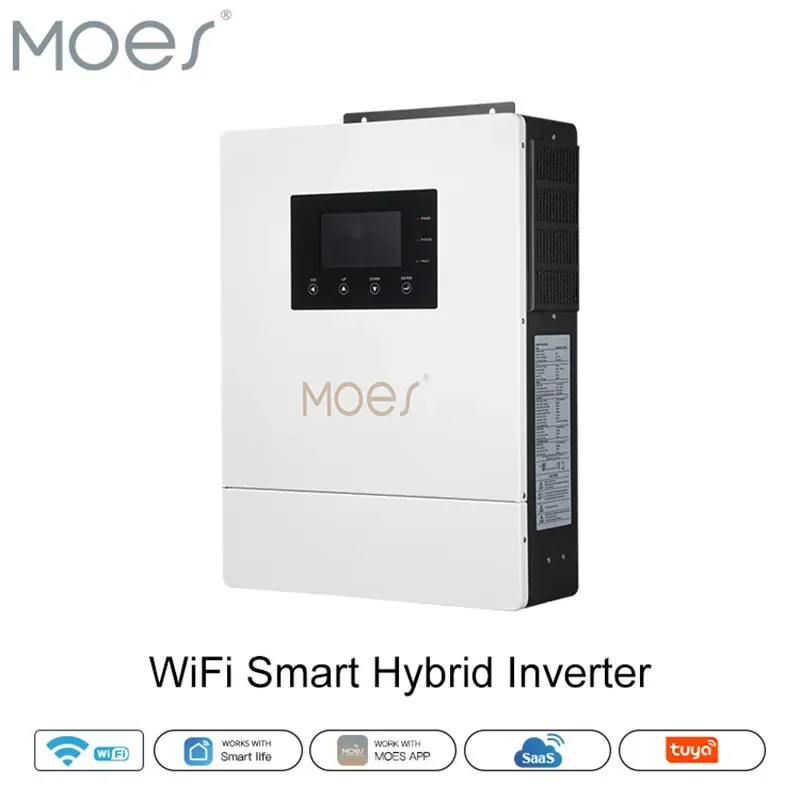
The MOES WiFi Smart Hybrid Solar Inverter product page reviewed for this package publishes these ratings.
On that live listing, DC operating voltage reads 48V.
The same page lists AC operating voltage as single phase 176–253V.
Frequency support covers 50Hz/60Hz.
Power range covers 4.2KW / 6.2KW.
Pure sine wave output is listed on that page.
Built-in MPPT solar controller (80A/100A) with MPPT voltage range 60V–450V is listed on that page.
WiFi monitoring features appear beside those electrical rows.
Page claim: can operate without a battery.
Public page ratings for this model include DC operating voltage 48V, AC single-phase 176–253V, dual-frequency 50Hz/60Hz operation, and power range 4.2KW/6.2KW.
Built-in MPPT on this SKU page is shown as 80A/100A across an MPPT window of 60V–450V, with pure sine wave output, multi-protection features, and WiFi monitoring listed alongside.
The listing also states operation without a battery as a product capability.
Scope every number above to that product page only. The batteryless operating claim is not the same as promising backup runtime without a storage bank.
Surge watts, efficiency percent, certifications, MOQ, and lead time are not invented here—put them on the RFQ and confirm against current documentation.
When the project is still choosing architecture rather than sizing fields, return to the hybrid buyers guide or the on-grid vs off-grid comparison. When the job is only twelve-volt discovery, use the twelve-volt RFQ inputs article. This page owns the general sizing checklist.
Lock documented simultaneous continuous watts, the largest credible surge event and whether starts can overlap, DC voltage class, AC voltage/frequency/phase, waveform, battery/DC path limits, and ambient/derating notes—then compare those fields to an exact model. Do not start from a single marketing kilowatt.
Both.
Continuous rating must cover sustained simultaneous loads. Surge rating must cover short motor starts.
Sustained loads cannot hide inside a surge number.
No.
Watt-hours per day primarily size battery storage and PV harvest. Inverter class follows continuous and surge power.
Keep energy on the battery/PV rows of the same RFQ.
Higher AC watts at lower DC voltage mean higher DC current, thicker cables, and more sag risk. Match inverter input voltage to the bank and choose voltage class before you argue about continuous kilowatts.
For mixed motor and electronics loads, lock pure sine on the RFQ. Modified sine may be acceptable for narrow resistive use cases, but it is a compatibility decision, not a default savings line.
Often the DC path sagged: cable resistance, weak bank, or BMS peak limits. Community wiring threads treat that as a system problem, not only an inverter sticker problem.
The MOES WiFi Smart Hybrid Solar Inverter page-scoped example above. Use only published parameters from that listing and confirm surge, efficiency, and compliance documents on the RFQ.
Operating temperature range, ventilation clearances, and any published derating notes for the exact model. Continuous ratings are thermal; hot rooms change the usable floor.


OTHER SMART DEVICES
Jun 13,2026
OTHER SMART DEVICES
Jun 12,2026
TUYA SMART HOME PRODUCTS
Jun 12,2026
 +86 137 3639 3028