


by NOVA

Oct 07, 2026
A solar inverter takes photovoltaic direct current from the array, holds that input in an operating window, and switches it into alternating current at the output. Buyers who ask how does a solar inverter work want that ordered path. The job title of the box is a different page.
The walk below stays on four moves: direct current in, the operating window, the inversion stage, and the AC handoff. A quote that names only a kilowatt figure has not finished the walk.
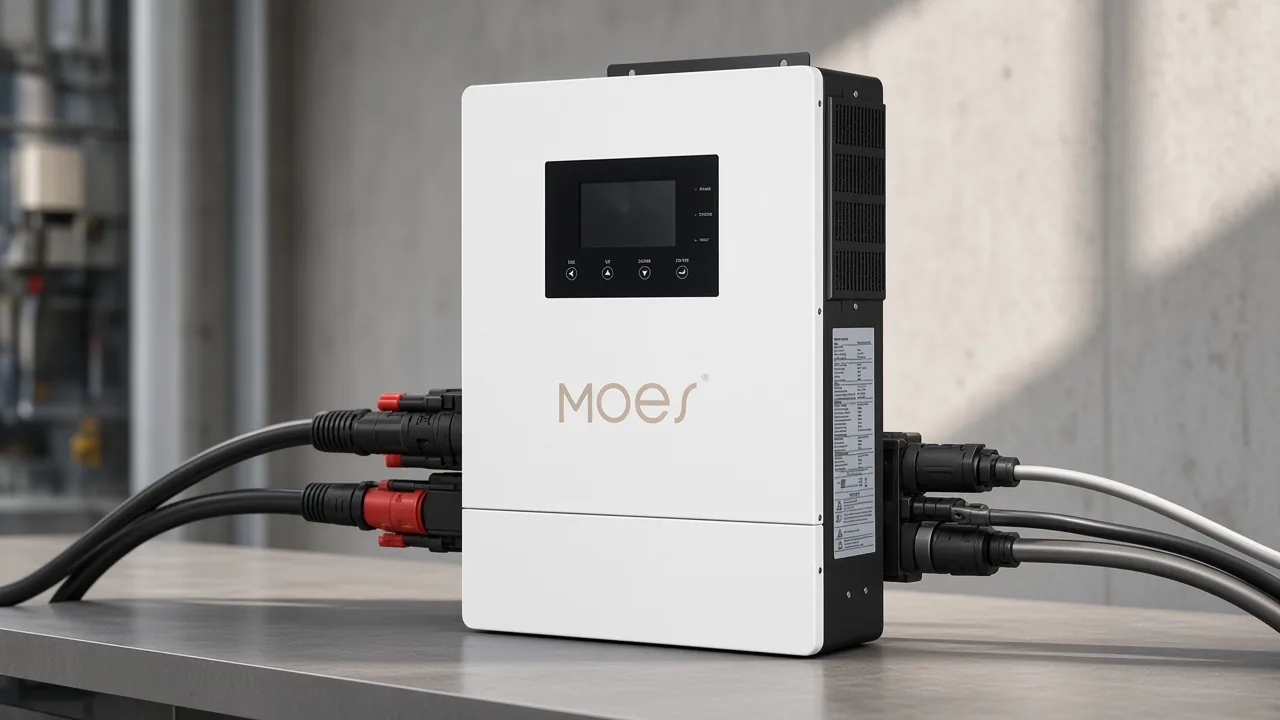
Photovoltaic direct current enters from the array. The solar inverter does not create that current.
Modules absorb light in a semiconductor stack. Electrons move one way, so the leads carry direct current.
Voltage climbs when the cells are cold and bright, and it sags when they heat up or a cloud crosses the string. The chassis downstream can only shape what those leads actually deliver.
Channel mail often says “inverter for solar” and attaches a single watt guess. That guess describes a hoped-for AC result. The path still starts at the photovoltaic array.
The solar inverter collections are where the chassis families are grouped. They do not replace reading the array voltage the project will present on a winter morning.
DC-to-AC conversion waits on that input. If the array sits outside the window the chosen listing prints, the later stages have an unstable source and the AC terminals leave nothing to negotiate.
Installers sometimes describe the same entry as “panel leads into the DC switch.” The principle is unchanged. The array is still the source, the leads are still direct current, and the inverter still waits until that current is inside its input range before it tries to build an output.
The operating window and maximum power point tracking hold the array at a usable point before inversion starts.
MPPT samples array voltage and current, then shifts the load so power stays near the knee of the curve. That is maximum power point tracking: a control loop on the DC input. Polarity flipping sits later, and charger hardware is a separate block you only get when the listing includes it.
The PV voltage window is the band those samples must remain inside. A string that looks comfortable at noon can leave the top of the window at dawn, when cold modules sit at a higher voltage.
Buyers write the window from the listing they intend to quote. They do not borrow a window from a neighbouring power class.
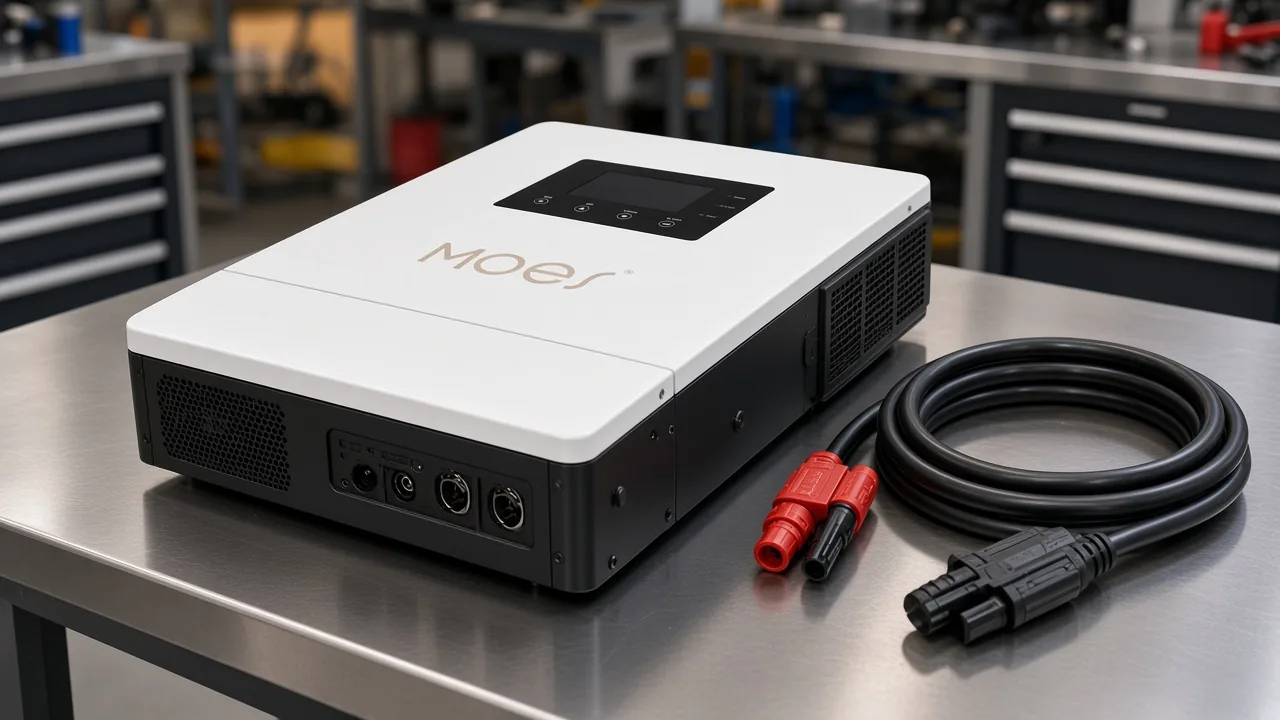
| Path stage | What gets written down |
|---|---|
| Array DC in | Photovoltaic array as the source |
| Operating window | PV voltage window and MPPT class as printed |
| Inversion | Waveform label the listing actually prints |
| AC handoff | Grid-following or local AC, matching the design |
Shade and mixed orientations change where that window is applied. A string chassis sees one combined curve. A microinverter can track a module on its own.
Either way, the buyer still records the window the hardware prints. Tracking method does not erase the voltage limits.
The inversion stage reverses direct current, and filtering moves the pulses toward a sine.
One working picture is an H-bridge. One diagonal pair of switches closes, then the other pair, so the output polarity flips.
Pulse-width shaping holds the switches on longer near the crest and shorter near the zero crossing. A choke, and on some designs a transformer, smooths those steps into a curve loads can use.
Department of Energy material describes the same idea without a brand schematic: the inverter switches the direction of the DC input rapidly, then filters can form a repeating sine. Wikipedia’s solar-inverter page adds why a PV unit bothers with the input curve at all. Neither source is a MOES control diagram.
From the field: On Physics Forums, a reader asked whether a solar inverter is the same thing as a transformer because the drawing looked magnetic. The staff reply was that the chassis is more than a passive transformer: a switching arrangement is what builds the waveshape. — Physics Forums
Magnetics may still sit in the filter. They do not replace the switches. A quote that says “transformer type” without saying whether the listing is a pure sine wave label, or something coarser, has skipped the stage the loads will actually feel.
Switching rates from tutorial circuits and from microcontroller reference designs stay off this page. The hybrid listing below does not print a switching rate, so a buyer cannot invent one for the line card.
Loads care about the shape that survives the filter. Motors and many power supplies expect a smooth rise and fall, which is why listings bother to name a sine-wave class at all.
A coarser steps-and-flats output can still be alternating current. That coarser shape is a different handoff. It belongs on the waveform line of the listing, not in a guessed diagram.
The AC terminals hand off alternating current that either follows the grid or is made on site.
Grid-tied designs lock phase, voltage, and frequency to the utility. The output current is then a guest on someone else’s waveform.
When that reference disappears, anti-islanding opens the path so a crew working a dead feeder does not meet exported power. Alternating current at the terminals stops because the design is built to stop.
A cabin or a backup panel that must stay up while the utility is dark needs a design that makes its own frequency. Community explanations of off-grid units point at an internal source for that reason. The two handoffs can share a brand name and still be different machines.
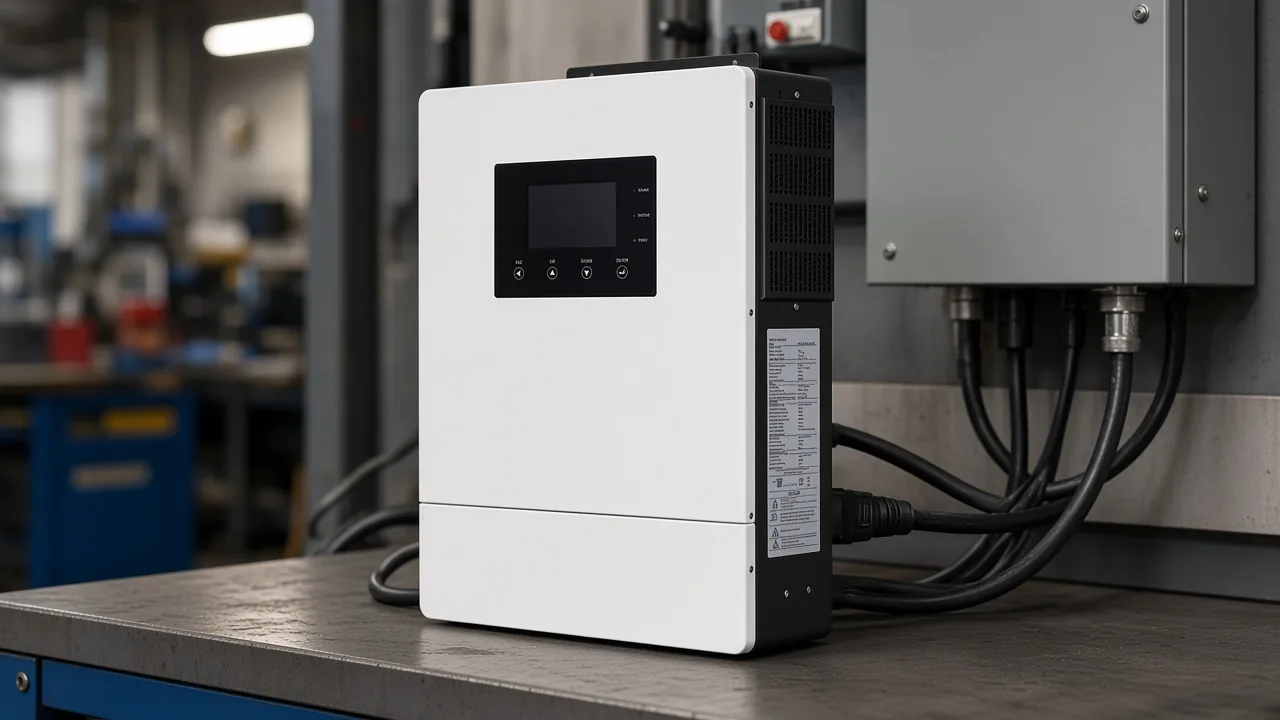
Hybrid chassis complicate the picture only by adding a battery port beside the PV input. The AC terminal is still the place the building loads attach. Whether that terminal may run while the grid is down is a design statement on the listing, written by the hardware, rather than a phrase the buyer adds in the email.
A practical split on the quote sheet is enough. Write “follows the utility” when the machine must see the grid before it makes current.
Write “makes its own AC” when the machine must feed loads with the utility open. Those two lines keep the handoff from collapsing into a single adjective.
The path forces a PV voltage window, a continuous AC rating, and a topology class onto the quote.
Topology class says where inversion sits. String hardware inverts after several modules share an input. Micro hardware inverts at the module.
Hybrid hardware can keep a charge path and a battery port next to the PV input. The class tells the buyer which of those boxes they are pricing. It still leaves the window and the continuous AC rating to be copied from the listing.
| Quote field | Why the path puts it on the sheet |
|---|---|
| PV voltage window | The array has to remain where MPPT can hold an operating point |
| Continuous AC rating | The terminals can hold only the sustained AC the listing prints |
| Topology class | String, micro, or hybrid changes where the inversion stage sits |
What the chassis is for, as a role on the project, is already on the page about what a solar inverter does. Read that once if the argument is about the job, not the sequence.
Array-matching arithmetic, install-cost lines, efficiency tables, and the off-grid versus hybrid choice each have their own articles. This one stops when the three fields above are filled from the listing in hand.
A battery-class power inverter, fed from a DC source other than a photovoltaic array, is a neighbouring product family. Its path skips the PV window. Leave its worksheet on the battery-inverter articles.
One live hybrid listing prints the window, the AC band, and the power range on a single page.
The MOES WiFi Smart Hybrid listing is an NVESS-series inverter/charger. The page calls it a multifunctional unit that combines inverter, solar charger, and battery charger behaviour, and it says the set can operate without a battery.
The waveform line is pure sine wave. Those words apply to this listing.
On this listing the printed path reads DC operating voltage 48V, MPPT voltage range 60V-450V, MPPT controller class 80A/100A, AC operating voltage single phase 176-253V, operating frequency 50Hz/60Hz, and power range 4.2KW/6.2KW.
| Printed line | What it fixes on the path |
|---|---|
| DC operating voltage 48V | Battery-side DC class on this chassis |
| MPPT voltage range 60V-450V | PV voltage window for the array |
| MPPT controller class 80A/100A | Current class of the tracker |
| AC operating voltage single phase 176-253V | AC band at the output |
| Operating frequency 50Hz/60Hz | Frequency strings printed on the page |
| Range of power 4.2KW/6.2KW | Continuous AC rating pair on this listing |
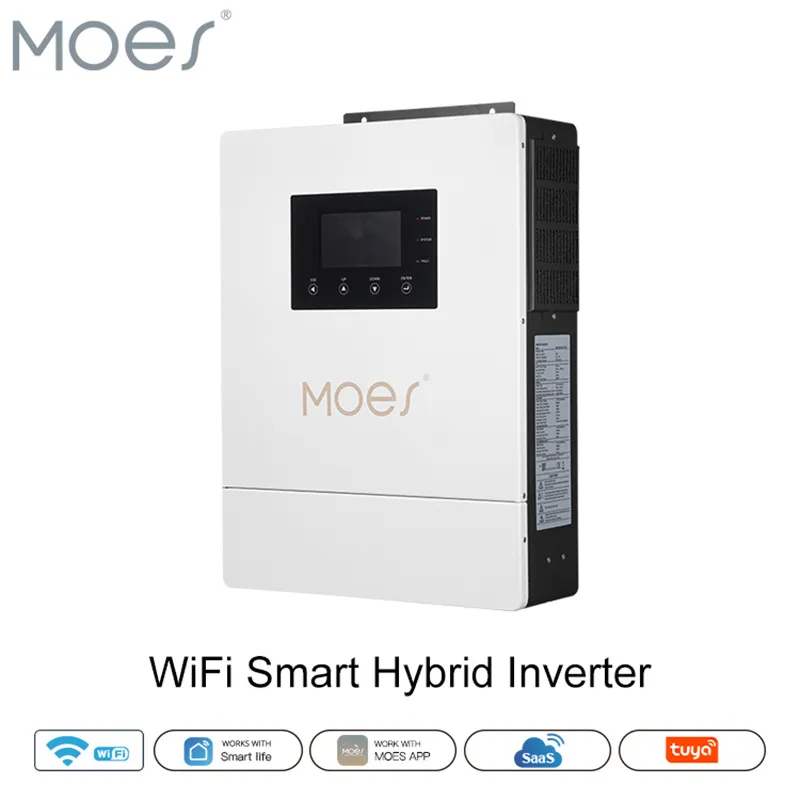
Use the listing when the project already wants a hybrid chassis in that power pair and the array can live inside the printed window. The “operate without a battery” line means the page allows a PV-only arrangement. It does not mean the AC terminals stay alive after sunset.
WiFi monitoring is a management extra on the same page. It sits beside the path. It does not replace any of the four moves.
If quantity, destination, and the array voltage you measured are already known, send them with the power pair through the contact form.
No: switches reverse the direct current and build the waveform. Magnetic parts may filter that waveform. They are not the whole path.
Many grid-tied designs do. Anti-islanding is the stop that keeps export off a dead utility line. A design built to ride through the outage has to say so.
Only when some DC source is still there, usually a battery path the hardware includes. The hybrid listing cited above allows operation without a battery, which describes a PV-fed case, not power after dark.
This path page does not publish a banned-load list. Match the load to the continuous AC rating and to the waveform label printed on the exact listing you are buying.
No service-life figure is assigned here. Warranty years belong on the listing or the warranty sheet, not on a mechanism walk.
A battery-bank size is an energy-storage calculation. The path ends at the PV voltage window, the continuous AC rating, and the topology class. Amp-hour maths belongs on a sizing article.
Read the function page when the question is what the chassis is hired to do. Stay here when the question is the order from array DC to AC terminals.




OTHER SMART DEVICES
Jun 13,2026
OTHER SMART DEVICES
Jun 12,2026
TUYA SMART HOME PRODUCTS
Jun 12,2026
 +86 137 3639 3028



