

by NOVA

Aug 07, 2026
Smart home appliances become useful B2B categories only after a buyer can say what the device controls, how it is expected to connect, which market documents are needed, and who will confirm the offered model. A product label alone cannot answer those questions.

First-party MOES catalog image used to illustrate a connected-device category; model-specific terms remain subject to RFQ confirmation.
Important: An ecosystem name is not proof that every device in a range is certified or interoperable. Confirm the offered model against current documentation. Connectivity Standards Alliance
“Smart appliance” can describe a socket, switch, sensor, panel, gateway, or appliance-control accessory. Those roles create different questions for a distributor. A category should therefore start with the job the device performs, not with an assumption that all connected products share the same installation or support path.
For a broader system conversation, begin at the MOES smart home products category. The category page is a product-range entrance, while this article is a way to qualify the evidence needed before a range decision.
Start with four roles that make a channel comparison readable:
| Role | Buyer question | Evidence owner |
|---|---|---|
| Control point | What does the device switch, sense, or command? | Offered-model documentation |
| Interface point | What connection or commissioning path is proposed? | Supplier and installer scope |
| User point | Who operates it and what support route is expected? | Channel program owner |
| Market point | What labeling, manual, or approval evidence is required? | Buyer and supplier before quote |
This prevents a channel from treating a wall control, a gateway, and a plug-in device as interchangeable line items. It also keeps a procurement brief useful when the final SKU is not yet selected.
Matter and Zigbee are ecosystem terms documented by the Connectivity Standards Alliance. They do not replace a model-level review. When a buyer uses those words, record the intended role, the devices that must be considered together, and the requested proof for the offered model.

Catalog detail for a connected-device discussion. It is not a certification or installation approval.
The Matter smart home buyer’s guide can help a team frame compatibility questions. The home automation system RFQ guide is the better next step when the buyer needs a system-level inquiry rather than a category decision.
Use one evidence sheet for each proposed category. It should be specific enough to expose missing information without inventing a technical conclusion.
| Category-brief field | What to record | Send with quote |
|---|---|---|
| Device role | The control, sensing, or outlet role under review | Yes |
| Deployment context | New build, retrofit, demonstration, or unspecified | Yes |
| Ecosystem request | Exact buyer language and required model proof | Yes |
| Market requirements | Requested manuals, labels, approvals, and languages | Yes |
| Support owner | Distributor, installer, brand, or project team | Yes |
The table is intentionally a decision record, not a substitute for an electrical design, a certification file, or a product datasheet.
For a plug-in connected-device inquiry, the bounded product reference is the MOES Tuya Smart Matter Plug WiFi Socket 16A listing. The catalog title makes it a relevant starting point for a device-category discussion.
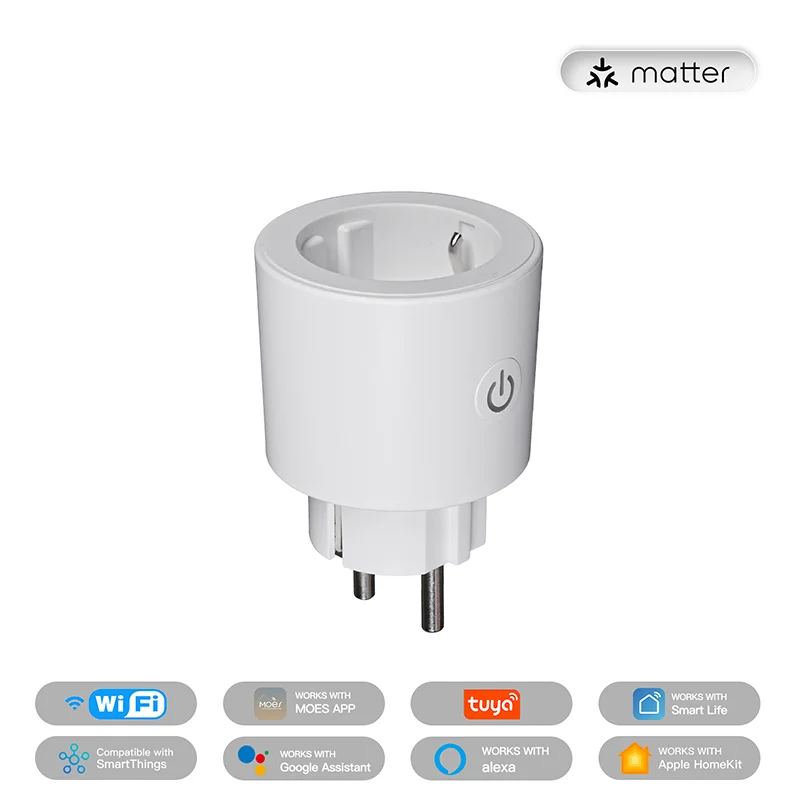
First-party product image. Confirm the offered model’s documents and target-market requirements before listing or installation.
It is not a recommendation to substitute a plug for a gateway, control panel, or wall switch. Those choices alter the device role and the proof a channel needs.
Send a concise brief through Contact Us or the OEM/ODM inquiry route with:
That record lets MOES respond with an offered-model discussion rather than an assumption-based compatibility claim.
It is a connected device category defined by the role a buyer wants to offer, such as control, sensing, outlet control, or system coordination. The final category still needs model evidence.
No. Those terms identify an ecosystem context. A buyer should request current evidence for the exact offered model and the intended system scope.
The role determines the comparison fields, expected support path, and product documents needed before a range is quoted or listed.
No. Images and titles are catalog evidence only. Market approval, labels, manuals, and installation conditions require current supporting documents.
The article references the MOES Tuya Smart Matter Plug WiFi Socket 16A listing as a bounded plug-in-device example.
Include the device role, proposed use context, target markets, requested documents, quantity, and the person responsible for model-level confirmation.


OTHER SMART DEVICES
Jun 13,2026
OTHER SMART DEVICES
Jun 12,2026
TUYA SMART HOME PRODUCTS
Jun 12,2026
 +86 137 3639 3028