


by NOVA

Sep 30, 2026
Lock solar inverter sizing by matching documented PV-array STC kilowatts to inverter AC continuous rating, a justified DC/AC ratio, MPPT voltage windows against string Voc and Vmp at temperature extremes, phase and grid type, and backup surge only when the datasheet prints it—before anyone reaches for catalog numbers. Distributors and EPC teams get an RFQ checklist first, then a scoped MOES hybrid example. Appliance load-list sizing lives on the power inverter sizing RFQ checklist; this page owns PV array inverter matching for the solar inverter category.
Solar inverter sizing means matching the PV array and string electrical windows to the inverter’s continuous AC rating and DC input limits before you talk SKUs.
A solar inverter converts the direct current from photovoltaic modules into alternating current for loads or export. That conversion role is the DOE framing for PV systems; sizing is the channel question of whether a given inverter’s AC continuous class and DC windows actually accept the array you intend to sell or install.
Consumer calculators often stop at “pick a kilowatt.” Channel buyers get burned when the quote never asks for array STC kilowatts, cold-morning open-circuit voltage, hot-afternoon maximum-power voltage, MPPT current per channel, or whether the site is single-phase or three-phase.
For B2B RFQs, treat solar inverter sizing as five locked decisions:
Do not start from a pile of household appliance running watts. That is a different RFQ job—documented on the power inverter sizing sibling—and it will drag this quote into load lists instead of array matching.
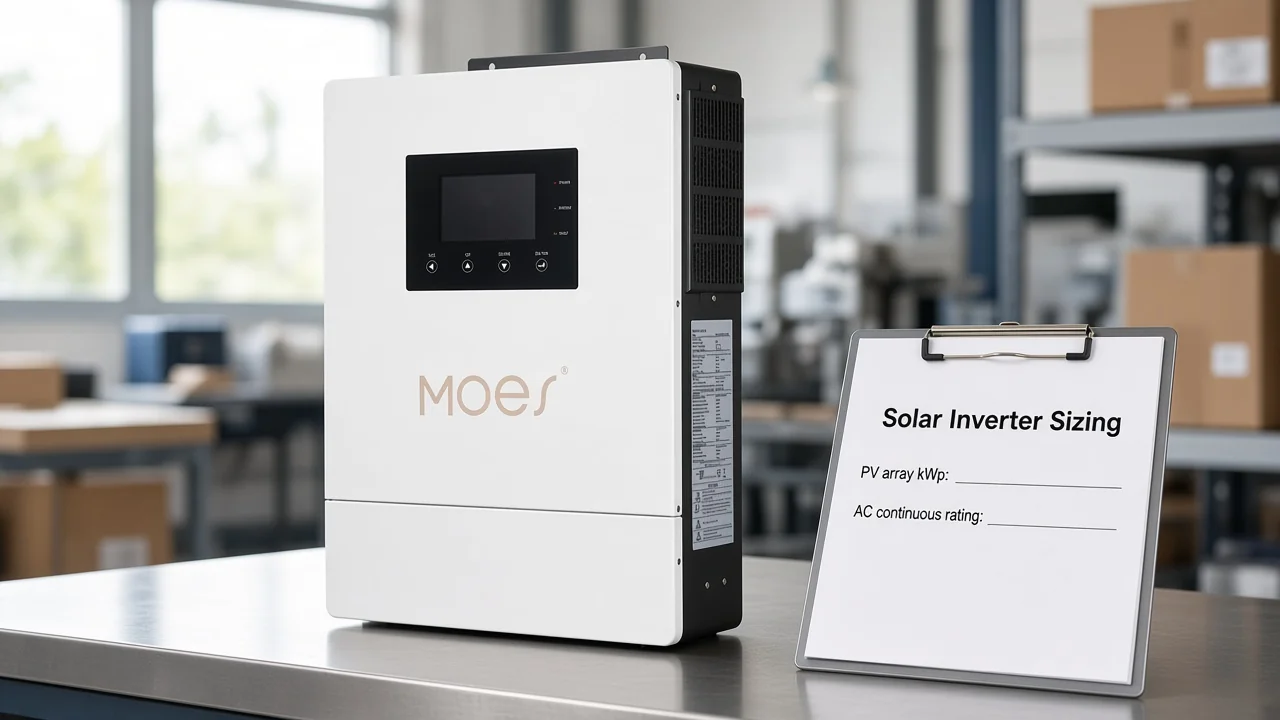
Put the array’s STC kilowatts and the inverter’s continuous AC rating on the same RFQ line before anyone opens a catalog.
Array nameplate power is rated under standard test conditions. Real fields rarely sit at those conditions all day, but the STC figure is still the commercial baseline buyers use to compare offers. The inverter’s continuous AC rating is the sustained output floor—the long-run AC kilowatts the unit can deliver without living permanently on an overload curve.
RFQ fields to lock first:
If the array figure and the continuous AC figure never appear together on the quote sheet, the channel is guessing. Guessing is how you ship an inverter that clips every clear noon—or an oversized AC class that wastes capital while sitting at inefficient part load.

Document a site-justified DC/AC ratio solar inverter figure on the RFQ; treat common industry ranges as education, not a MOES warranty.
DC/AC ratio is the array’s rated DC power divided by the inverter’s nominal AC power. Independent technical education commonly describes ratios around 1.1 to 1.3 as standard practice for many fixed-tilt designs, because arrays rarely deliver full STC output for most of the year and a 1:1 match often leaves the inverter under-loaded. That range is practice language from design education—not a guarantee printed on MOES product pages.
When DC power available exceeds what the inverter can convert, the unit holds AC at its limit. That behavior is clipping: some peak harvest is left unconverted. Clipping is a power limit, not permission to ignore absolute DC voltage.
RFQ documentation asks:
Do not write “DC/AC = 1.2” on a purchase order as if it were a universal warranty. Write the array kWp, the inverter continuous AC, the ratio that results, and the evidence you used.
Tip: Midday clipping trims power; a cold-morning over-voltage fault is a different absolute-DC risk. Keep both lines on the RFQ. — source: https://inverterdata.com/en/guides/how-to-size-a-solar-inverter/
Cold open-circuit voltage caps how many modules you may series; hot maximum-power voltage sets the floor against the MPPT tracking window.
Module voltage rises as cells get colder and falls as they heat. Engineering education treats two checks as non-negotiable: maximum string length from cold Voc against the inverter’s absolute maximum DC input voltage, and minimum string length from hot Vmp against the inverter’s minimum MPPT voltage. Round the maximum count down; round the minimum count up when the math sits on a fraction.
MPPT voltage range string sizing is the practical name for that pair of checks. MPPT voltage range is the band where the inverter can track maximum power.
Absolute maximum DC voltage is a hard stop—often checked on the coldest clear morning, not at noon operating voltage. Forums keep showing newcomers aiming at a “rated PV voltage” sticker while ignoring Voc temperature rise.
RFQ fields for string honesty:
Important: Size maximum series count from cold Voc against absolute max DC input—not from a comfortable Vmp target. Cold mornings are when strings fail this check. — source: https://www.mayfield.energy/technical-articles/2023-update-how-to-calculate-pv-string-size/
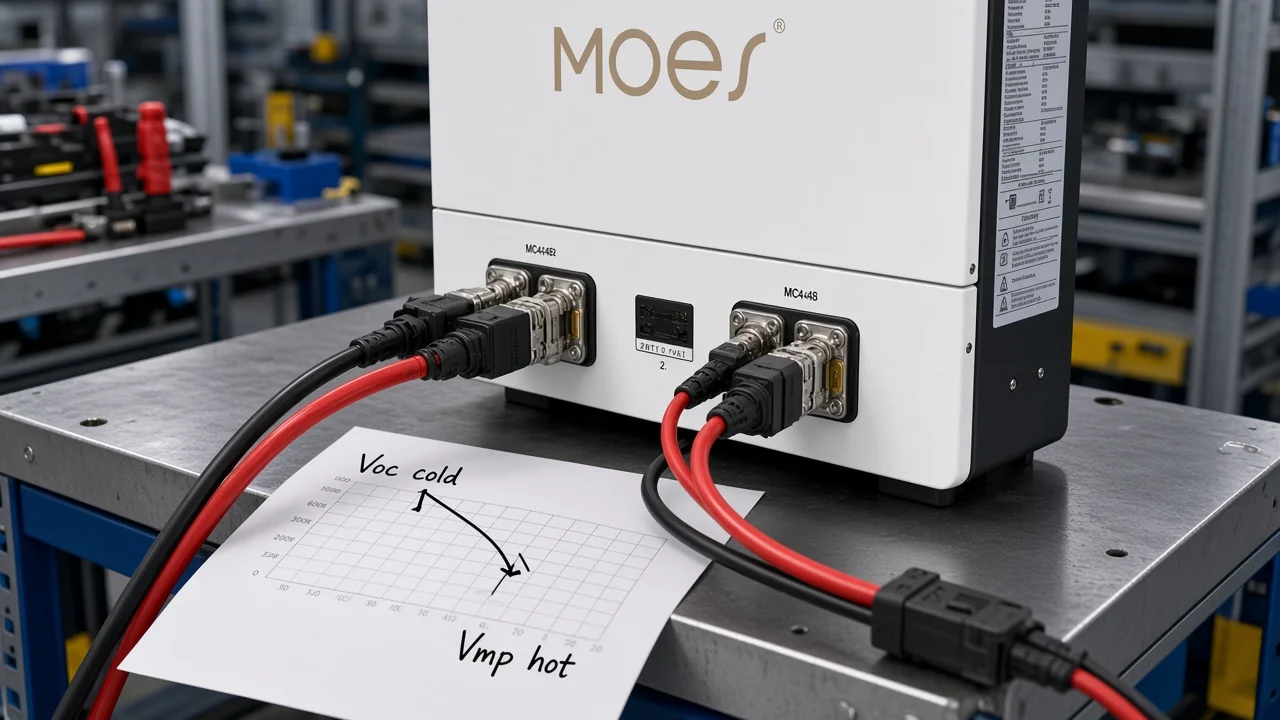
Use continuous versus surge language in a solar inverter sizing RFQ only when hybrid or off-grid backup loads are in scope and the exact model page prints surge or peak figures.
Solar array matching starts from DC power and MPPT windows. Backup contexts add a second conversation: motors and compressors that need short peak AC beyond the continuous floor.
That conversation is easy to confuse with the power-inverter load-list thesis. Keep them separate.
When backup is in the quote, demand:
MOES’s low-frequency pure sine hybrid off-grid inverter/charger page states surge capacity up to 300% peak power for inductive loads on that product scope. Do not copy that percentage onto a different SKU that never prints it. If the job is mostly appliance continuous and surge without a PV-array thesis, route the channel to the power inverter sizing checklist instead of bloating this RFQ.
Lock single-phase versus three-phase, AC voltage window, and frequency before you substitute inverter SKUs.
A correctly matched DC/AC ratio still fails commissioning when the AC side does not match the site. Channel RFQs should treat phase and grid type as hard gates, not footnotes.
Lock single-phase or three-phase requirement on the RFQ. Lock nominal AC voltage and the acceptable range next.
Lock 50 Hz or 60 Hz (or dual as printed). Lock on-grid, off-grid, or hybrid operating mode expected for the quote. Lock pure sine versus other waveform requirements when loads need them.
The MOES WiFi Smart Hybrid example used later on this page prints single-phase AC 176–253 V, 50 Hz/60 Hz, and pure sine wave on the live product page. That is page-scoped evidence for that SKU—not a claim that every MOES inverter shares the same AC envelope.
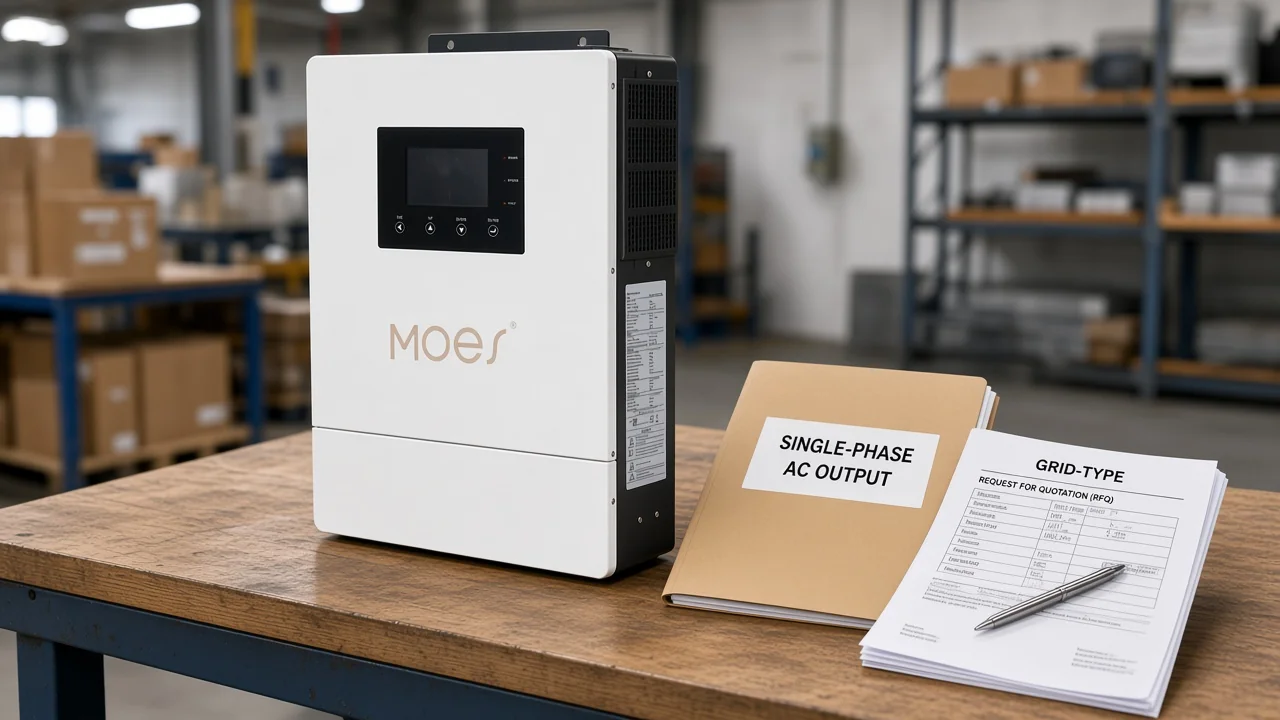
Copy these fields into the channel RFQ before asking for catalog numbers.
| RFQ field | Why it matters | Evidence to request |
|---|---|---|
| Array STC power (kWp) | Sets DC side of DC/AC | Module count × STC wattage or array schedule |
| Inverter continuous AC rating | Sets AC floor | Exact-model datasheet continuous figure |
| Intended DC/AC ratio | Documents oversizing intent | Site note + resulting ratio math |
| Module Voc / Vmp + temp coefficients | Enables string math | Module datasheet |
| Site design low / high temperature | Temperature-corrects Voc / Vmp | Agreed climate basis |
| Absolute max DC voltage | Cold Voc hard stop | Inverter datasheet |
| MPPT voltage range | Hot/cold operating window | Inverter datasheet |
| MPPT count and current per channel | Parallel string limits | Inverter datasheet |
| Phase / AC voltage / frequency | Grid and load fit | Site one-line + inverter AC table |
| Backup surge (if in scope) | Inductive start headroom | Exact-model printed surge definition |
| Waveform / operating mode | Compatibility | Pure sine / hybrid / off-grid as printed |
If any row is blank, the quote is not ready for a SKU. Catalog browsing before this table is theater.
After the RFQ fields clear, pick a scoped mid-size single-phase hybrid example—not a universal answer for every array.
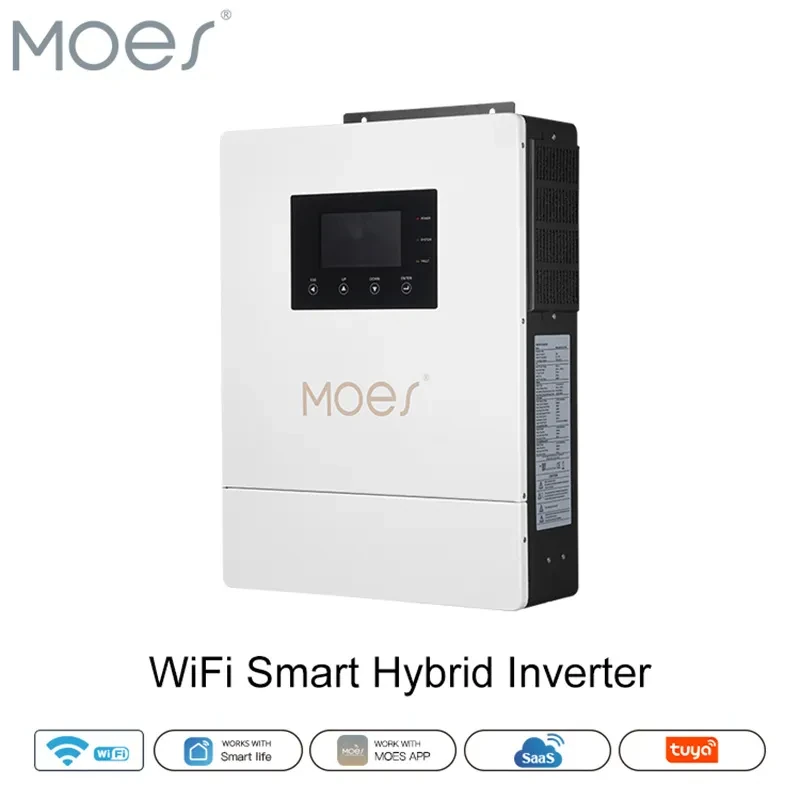
The live catalog example is the MOES WiFi Smart Hybrid Solar Inverter 4.2KW/6.2KW.
Live page facts you may cite for this SKU only include the printed power range of 4.2KW / 6.2KW. DC operating voltage is 48V on that page.
On the same listing, AC operating voltage reads single phase 176–253V. Frequency support covers 50Hz/60Hz. Built-in MPPT solar controller is listed as 80A/100A.
MPPT voltage range is 60V–450V. Pure sine wave, WiFi monitor, multi-protection, and operate without a battery are listed as printed.
Illustrative matching exercise after fields are locked. This is not a yield study and not a warranty.
| Check | Illustrative value | Page / practice basis |
|---|---|---|
| Array STC example | ~5.0 kWp | Channel RFQ input (project-specific) |
| Inverter continuous AC class | 4.2 kW option on the page | Printed power range |
| Resulting DC/AC | ≈ 1.19 | Education practice often cites ~1.1–1.3; not a MOES guarantee |
| MPPT window to respect | 60V–450V | Printed MPPT range |
| AC envelope | Single phase 176–253V, 50/60Hz | Printed AC table |
| DC bus class | 48V | Printed DC operating voltage |
An illustrative channel example uses about 5.0 kWp of array against the 4.2 kW AC class. Resulting DC/AC ≈ 1.19.
Use the 6.2KW class on the same page when the RFQ’s continuous AC floor and array schedule justify the step-up. Keep string Voc/Vmp math on the module datasheets and site temperatures—MOES pages do not invent module Voc for you.
Send the completed RFQ table with the SKU shortlist. If the job is still “which appliances run together,” stop and use the power inverter sizing checklist instead of forcing a PV-matching page to answer a load-list question.
It means locking PV-array STC power, inverter continuous AC rating, DC/AC documentation, MPPT and absolute DC windows versus string Voc/Vmp at temperature, and phase/grid fields before catalog numbers—not guessing from a single sticker kilowatt.
Record the array kWp, the inverter continuous AC, and the resulting ratio plus who owns clipping risk. Independent education often discusses roughly 1.1–1.3 as common practice for many designs; that is not a MOES product warranty unless an exact datasheet states a limit.
Open-circuit voltage rises as cells get colder. Maximum modules in series must keep cold Voc below the inverter’s absolute maximum DC input voltage. Round down when the math is fractional.
Maximum-power voltage falls in heat. Minimum series count must keep hot Vmp above the inverter’s MPPT lower bound so tracking does not drop out on the hottest production hours.
No. Clipping is the inverter holding AC at its power limit while the array could deliver more DC.
Exceeding absolute DC voltage is a hard electrical limit and a damage or warranty risk. Keep both checks on the RFQ.
When hybrid or off-grid backup loads are in scope and the exact model page prints surge or peak figures. Otherwise keep solar inverter sizing on array and MPPT matching, and use the power inverter sizing sibling for appliance load lists.
The MOES WiFi Smart Hybrid Solar Inverter with printed 4.2KW/6.2KW power range, 48V DC, single-phase 176–253V AC, 50/60Hz, and MPPT 60V–450V with 80A/100A controller is the scoped example.
Use it only after RFQ fields clear and only within that page’s printed scope.
Not on this checklist. Appliance continuous and surge load lists are the power inverter sizing RFQ job. Start solar inverter sizing from the PV array and string windows, then add backup surge only when the architecture and datasheet support it.




OTHER SMART DEVICES
Jun 13,2026
OTHER SMART DEVICES
Jun 12,2026
TUYA SMART HOME PRODUCTS
Jun 12,2026
 +86 137 3639 3028



