

by NOVA

Sep 08, 2026
The difference between on grid and off grid solar inverter options is a grid-dependency decision: on-grid (grid-tied) units synchronize to the utility and normally shut down on outages, while off-grid units form their own AC reference and rely on a battery bank to carry loads when the sun is low. This page gives B2B buyers a decision matrix, clarifies when hybrid sits between those poles, and locks RFQ fields for channel quotes—without rewriting MOES off-grid or hybrid buyers guides.
Deep SKU selection for stand-alone carts stays on the off-grid solar inverter buyers guide. Browse category stock under Off Grid Inverter, Hybrid Inverter, and Solar Inverter.
For distributors and EPC teams, the on grid vs off grid solar inverter question is architecture language you can put on a quote—not a carton slogan.
An on-grid solar inverter, also called a grid-tied inverter, converts PV DC to AC while locking output to the utility’s voltage, frequency, and phase. Surplus energy can flow to the grid when local policy and interconnection allow it—this is the net metering / export path when the utility program exists.
Because the utility is the reference, these designs include anti-islanding behavior. When the grid disappears, the inverter stops energizing the line so crews are not working on a live conductor they believe is dead.
An off-grid solar inverter does the opposite job. It generates its own AC reference and supplies a defined set of loads from a battery bank that solar—and sometimes a generator—keeps charged.
There is no parallel export story on a classic off-grid design. If connected loads exceed continuous or surge capacity, the system browns out or trips because there is no infinite utility buffer behind the meter.
Channels get hurt when sales language mixes true off-grid, a zero-export limiter on a grid-parallel design, and hybrid units that take grid power in without selling power out. Community threads on DIY Solar repeatedly show newcomers asking whether those labels are the same.
They are not. Lock the architecture word—and the grid-tied vs off-grid inverter contrast—before you argue about brand or kilowatts.
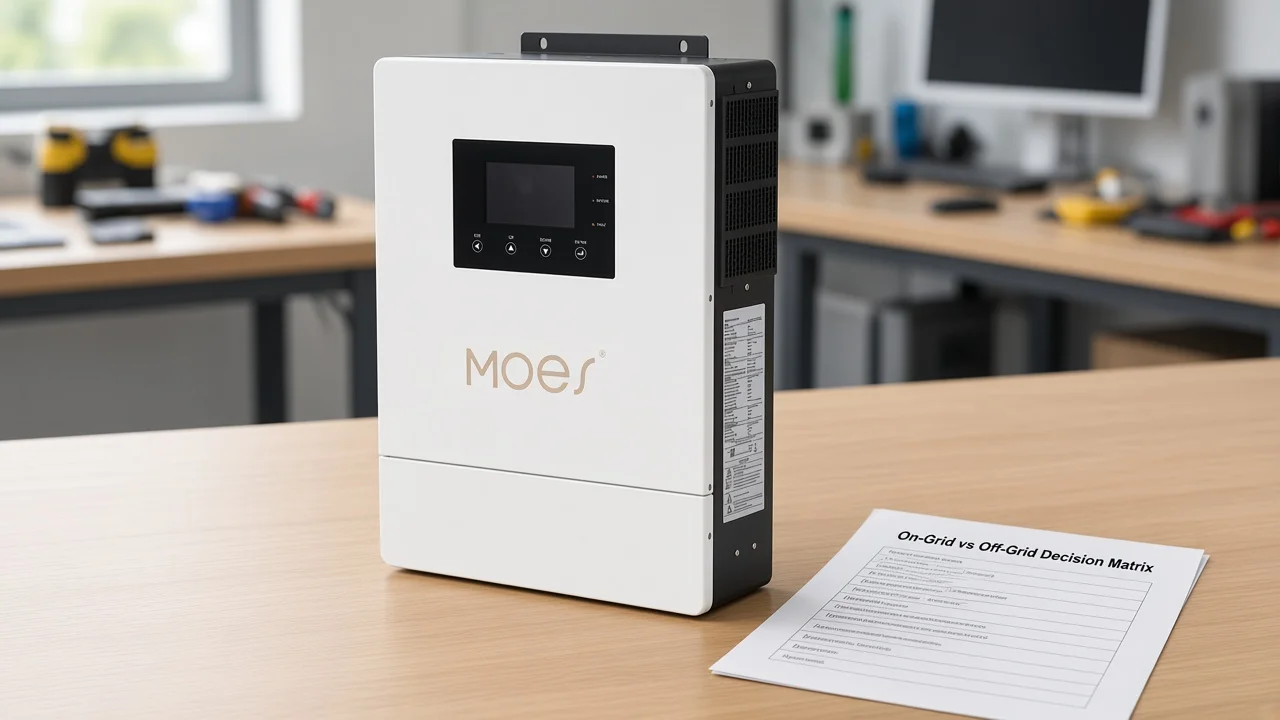
Compare options on the fields that change BOM, paperwork, and callback risk—not on brochure adjectives.
| Decision field | On-grid (grid-tied) | Off-grid |
|---|---|---|
| Grid reference | Required for normal operation | Not required; inverter forms AC |
| Battery bank | Not required for classic string/grid-tie | Required for night and autonomy |
| Behavior on utility outage | Shuts down (anti-islanding) | Continues from battery within ratings |
| Export / net metering path | Possible when interconnection allows | No utility export path |
| Load coverage rule | Grid covers shortfalls | Inverter must cover all attached loads + surge |
| Typical buyer job | Bill offset on a reliable grid | Remote site or no usable utility |
| Dominant cost driver | Inverter + array + interconnection | Battery + autonomy days + larger array |
A distributor quoting a suburban rooftop with a signed interconnection agreement is not in the same RFQ as an installer specifying a cabin with a critical-load panel and two days of autonomy.
Battery cost usually dominates off-grid BOM conversations. Do not invent payback percentages on the quote; ask for autonomy days and generator fallback instead.
Important: Grid-tied solar is generally designed to switch off when utility power is lost — source: energy.gov solar resilience basics.
Tip: Department of Energy resilience guidance is blunt: panels alone do not keep a building powered during outages unless storage and a properly configured inverter path are in the design. Treat outage runtime as a hard RFQ question — source: https://www.energy.gov/cmei/systems/solar-and-resilience-basics
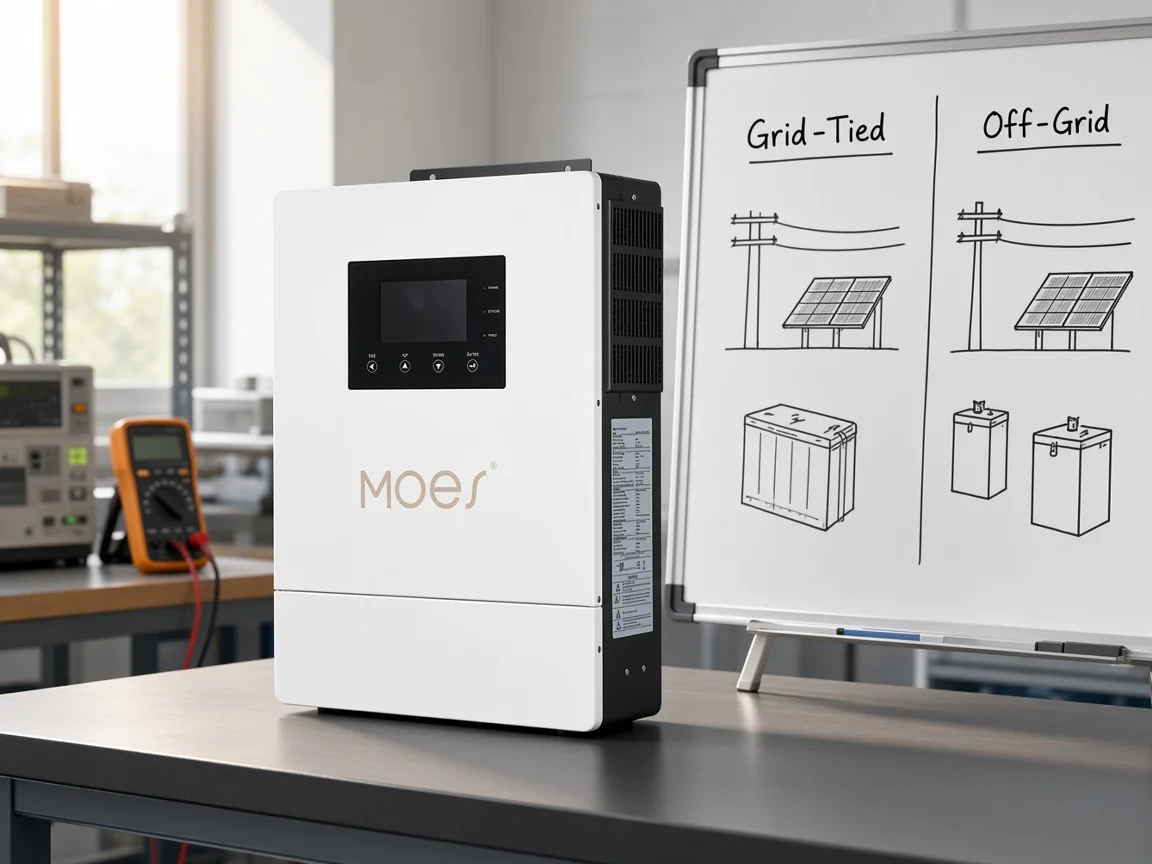
A hybrid solar inverter belongs in the quote when the site needs both grid interaction and hybrid solar inverter backup storage—not when a salesperson wants a fashionable label.
When utility power is present, many hybrid designs synchronize to the grid, charge batteries from PV and sometimes from AC, and support loads from storage after a grid failure—if the exact model documents island or backup behavior.
Compare that to a classic on-grid string inverter with no battery terminals. A pure off-grid box that never parallels the utility for export is a different SKU class again.
Forum language helps channels stay honest. Some “off-grid” all-in-one units accept grid-in as assist or charging while keeping grid-out at zero.
Useful? Sometimes.
It is still not the same SKU class as a grid-tied exporter. If the customer wants bill credits for surplus kWh, you are in interconnection territory.
If they want zero backfeed and a separate backed-up panel, you are closer to off-grid or hybrid-assist architecture.
Do not expand this section into a full hybrid buyers guide. When the architecture answer is “hybrid,” send deep selection to hybrid category pages and existing hybrid selection content, then keep this article on the comparison gate.
Outage behavior and export policy decide the architecture before price negotiations start.
Ask whether the building must stay up when the utility is dark. If the answer is yes, classic on-grid alone fails the job.
You need storage plus an inverter topology that can form or hold an islanded AC source for the backed-up loads. DOE educational material on solar and resilience makes the same point: resilience needs more than panels.
Ask whether surplus energy will be exported. Export brings interconnection agreements, possible insurance or disconnect hardware, and utility review timelines that change channel lead times.
DIY Solar contributors often note that permission, listed disconnects, and paperwork can dominate cost even when hardware looks cheap. That is a quote risk for B2B channels that promise turnkey savings without naming the utility path.
Ask what “connected to the grid” means in the customer’s sentence. Pulling AC in through a transfer path is not the same as paralleling for export.
Off-grid inverters are sometimes used with grid-assist or generator inputs. That still requires correct transfer and interlock practice under local code. Do not tell a buyer an off-grid inverter is “basically on-grid” because it has an AC input terminal.
Interconnection standards education in the IEEE 1547 family expects grid-tied distributed energy resources to detect islanding and disconnect promptly. Use that as a reason to request the right certificates and utility package for the target market—never as a claim that a specific MOES SKU is listed for a named local inspector unless you hold that document.
Lock these fields before you argue about brand, MPPT amps, or Wi-Fi apps.
| RFQ field | Why it matters | Evidence to request |
|---|---|---|
| Site grid status | Decides on-grid vs off-grid vs hybrid class | Utility availability note; outage frequency goal |
| Export / net-metering intent | Triggers interconnection scope | Utility program name or “no export” statement |
| Critical-load list + surge | Sizes off-grid/hybrid continuous and surge | Load schedule; largest motor LRA/FLA |
| Battery voltage and chemistry | Sets DC bus and charger compatibility | 48 V vs 24 V bank; BMS notes |
| Autonomy days | Drives battery kWh and array oversize | Autonomy target; generator fallback? |
| Transfer / ATS plan | Prevents illegal paralleling | Single-line sketch; interlock method |
| Monitoring expectation | Separates nice-to-have app from code path | Wi-Fi/LAN need; who owns credentials |
| Documentation pack | Protects distributor margin on returns | Datasheet for exact model; wiring diagram |
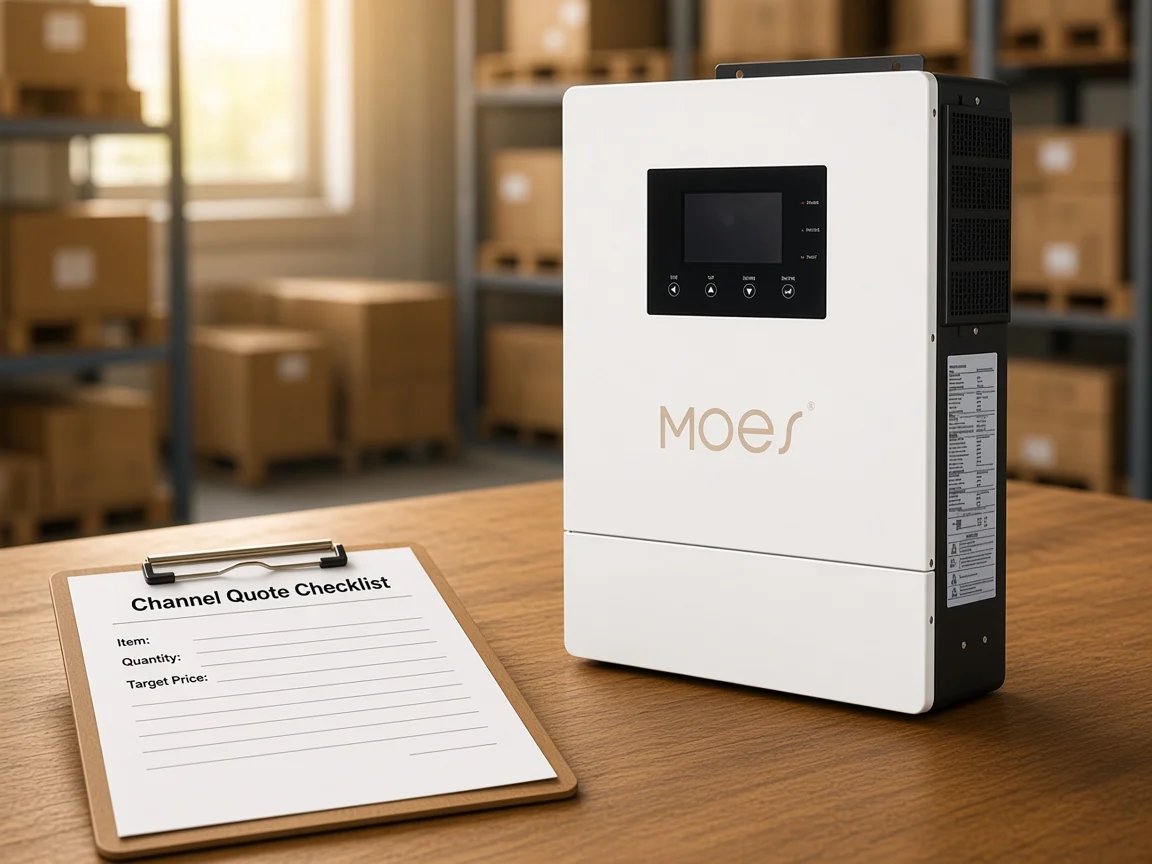
A practical channel habit is to write the architecture sentence in the quote header. Write header examples such as Grid-tied with no backup; Off-grid critical-load panel at 48 V with two-day autonomy; or Hybrid backup with no export.
That single sentence prevents the zero-export vs off-grid mix-up that fills forum threads. Attach the RFQ table above so purchasing and engineering share the same gates.
If the project is actually a wiring-input problem—three-phase diagrams or battery inverter conductor schedules—stop and use the wiring project-input articles instead of forcing those details into this comparison.
After the architecture sentence is locked—and only then—inspect a live SKU against the RFQ.
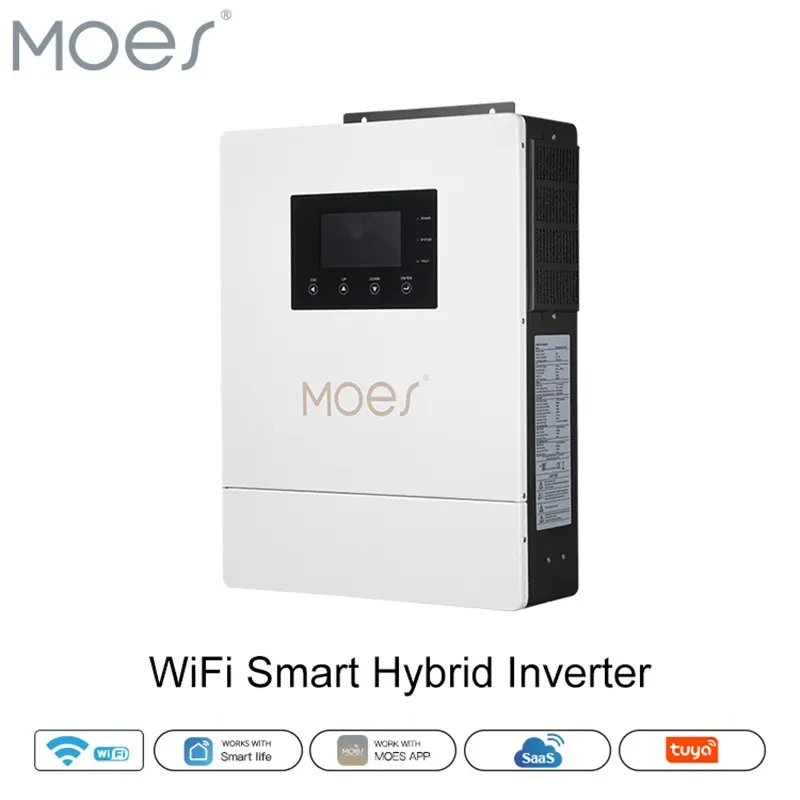
The MOES WiFi Smart Hybrid Solar Inverter 4.2KW 6.2KW Off-Grid 48V Charger Inverter is a first-party example of a multifunctional inverter/charger path. The NVESS-series listing combines inverter, solar charger, and battery charger functions with LCD configuration for charging current, AC charger priority, and acceptable input voltage windows.
Public page ratings for this model include DC operating voltage 48 V, AC single-phase 176–253 V, dual-frequency (50 and 60 hertz) operation, and power range 4.2 kW / 6.2 kW.
Built-in MPPT is listed at 80 A / 100 A with an MPPT voltage range of 60 V–450 V, plus pure sine wave output, multi-protection, and WiFi monitoring.
The listing also states operation without a battery as a product capability. Treat that as a page-scoped feature to validate against your load profile—not as permission to skip battery planning on a true off-grid autonomy job.
The page describes a multifunctional inverter with an integrated MPPT charge controller role alongside the battery charger.
Use this SKU when the RFQ already points to a hybrid/off-grid charger inverter class with 48 V storage and single-phase output in this power band. Do not use the page to claim utility listing, transfer-time guarantees, or market approvals that are not shown.
For broader assortment, start from the off-grid inverter and hybrid inverter category hubs. Then return to your RFQ checklist before you issue a firm quote.
On-grid inverters synchronize to the utility and usually stop on outages. Off-grid inverters form their own AC and use batteries to supply defined loads without depending on a utility reference.
Neither is universally better. Choose on-grid when the grid is reliable and export/interconnection fits the job. Choose off-grid when there is no usable utility or the backed-up load set must stand alone.
Some off-grid or hybrid units accept grid or generator AC for charging or assist through designed transfer paths. That is not the same as paralleling for export. Follow the model’s diagram and local interlock rules.
Classic grid-tied inverters shut down for anti-islanding safety. Backup during outages needs storage and an inverter configuration that can support islanded loads.
Quote hybrid when the site needs both grid interaction and battery backup, or documented island behavior. Do not use “hybrid” as a vague upgrade word for every RFQ.
Lock grid status, export intent, critical loads and surge, battery voltage and chemistry, autonomy, transfer plan, monitoring expectations, and the exact-model documentation pack.
The MOES WiFi Smart Hybrid Solar Inverter 4.2/6.2 kW 48 V page is a live example after architecture lock. Use only its published ratings for that SKU.
No. Zero-export usually describes limiting backfeed on a grid-parallel design. Off-grid means you are not relying on parallel utility export architecture—write the architecture sentence explicitly.


OTHER SMART DEVICES
Jun 13,2026
OTHER SMART DEVICES
Jun 12,2026
TUYA SMART HOME PRODUCTS
Jun 12,2026
 +86 137 3639 3028