

by NOVA

Sep 15, 2026
B2B buyers should compare power inverter vs power bank options by load class first: USB-only DC charging, AC continuous watts, and motor surge—then choose a separate inverter-plus-battery BOM versus an integrated portable power station. This page gives a decision matrix, transfer/PV charging gates, and channel RFQ fields. It recommends a live MOES pure sine power inverter for the inverter path and treats power banks as an RFQ class because no MOES bank SKU is live today.
Browse inverter stock under Solar Inverter. Deep continuous/surge math stays on the same-day sizing RFQ sibling when published. Architecture contrasts for grid-tied versus stand-alone live elsewhere—keep that outline off this comparison.
For channel and EPC quotes, a portable power station vs inverter debate starts with packaging, not marketing adjectives.
A power inverter converts DC from an external battery bank—or a PV/battery system—into AC for wall-style loads. The inverter does not store energy by itself; the DC source supplies the watt-hours.
A “power bank” in consumer catalogs often means a pocket USB pack. In B2B RFQs the same phrase frequently means a portable power station: battery, charger, inverter, and USB/DC outlets in one enclosure.
Those three labels are not interchangeable. A USB-only bank cannot answer an AC fridge RFQ. An integrated station is not the same BOM as a pure sine inverter plus field-selected batteries, fuses, and cables.
Lock the class word on the quote before you argue brand, Wh marketing numbers, or Wi-Fi apps.
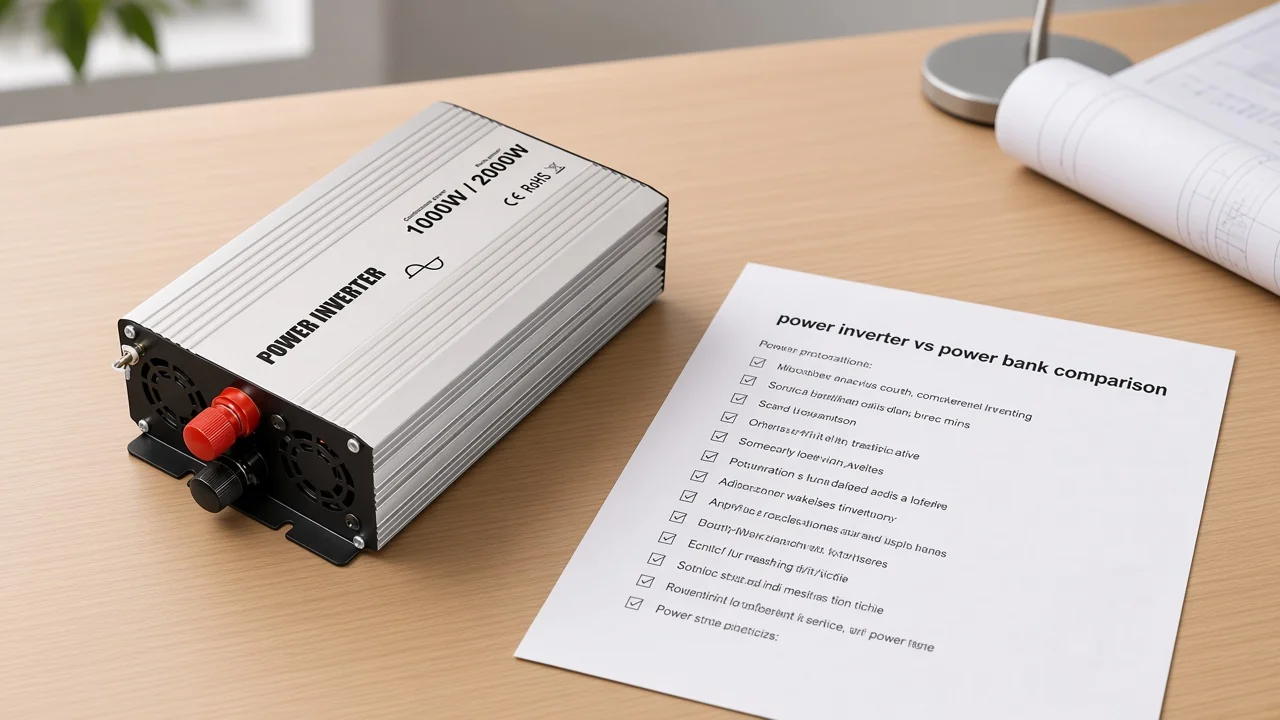
Compare the fields that change BOM, callback risk, and stock strategy—not brochure slogans.
| Decision field | Inverter + external battery | Integrated power bank / portable station |
|---|---|---|
| Energy storage | Separate battery bank sized to Wh/autonomy | Built-in pack (Wh stated by that vendor) |
| AC conversion | Discrete power inverter SKU | Built-in inverter stage |
| Expandability | Add parallel batteries / upsize inverter class when design allows | Often capped by proprietary expansion rules |
| Repair path | Replace inverter, battery, or cabling as parts | Module failure may force whole-unit replacement |
| Field assembly | Wiring, fuses, disconnects, torque practice | Usually plug-and-play outlets |
| USB / DC outlets | Only if you add them or choose a hybrid AIO | Common on station panels |
| Typical channel job | Configurable job-trailer / cabin / solar carts | Fast deploy kits with fewer assembly steps |
Community builders favor separate lithium banks and inverters when they need adaptability and part-level repair. They still admit stations win on convenience and lower day-one assembly skill.
From the field: Separate battery-and-inverter builds tend to beat sealed “box” stations on adaptability and repair; stations stay attractive for plug-and-play speed but can be harder to integrate when outputs or connectors are proprietary — language mirrored in DIY Solar discussions of power stations versus standalone battery and inverter setups.
Do not invent payback percentages on either path. Ask for load class, runtime goal, and who will service the gear.
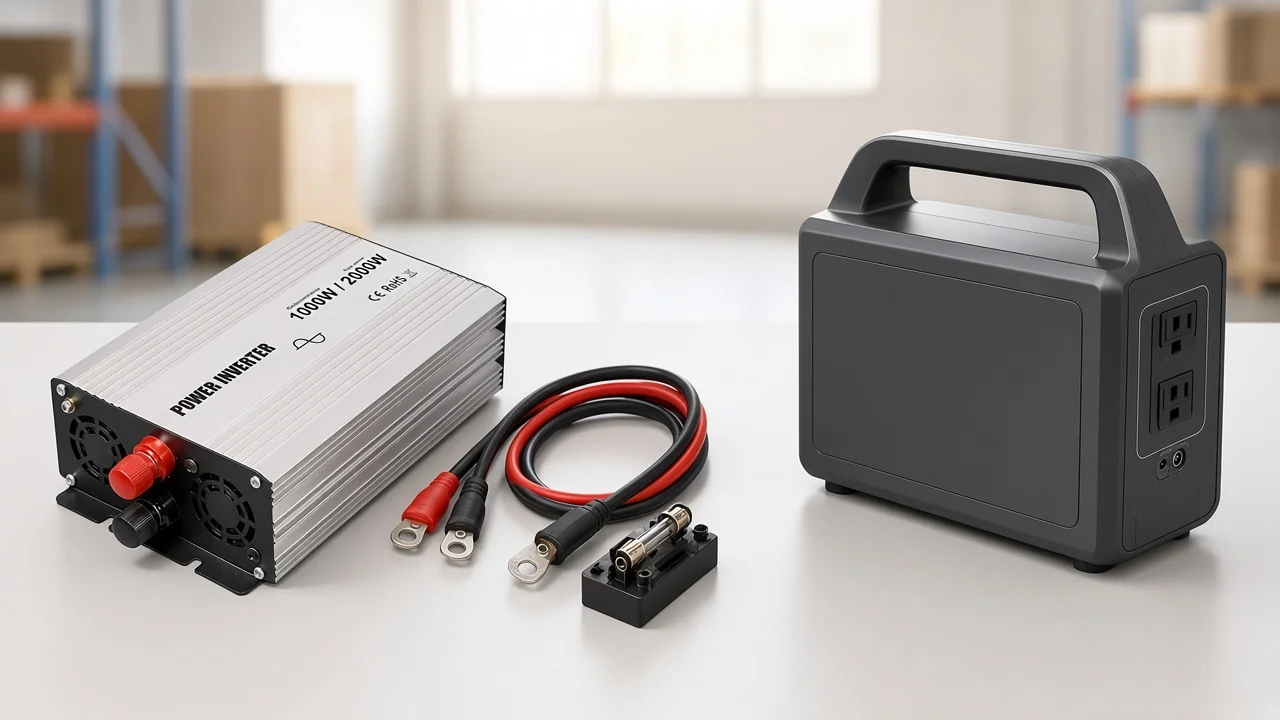
Load class decides the architecture before price negotiations start.
USB-only lists—phones, tablets, small DC lights—often stay inside a power-bank or station RFQ. They do not automatically justify a high-watt AC inverter line on the quote.
AC continuous watts are the sum of devices that must run at the same time. That number belongs on both inverter and station RFQs whenever wall outlets are required.
Capture continuous watts and surge watts as separate RFQ lines so channel quotes do not collapse them into one marketing peak.
Surge watts cover motor and compressor starts. Fridges, pumps, and many tools need a short burst above running watts. Ask for the highest single start event and how long that surge must be supported—not only a marketing “peak” label.
Waveform still matters. Pure sine output is the safer default for motors and sensitive electronics; modified sine can be acceptable for some resistive loads but should be explicit on the RFQ.
These comparison gates do not replace a full continuous/surge sizing worksheet. When the buyer needs calculator-depth math, send them to the sizing RFQ sibling and keep this page on class choice.
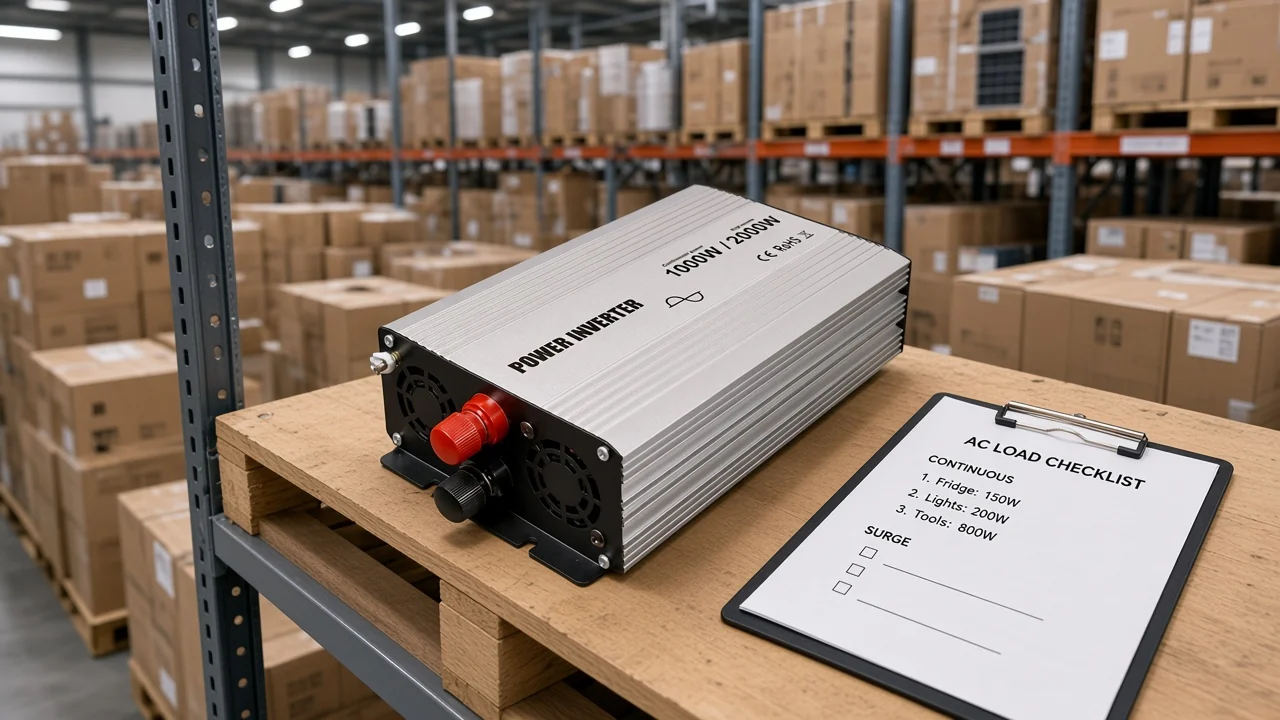
Transfer behavior and recharge paths change which SKU class you stock.
If loads must hand off between utility, generator, and inverter output, the quote needs a documented Transfer switch / ATS practice under local code. A portable station plugged into a few outlets is not the same transfer story as a critical-load panel fed by an inverter system.
PV charging / charge controller choices on the inverter path usually mean array voltage windows and cable protection as balance of system parts around the conversion block. DOE power-electronics guidance treats inverters as the DC-to-AC stage that still sits inside a wider BOS package of wiring, disconnects, and protection.
Integrated stations may advertise solar inputs with proprietary connectors and limited charge rates. Capture max PV input, connector type, and whether third-party controllers are allowed before you promise “solar ready” on a channel flyer.
Stocking reality for MOES channels today: solar inverter families are live on the pillar. Integrated power banks are an RFQ class to source or decline—not a fabricated catalog SKU.
Lock these RFQ fields before anyone argues brand, Wh marketing numbers, or app features on either class.
| RFQ field | Why it matters | Evidence to request |
|---|---|---|
| Load class | USB-only vs AC continuous vs motor surge | Device list with running and start watts |
| Packaging class | Inverter+battery vs integrated station | Explicit class word on the PO |
| Continuous AC watts | Steady simultaneous load | Sum of concurrent AC loads |
| Surge watts + duration | Motor start survival | Highest LRA/start event and seconds needed |
| Waveform | Motor/electronics compatibility | Pure sine vs modified sine requirement |
| DC bus voltage | Cable size and inverter match | 12 / 24 / 48 V class |
| Runtime / Wh goal | Battery or station capacity | Hours at stated load, not empty “backup” labels |
| Transfer / ATS need | Code and panel design | Single-line sketch or load panel scope |
| PV charge path | Solar input limits | Voc/Isc window, connector, controller rules |
| Service model | Repair vs whole-unit swap | Spare-part expectation and who services |
Important: Backup power during outages needs a properly configured inverter path plus storage—solar panels alone are not enough when the design depends on the grid — source: Department of Energy solar and resilience basics.
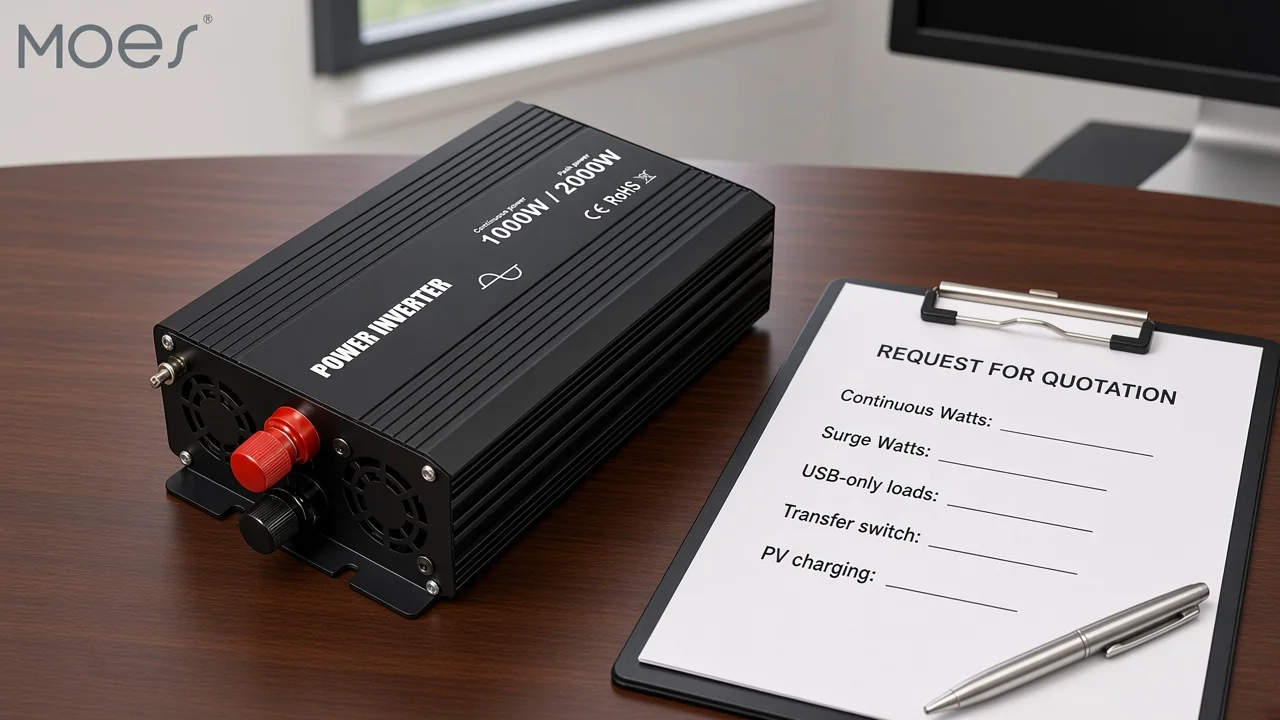
Quote a live MOES inverter when the RFQ locks on AC continuous/surge loads, expandable battery BOM, or serviceable parts—not when the buyer only needs pocket USB charging.
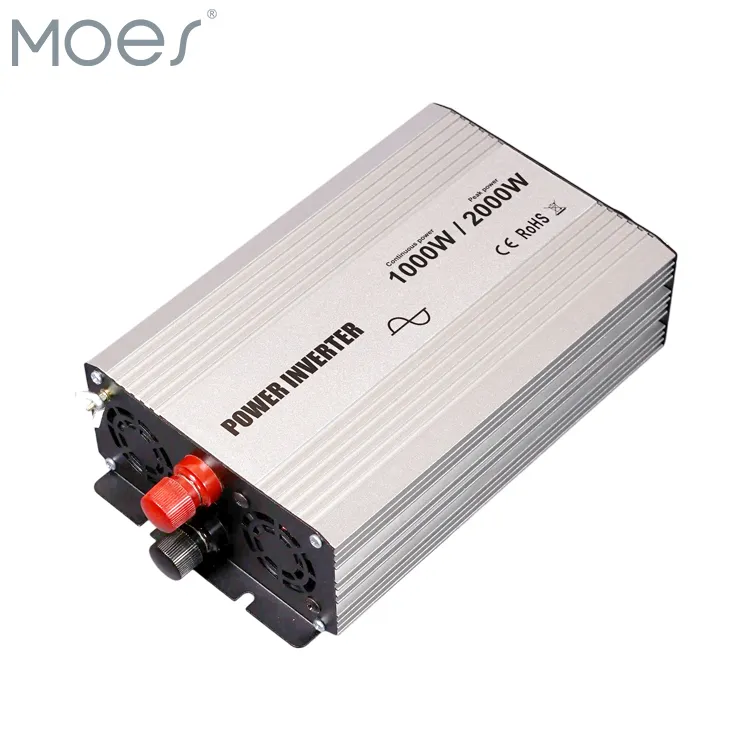
The 1000W 2000W 12V Pure Sine Wave Power Inverter is the inverter example here—a live pure sine wave power inverter SKU rather than an invented bank. The live page positions a high-frequency pure sine converter for solar, RV, UPS-style backup for sensitive electronics, and household AC loads when paired with a properly sized battery system.
Live technical parameters include DC operating voltage options of 12V/24V/48Vdc, AC output options of 110V/120V/220V/240Vac, 50 or 60 hertz frequency, and a stated power range of 300W ~ 6000W across the family language on that listing. Protection callouts on the product presentation include over-current, over-voltage, over-temperature, overload, short-circuit, and low-voltage protection.
Use those listing values only for this SKU family conversation. Skip inventing a single continuous rating for every variant, and skip inventing transfer-time or Wh numbers that are missing from the listing.
MOES catalog search on 2026-09-15 returned no live power-bank / portable power station product. Treat the bank side as an RFQ class: collect Wh, AC continuous/surge, USB port map, PV input, and connector rules from whatever brand the channel sources—or keep the quote on the inverter-plus-battery path above.
When the architecture answer is hybrid off-grid charging instead of a simple power inverter, move deep selection to hybrid category pages without rewriting buyers-guide siblings here. For project wiring inputs, use the existing battery power inverter wiring-diagram piece rather than expanding this comparison.
Send the next channel question to Contact Us with the RFQ table filled—class, continuous/surge, waveform, DC voltage, and transfer/PV notes.
No. A pocket power bank is usually USB/DC only.
A portable power station integrates battery storage with AC outlets and often USB/DC ports. Put the class word on the RFQ before comparing brands.
Quote the separate path when the buyer needs expandability, part-level repair, or a configurable continuous/surge BOM. Stations fit fast plug-and-play kits with fewer assembly steps.
Often no. If the load list is phones, tablets, and small USB accessories, stay in a USB/DC bank class unless the customer also requires wall outlets.
List simultaneous running watts as continuous AC, then the highest motor-start surge and how many seconds it must last. Do not rely on a single marketing “peak” number.
No live MOES power-bank or portable power station SKU appeared in catalog search for this package. Recommend the live pure sine power inverter path for AC jobs, and treat bank requirements as an RFQ class without invented Wh/USB claims.
No. An inverter converts DC to AC; runtime comes from storage and a configured path. DOE resilience guidance is clear that panels alone do not keep loads up during outages without storage and a suitable inverter arrangement.
Avoid simultaneous loads and motor starts that exceed continuous or surge ratings, and avoid mismatched waveform expectations for sensitive electronics. Capture the device list before promising outlets.


OTHER SMART DEVICES
Jun 13,2026
OTHER SMART DEVICES
Jun 12,2026
TUYA SMART HOME PRODUCTS
Jun 12,2026
 +86 137 3639 3028