


by NOVA

Oct 08, 2026
A water sensor works by letting conductive water close a path that dry air leaves open, then turning that change into a local alarm or a wireless alert. how does a water sensor work is the buying question for that chain: a conductive probe or a sensing cable, a small decision inside the device, and an optional motorized valve that moves only after the event. The class name for the hardware sits on what a water leak sensor is, and the branch that holds the related MOES hardware is Tuya smart home products.
A water leak detector, in the wording a project sheet usually wants, is that front end pointed at a floor or a chase that should stay dry. Occupancy hardware follows heat and motion through a room, which is a different instrument. Here the useful object is the water bridge, the message that leaves the device, and the actuator that may move later.
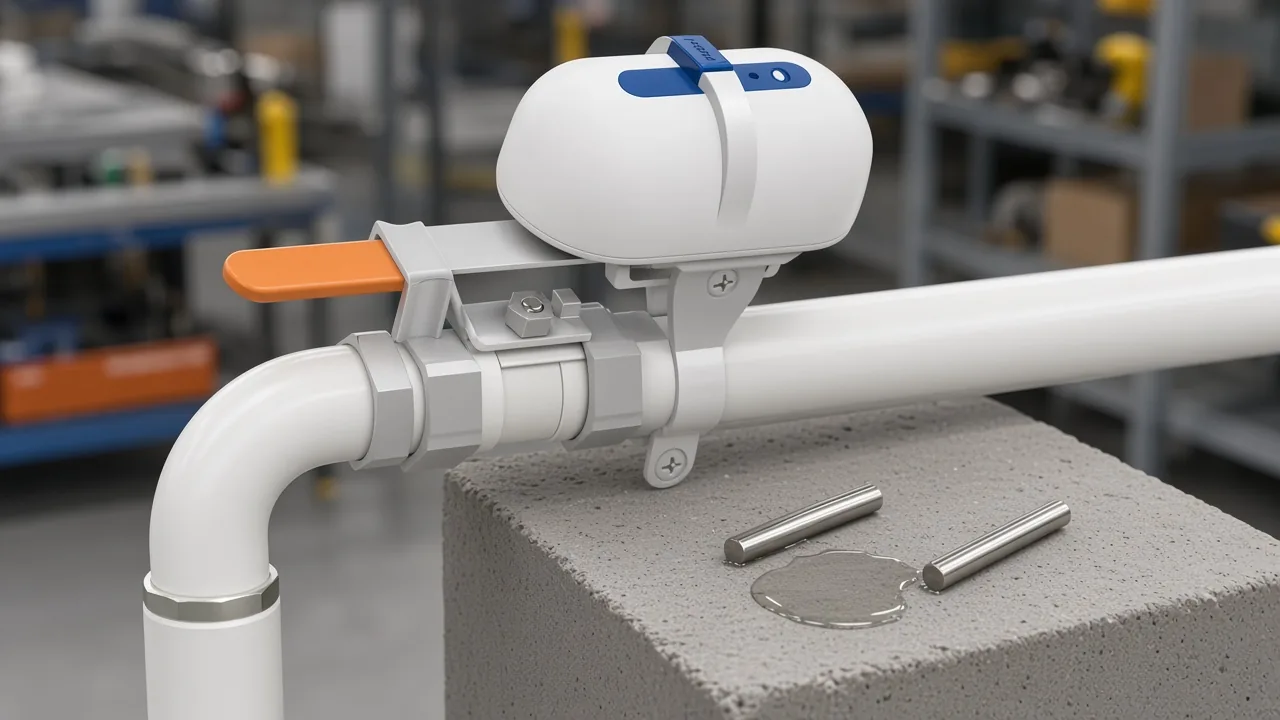
Air between two metal contacts is a poor electrical path, so the front end stays quiet while the floor is dry. A conductive probe is those contacts, held a short distance apart and aimed where a puddle would collect. When water that carries dissolved minerals bridges them, resistance falls and a small current can flow.
Wait on that bridge before treating the reading as a leak event. A common water detector puts the same idea in a flat body on the floor or in a short sensing cable: enough water across the contacts lowers resistance, a sound can start, and a further signal can leave the device. The reading is the bridge itself.
Pure laboratory water is a weak bridge because it carries few ions. Tap water, condensate that has picked up dust, and wash water usually conduct well enough for this kind of front end. A buyer who expects the same behavior in deionized rinse water is asking a different liquid to do the job.
| Path stage | What the buyer is looking at |
|---|---|
| Dry gap | Air between contacts, or a dry sensing cable |
| Moisture bridge | Water that can carry current across that gap |
| Local decision | Circuit that treats the new path as water present |
| Local alarm | Sound or lamp on the device |
| Wireless alert | Radio event toward a phone or a hub |
| Actuator | Motorized valve that may move after the event |
The circuit watches the gap against the dry baseline it was built around. A sudden easier path means water is across the contacts, and the output changes. On a simple unit that output is a local alarm: a beep, a lamp, or a relay contact beside the probe.
The decision is local even when a phone will hear about it later. Something in the device has to agree that the bridge is real enough to count. Builders sometimes require the wet reading to repeat, so a single drip or a brief splash does not become the event the rest of the system trusts.
Threshold and probe spacing travel together. Contacts that sit high off the floor need a deeper film before both metals touch the same puddle. Contacts that nearly touch the slab will speak sooner, and they will also speak for a damp film that a facilities lead might still call a dry day.
Once the local decision is made, the news can stay in the room or it can travel. A standalone water leak detector may only sound. A connected unit adds a transmitter, and the wireless alert is a separate step from the wet/dry reading.
Shop pages describe this handoff in one shape. Water touches the probes, the circuit accepts the bridge, and a radio carries the event to a phone or a hub.
The person who can shut a manual valve may be off site, which is why the radio exists. The sensing step has already finished before that message is on the air.
For a wired handoff, use a relay contact as the departure. The probe circuit closes a contact, and another panel, already in the building, treats that contact as an input. In that arrangement the “radio” is a pair of wires, and the hub is whatever panel already owns the input.
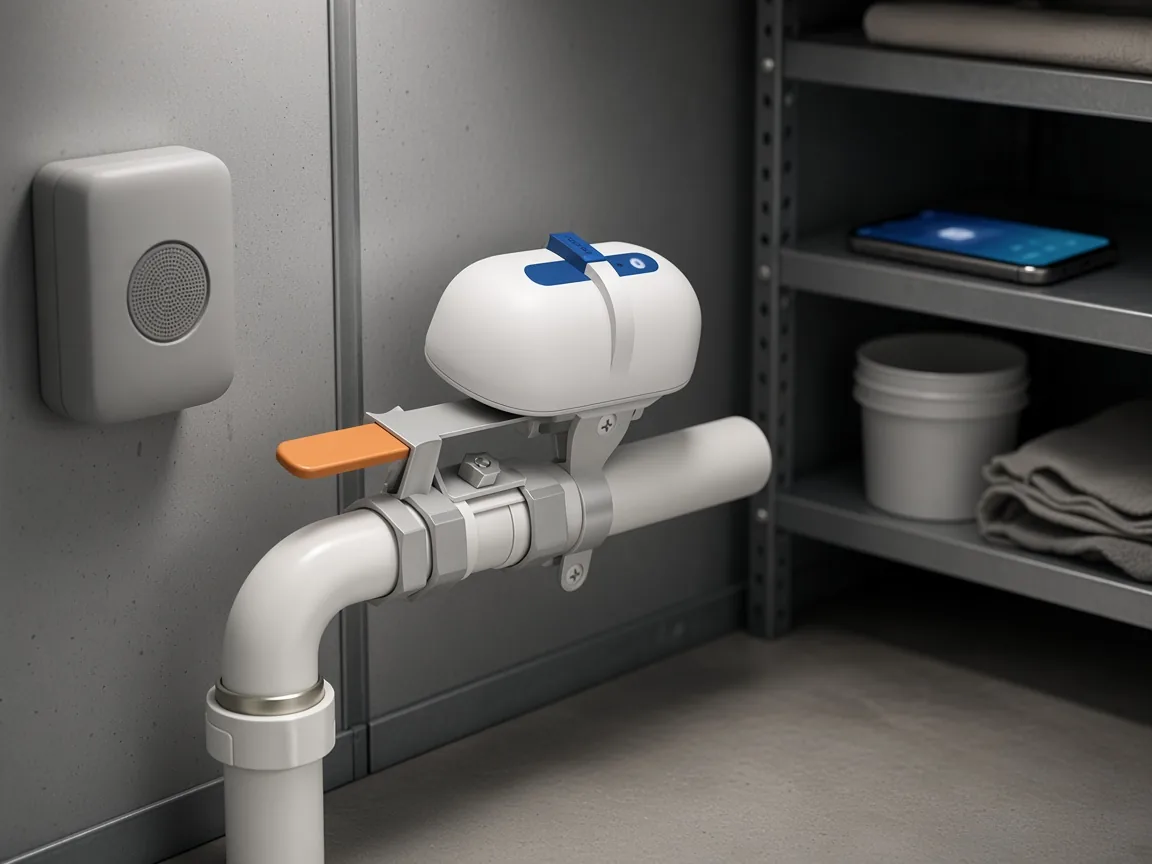
Valve motion is a later action. The sensing circuit reports the wet path. A motorized valve, if the project includes one, is the device that turns the handle.
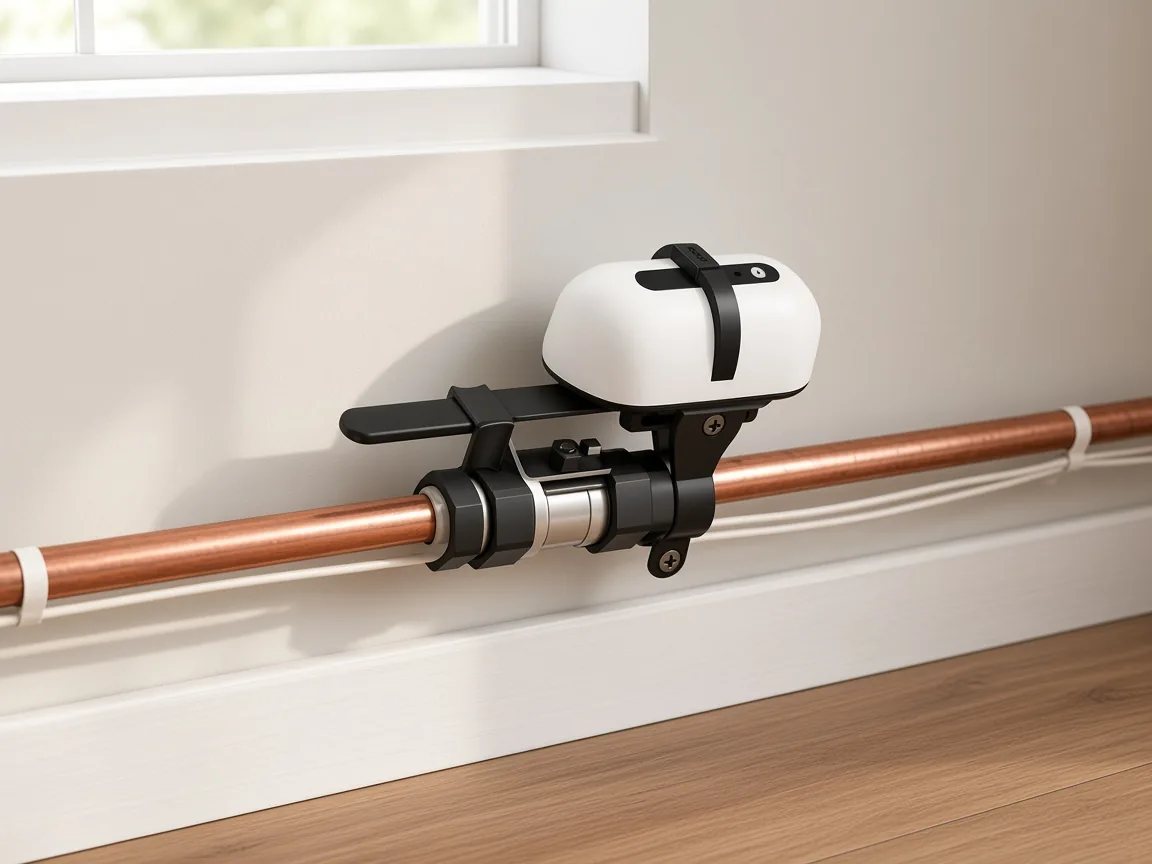
On the live MOES catalog, the matching actuator is the WiFi water gas pipeline auto shut-off valve controller, model WV-QY-WH. The product description says it links with smart water sensors, shuts the valve when leakage is detected, and pushes an alarm in the app.
The page is the controller for a pipeline valve. It is the actuator in this chain.
The Other Smart Devices collection, read with that page, did not present a separate water-sensor model title. Procurement can still buy the controller when the project already has a sensor path and needs something to move the valve. Asking that controller page for probe spacing or cable length will come back empty, because those fields belong to the sensor in front of it.
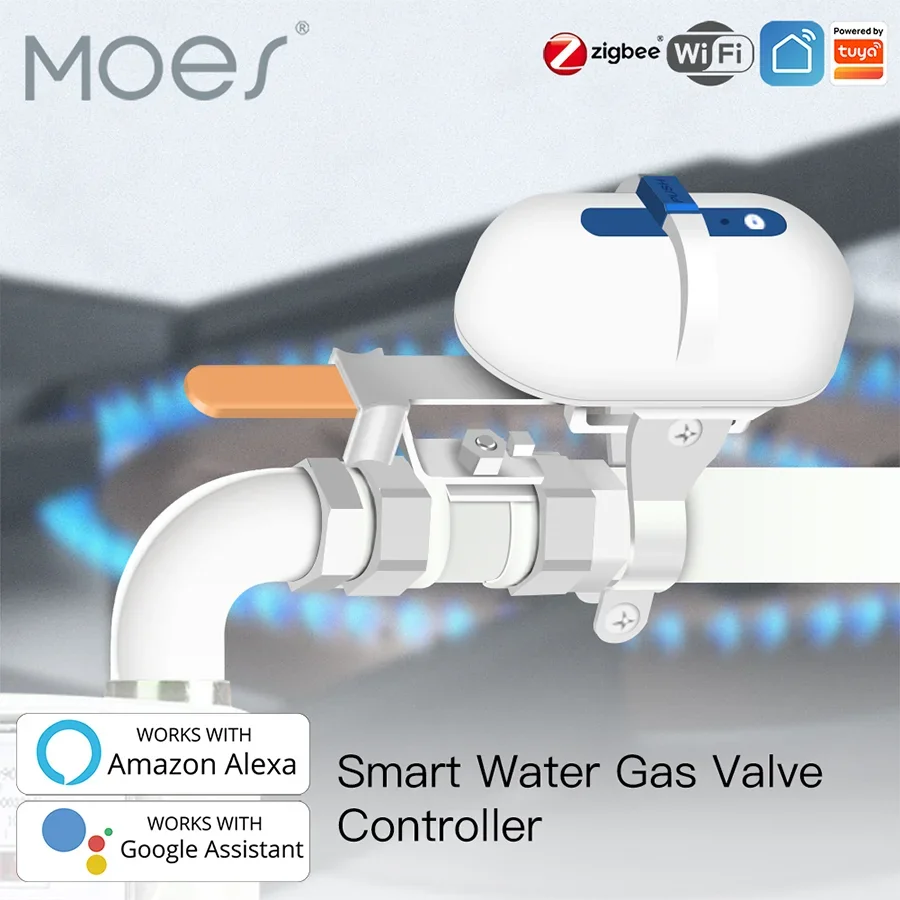
Printed controller fields stay on the actuator line in the table under this photo.
| Ask on the sensor path | Why it belongs there | Printed note on WV-QY-WH |
|---|---|---|
| Probe or sensing cable | Spot watch versus a run along a chase | The controller page does not choose this geometry |
| Power for the front end | The gap has to stay under watch | Controller supply is 12V/1A |
| Hub, if any | Only when that radio needs a receiver | ZigBee version needs a Tuya gateway; Wi-Fi version is listed as 2.4G Wi-Fi |
| False wet behavior | Residue, steam, and tired power can mimic a bridge | Sensor behavior is outside this actuator page |
| Time to move the valve | Happens after the event arrives | Close 5-10s and open 5-10s; pressure 6MPa; sizes 1 inch and 1.25 inch |
A mechanical room makes the split concrete. Two contacts under the water heater report a film on the slab. Minutes later, if the linkage is in place, WV-QY-WH turns a ball valve on the supply.
The contacts did the noticing. The white actuator on the pipe did the closing. Mixing those two jobs on one line item hides which vendor has to answer which question.
A conductive probe watches one place. Both metals have to meet the same puddle, so the installer aims the body at the low spot: under a pan, beside a tank, at the lip of a sump. The physics stays the open-versus-bridged gap.
A sensing cable stretches that idea along a route. Conductive cores run inside the cable, and water that wets the jacket forms a low-resistance path between those cores.
A control circuit compares the change with its threshold and can then alarm, or it can hand the event to equipment that should stop. The cable is useful along a pipe chase, a riser, or the edge of a room where the leak might start anywhere on a long line.
The choice is geometric. A single puddle under one appliance fits a probe. A long run where the wet spot could appear at many points fits a cable.
Both still end in the same kind of news: the path got easier, so water is being treated as present. Level floats, pressure heads, and ultrasonic echoes answer how high the surface is. That is a different question from whether water reached this contact.
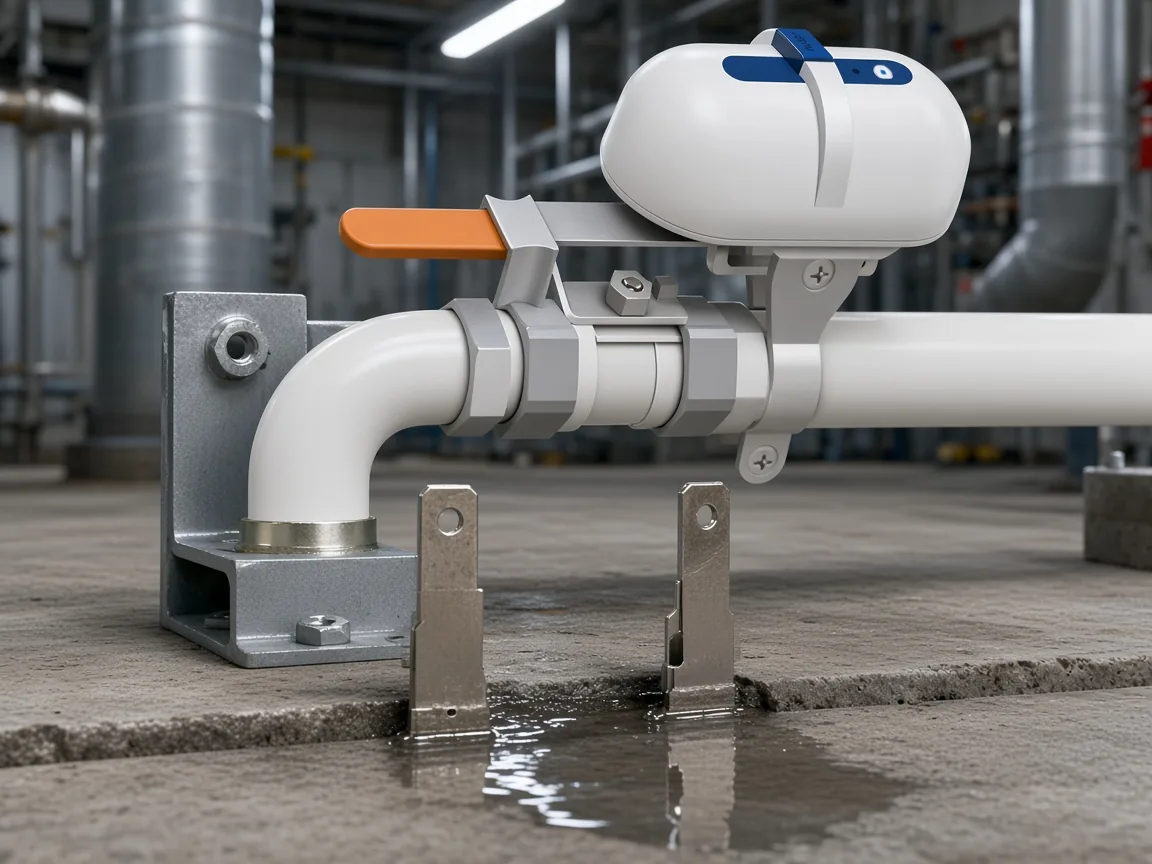
Whatever radio or beep follows, the front end needs power while it watches the gap. A battery pack, a plug-in supply, or a panel feed can do that job. The project has to name which one, because a dark front end reports nothing, including a real bridge.
A hub enters the drawing only when the chosen radio needs a receiver. On the WV-QY-WH page the ZigBee version is described as needing a Tuya gateway, while the Wi-Fi version is described as joining the router and the app directly.
That split belongs to the actuator’s own radio. A sensor in front of it can have a different radio, a different power source, or only a relay contact and no radio of its own.
Buyers get into trouble when one line item is asked to answer both. “Does this need a hub?” is meaningful only after you say which box. The probe circuit might be a local alarm with no hub.
The valve controller on the same job might still need a gateway for its own protocol version. Write the two dependencies on two lines.
Field notes from consumer leak alarms also tie weak batteries to extra notifications. That is a reason to ask how the device behaves as power falls, and to ask it of the sensor vendor. It is a reason to leave hour claims off the page until that vendor prints them.
The same bridge that makes the sensor useful will also close for things a walk-through might miss. A damp film, mineral crust left after an earlier wet event, or water that is still sitting in a cloth under the body can complete the contacts. The floor looks dry to a glance and the circuit still sees an easier path.
From the field: One builder hung copper stand-offs over a sump that stayed wet. The copper grew a heavy patina and the alarm stayed quiet on a later rise, while a wet finger across the cleaner screws still sounded. Probe metal is part of the path when the spot never really dries (source: https://www.eevblog.com/forum/projects/water-leak-alarm/).
Steam is the household version of the same story. People have reported a unit by a dryer sounding when the vent slipped and humid air hit the contacts. Another report, from a basin that always sweats, described condensation on a hanging sensor that kept declaring water.
In both cases the circuit was consistent. The water film was simply smaller than the leak the buyer had in mind.
Dirt and corrosion pull in opposite directions, and both matter on a maintenance visit. A conductive crust can hold the alarm on after the puddle is gone. A corroded copper face can refuse to conduct when the water finally arrives.
Stainless or galvanized faces show up in shop talk for pits that stay damp, because the metal has to survive the location as well as notice the next rise.
A tired power source belongs in the same conversation, without a borrowed runtime number. Homeowner threads describe false notifications arriving together with a low-battery message. The practical question for a quote is what the device emits when power is low, and whether that emission can be told apart from a wet bridge.
Very pure water is a poor conductor, so a continuity probe may stay quiet in a deionized rinse even while the liquid is visibly present. Ordinary tap water and most wash-down water carry enough dissolved material to bridge the contacts. If the project handles high-purity water, the sensing method has to be chosen for that liquid.
Steady direct current through water can plate and eat metal over time, which is electrolysis at the contact face. Designers who expect the probes to sit wet often excite them with alternating current so the metal lasts longer. A probe that is dry almost all year can still be built more simply, and the quote should say which approach the model uses.
Yes. Condensation, dryer steam, and a conductive film left on the contacts are all real bridges as far as the circuit is concerned. A dirty face can keep the local alarm running after the visible water is gone.
Cleaning, contact height, and a repeat count before the event is trusted are the usual counters, and they belong in the sensor notes.
The sensing circuit reports the wet path. Turning a valve is the job of a motorized valve or a controller such as WV-QY-WH, and only after that controller receives the event and is linked to do so. A probe with a beep and no linkage leaves the handle where it was.
Ask whether the front end is a conductive probe or a sensing cable, what liquid it is expected to bridge, how it is powered, whether a hub is required for its radio, and how it behaves on a false wet or on low power. Ask the actuator line separately for linkage and for the time it takes to move the valve.
A float follows the liquid surface by buoyancy and then moves a reed or a microswitch. The leak path here is electrical continuity through the water itself.
Floats are a fair tool for a high level in a basin. They answer a different physical question from a floor probe.
Ask what feeds the front end, and what the device does as that supply falls. Ask whether its radio needs a hub or gateway, and keep that answer off the valve controller’s own Wi-Fi or ZigBee line. Two boxes on one job can have two different answers.




OTHER SMART DEVICES
Jun 13,2026
OTHER SMART DEVICES
Jun 12,2026
TUYA SMART HOME PRODUCTS
Jun 12,2026
 +86 137 3639 3028



