


by NOVA

Oct 01, 2026
A water leak sensor is a floor-level probe or cable that reports unwanted water by completing a continuity circuit and then raising an alert. It does not close a pipe by itself.
This page names that quote object, splits puck versus cable at class level, and maps the alert path so protocol, power, placement zone, false-alarm handling, and hub dependency can lock before a catalog number. For a wider sensor map, see the types of smart home sensors guide; this unit stays on the leak-sensing head term.
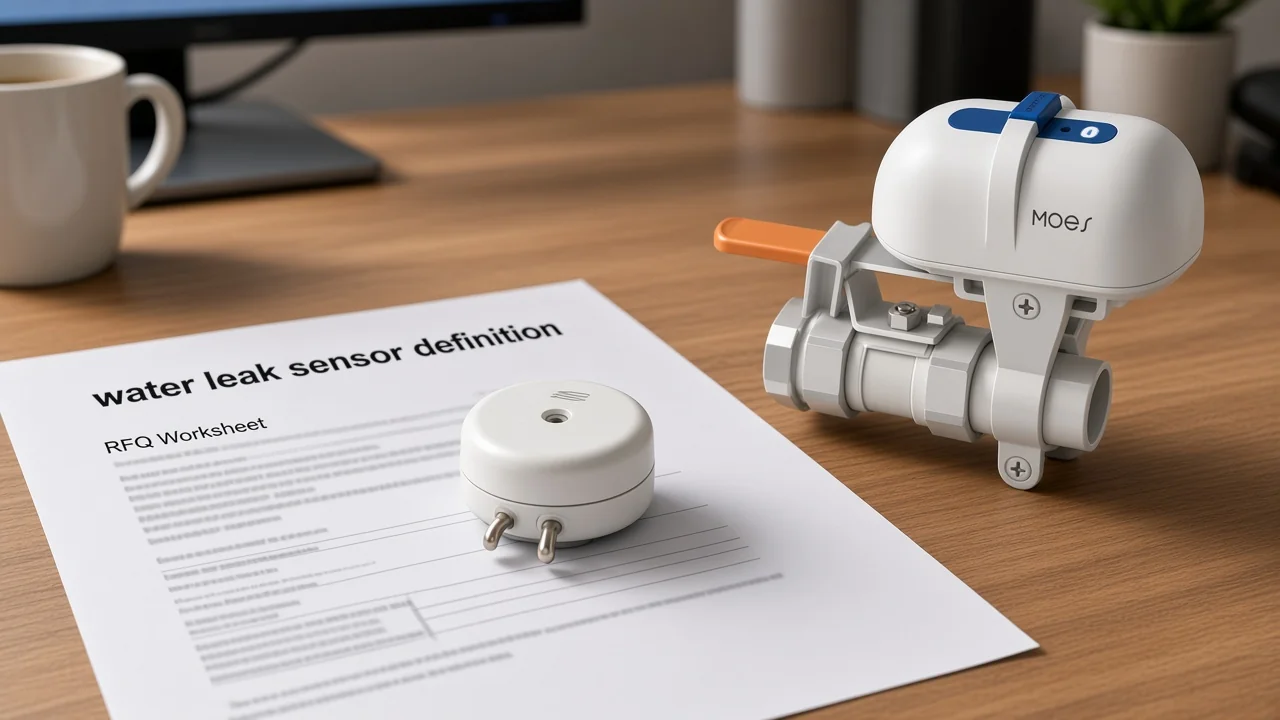
A water leak sensor reports unwanted water at a sensing surface and raises an alert; it does not stop the supply by itself.
On a distributor sheet, the line is a detector, also sold as a water leak detector or flood sensor, that sits where water should not be. Encyclopedia wording is blunt: a water detector relies on conductivity to drop resistance across two contacts, then sounds an alarm and can signal onward.
Independent security explainers use the same job: sense moisture where it should not be, then tell someone soon enough to act. That is the quote object. It is not a complete plumbing repair, and it is not a building-management cable grid unless the RFQ actually names that class.
US homeowners insurance treats water damage and freezing as a named loss class. About one in 60 insured homes has a property damage claim caused by water damage or freezing.
That statistic is industry context, not a MOES performance claim. It is why channels bother to define the SKU instead of bundling “leak” into a vague gadget pack.
If the RFQ only says “send leak sensors,” purchasing still does not know whether the buyer wants a puck, a rope, a local siren, an app push, or a valve. Lock the object first.
Most consumer units close a circuit when water bridges two contacts; they only see water that reaches them.
Those contacts are conductive probes. They sit a short distance apart as an open circuit. Domestic water carries enough dissolved ions to bridge the gap, so electronics treat the path as closed and fire the alert.
Technical explainers describe the same continuity loop as a low-voltage circuit, typically operating at less than five volts. Academic notes add a useful caveat: very low-ion water, such as distilled water, may not conduct well enough to trip a simple probe.
A how-does-a-water-leak-sensor-work question is therefore a geometry question as much as an electronics question. Water that stays inside a wall, under a slab, or behind a sealed cabinet never reaches the contacts.
Some pucks add a second set of contacts on top to catch drips. That still requires liquid on metal. Airborne humidity is not the same event unless the SKU also prints a humidity sensor.
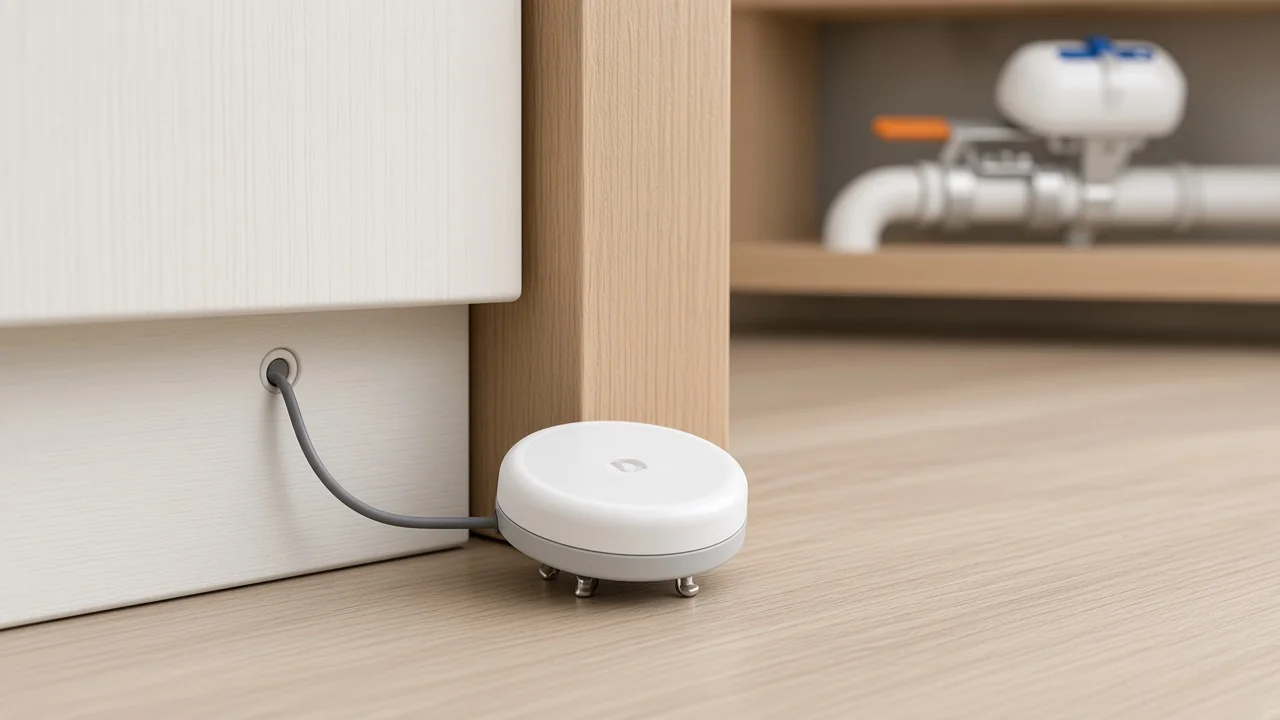
Spot pucks watch a small pool; cables watch a run; neither is a whole-home flow meter.
A puck / spot sensor is a compact point detector. Reviewers describe battery puck models with bottom probes for pooling water, and some add a drip contact on top.
A rope / cable sensor extends the sensing conductor so moisture anywhere along the length can trip the unit. Independent tests treat a plug-in cable on the floor as a different coverage style from a puck that only sees a few centimetres of tile.
Keep this split at taxonomy level. Broader motion, contact, climate, and life-safety classes belong on the sensor types guide, not here.
A flow monitor is a different class. It watches volume or pattern at a main line instead of waiting for a puddle. Thermal clip-on monitors that infer hidden flow from pipe temperature are another quote object as well.
| Style on the RFQ | What it watches | Typical mix-up |
|---|---|---|
| Puck / spot | A small pool or drip at one location | Pricing it as if it wrapped a heater base |
| Rope / cable | Moisture along a laid length | Treating cable length as “whole house” coverage |
| Flow monitor | Usage or pattern on a supply line | Filing it as a floor flood sensor |
| Shutoff valve controller | Motion of a valve after a rule | Filing the actuator as the sensor |
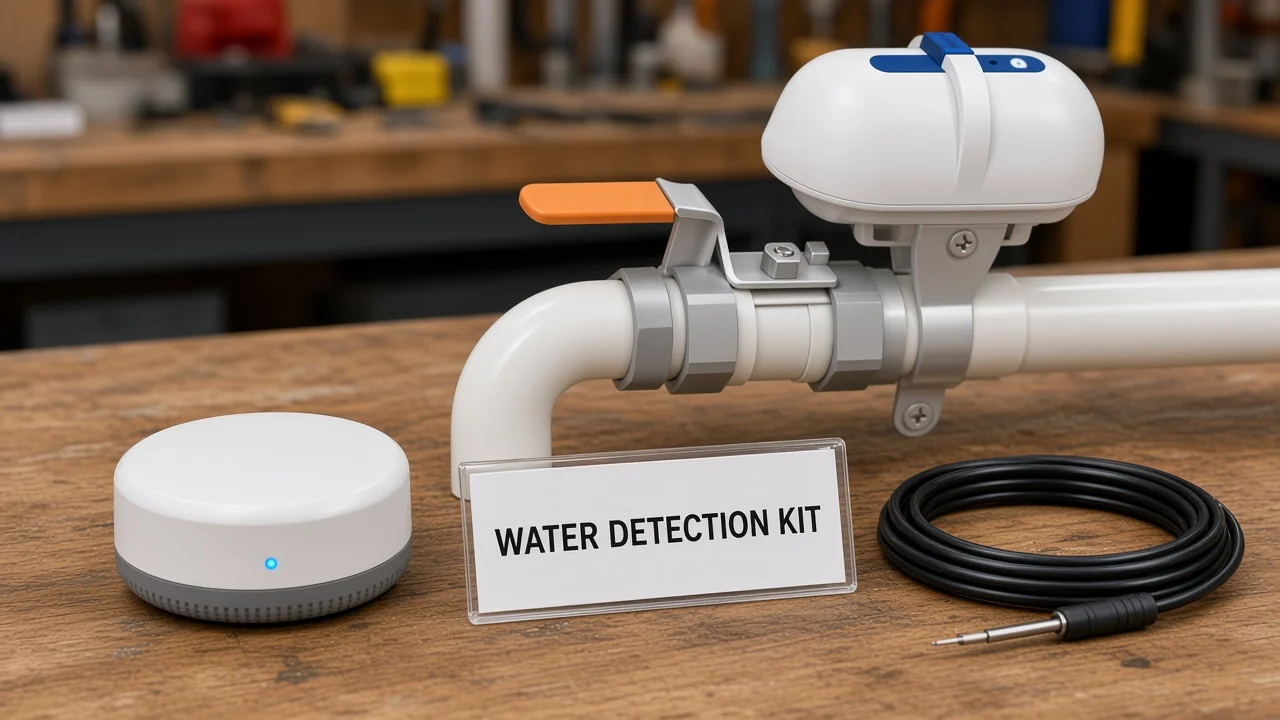
Local sirens, app pushes, and hub events are different paths; mesh radios usually need a powered gateway.
The alert path is the output of the SKU. A standalone unit may only scream in the room. A connected unit sends a wireless event to an app, a security panel, or a smart home hub.
Independent explainers split Wi-Fi pucks that join a router from Zigbee or Z-Wave pucks that sip power but need a hub. Hubs may cost extra on the BOM even when the puck looks cheap.
Battery-powered local alarms can still sound in a mains outage. Remote notify needs the radio path and usually a powered router or hub.
Field threads on hub-paired leak pucks complain about daily “offline” notices even when signal looks fine. Some installers treat heartbeat dropouts as battery theatre rather than a wet event. Quote the difference: leak event versus device-not-seen.
If the RFQ uses a mesh radio, print the hub SKU or print a deliberate decline. The live MOES wired multi-mode gateway page lists 5V 1A supply, Wi-Fi 2.4GHz with ZigBee, BLE, and Mesh, and stable control of 128 devices. That page does not prove MOES sells a matching water-leak puck.
Shutoff, combustible-gas, and flow-monitor hardware are separate quote objects.
A sensor tells someone water is present. A shutoff valve controller moves a valve. Pairing them is an automation rule, not a single SKU identity.
Important: A water leak sensor does not shut off the supply by itself. If the buyer wants the pipe closed, the RFQ needs a named actuator and a named rule, not a hope that the puck contains a motor. — Security.org
Catalog pages that mix “water sensor” language with quality probes, tank-level probes, or whole-home flow valves create the same mess on a channel quote. Ask which physical question the line answers: is there water on this floor, is the tank low, or is the house using water when it should not?
US EPA WaterSense product guidance treats leak-detection devices and flow-monitoring devices as related tools for water waste, not as one interchangeable SKU.
A gas leak sensor is a different leak family. The live MOES Safety Alarm System Gas Leak Smart Sensor is model ZSS-QY-GL, a Zigbee3.0 natural-gas alarm with an 8% LEL trigger, DC 5V 1A power, and audible plus visual warning. It is not a floor moisture puck.
Keep gas planning on its own product and article track. Water and methane do not share a probe.
Condensation and humidity can bridge probes; zone notes belong on the RFQ, not as install steps.
A false alarm here means a “wet” event without a plumbing leak. Independent explainers flag humidity and condensation as common trips. Community posts describe attic heater pans that fire on cold mornings, and sump cables that dew up when cold well air meets a warm basement.
Standard leak detectors detect standing water, not airborne humidity. Typical puck housings raise the contacts slightly so damp concrete alone does not complete the circuit.
Still, a cable laid over a cold pipe or across a sump opening can collect droplets that look like a flood to the firmware. Home Assistant users have also reported low-battery alerts that present like wet events on some models.
The placement zone field is therefore a map, not a how-to. Name the rooms and appliance bays the channel is quoting: under-sink cabinets, washer and dishwasher bays, heater pans, toilets, ice-maker lines, lowest basement points. Do not write fastener sequences or brand-install videos here.
From the field: Home Assistant users report leak sensors that raise wet-looking alerts when the real issue is a low battery or a flapping wet/dry state. Split those alert types on the quote sheet. — Home Assistant Community
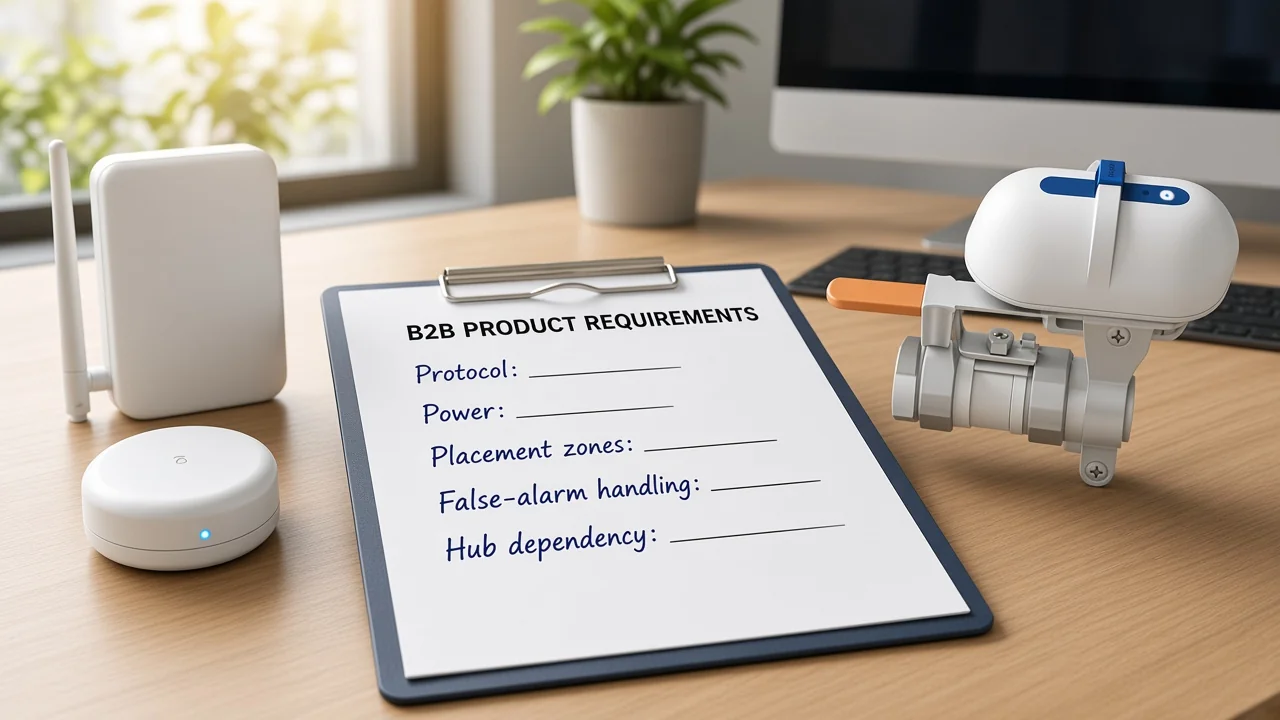
Lock protocol, power, zones, false-alarm ownership, and hub dependency.
Those five fields turn the definition into a priceable line. Skip any of them and purchasing will guess a puck when the site needed a cable, or guess Wi-Fi when the warehouse only stocks mesh.
| Field | What to print | Why it changes the quote |
|---|---|---|
| Protocol | Wi-Fi, Zigbee, proprietary, or hub-bridged | Decides app path and whether a gateway line appears |
| Power | Battery vs mains, plus charger notes if printed | Decides maintenance and outage behaviour |
| Placement zone | Named bays and floor materials | Decides puck versus cable coverage |
| False-alarm handling | Condensation, humidity, battery-vs-wet routing | Decides support tickets after cutover |
| Hub dependency | Required, not required, or declined in writing | Decides whether the BOM is incomplete |
Add sensing style (puck versus cable) beside those five. Add shutoff adjacency only if the buyer wants an actuator. Leave IP ratings, battery hours, and Matter claims blank unless a live datasheet for that exact SKU prints them.
Tip: Write “leak event” and “device offline” as two alert types on the same sheet. Hub-paired fleets generate both, and mixing them trains the night crew to ignore the one that matters. — Security.org
Use the hub as the category landing; treat WV-QY-WH only as an actuator that can link to a sensor, not as the sensor.
A MOES water-leak SKU is not printed on the live Other Smart Devices collection. The collection shows carbon monoxide detectors, gas leak alarms, presence sensors, hubs, plugs, panels, and cameras. Public product search on “water” returns waterproof cameras, not a flood puck.
Land the conversation on Other Smart Devices after the fields above are locked. If the RFQ still needs a moisture puck, carry that line as a datasheet confirmation rather than inventing a catalog number.
When the remaining need is pipeline close and open, the live MOES WiFi Water Gas Pipeline Auto Shut OFF Valve Controller is an adjacent actuator. The page prints model WV-QY-WH, 12V/1A supply, 6MPa valve pressure, 5–10s opening and closing times, and 1 inch / 1.25 inch valve specifications.
The same page states two optional protocols: a Wi-Fi version that connects to 2.4G WiFi and the mobile app, and a ZigBee version that requires a Tuya gateway. It also states leakage linkage: the valve shuts off automatically when leakage is detected and the app pushes an alarm.
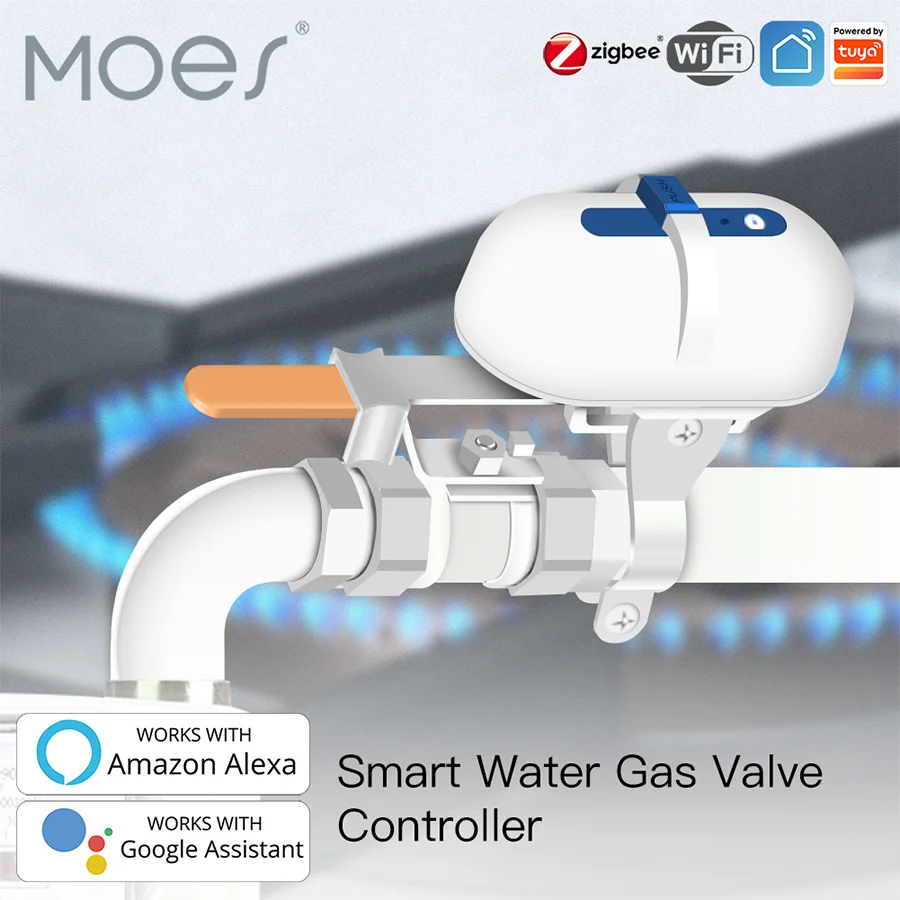
That linkage sentence assumes a smart water sensor exists in the project. It does not mint a MOES floor-sensor SKU. Keep the valve off the flood-sensor line item.
For quantities, labeling, and OEM scope after the definition is frozen, use Contact Us.
Yes for most channel RFQs. Retail copy swaps the two names for the same floor probe or cable that reports unwanted water. Confirm sensing style and alert path rather than arguing the noun.
Water bridges conductive probes or a sensing cable, the circuit closes, and the unit follows its alert path. The how-does-a-water-leak-sensor-work residual is principle and coverage, not fastener order.
No. Detection raises the alert. A shutoff valve controller performs the close only when the RFQ names that actuator and the rule that binds them.
Usually not for app-direct Wi-Fi endpoints. Mesh radios still need a matching gateway line, or a written decline, before the BOM is complete.
Condensation can bridge contacts. Treat false-alarm handling as a field: offset from cold pipes, separate battery alerts from leak events, and keep humidity SKUs off the leak line unless printed.
The live collection checked for this package does not list a dedicated water/flood leak SKU. Use the hub as the category landing and confirm any puck line on a datasheet.
The printed gas SKU is a natural-gas detector with an 8% LEL trigger. Water and combustible gas do not share a sensing job.
Only after water reaches the contacts. In-wall and under-slab leaks need a different class, such as a flow monitor, or they stay invisible to a puck.




OTHER SMART DEVICES
Jun 13,2026
OTHER SMART DEVICES
Jun 12,2026
TUYA SMART HOME PRODUCTS
Jun 12,2026
 +86 137 3639 3028



