


by NOVA

Oct 03, 2026
A solar inverter converts photovoltaic (PV) direct current into alternating current that site loads or a utility interface can use — that is the plain answer to what does a solar inverter do before anyone prices a chassis. Panels harvest energy as Direct current (DC). Most building equipment and the grid expect Alternating current (AC).
The inverter is the conversion bridge between those two worlds. For how does a solar inverter work at principle level, read the switching picture below.
For the category noun, open what is a solar inverter once. PV↔inverter sizing maths lives on the solar inverter sizing RFQ checklist.
Here the job is solar inverter function: name the conversion role, show the PV interface, separate accompanying jobs, write Grid-tied / off-grid / backup framing, lock three RFQ fields, then inspect one live MOES hybrid listing as an example.
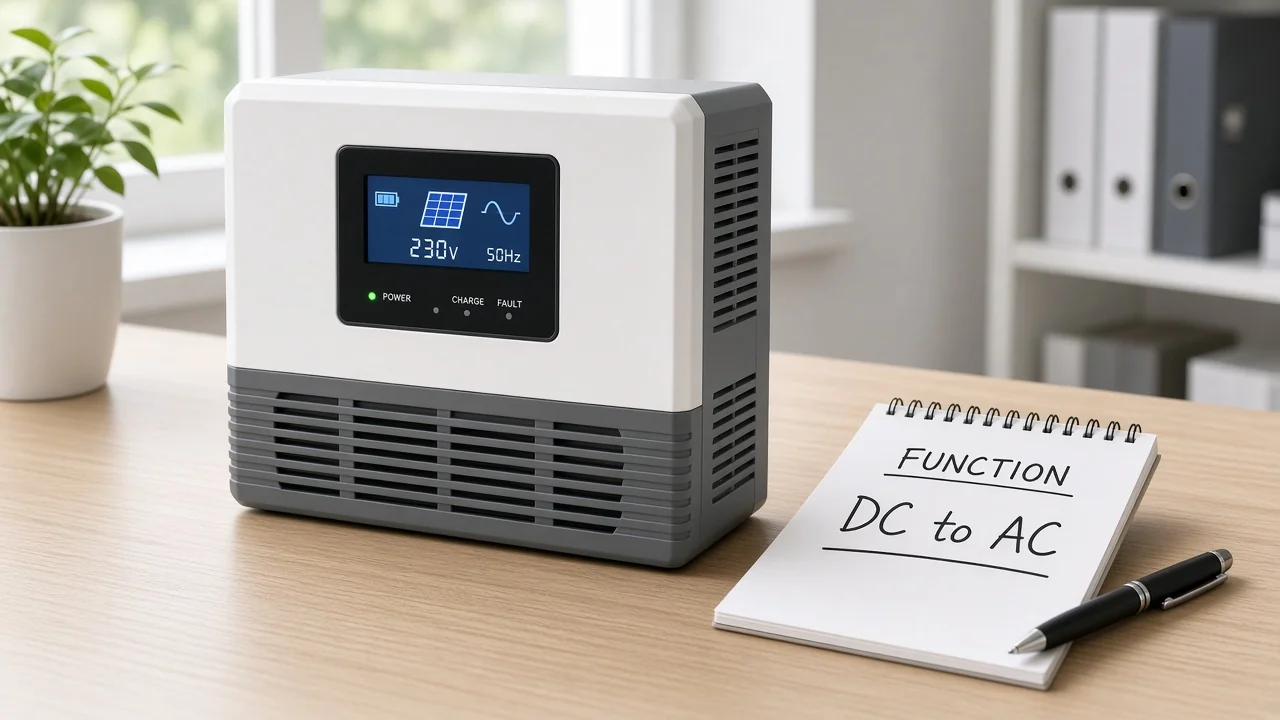
A solar inverter’s core job is DC to AC conversion for a photovoltaic project. In professional terms, it is the power-electronics box that turns variable DC from the array into utility-frequency AC. In plain language, it makes panel power look like the power your loads or grid connection expect.
Energy-agency explainers describe the same sequence: solar panels generate DC; the inverter produces AC for the grid or for appliances. Inside the unit, solid-state switches flip the DC polarity back and forth at high speed.
Filters and control loops then reshape that switched waveform into AC that equipment can accept. You do not need a semiconductor lecture to quote the device. You need to know that “invert” here means reverse and reshape the current path.
Call the same box a PV inverter or a solar power inverter when RFQ language is looser. The job stays conversion.
Distributors still see the word used as if the conversion job were optional. It is not. Without an inverter — or another engineered AC path — PV DC stays on the wrong side of most wall-powered equipment.
At principle level, the inverter sits on the DC side of a Photovoltaic (PV) array / string and presents an input window the array must fit. A string package gathers modules into series strings that feed a central conversion chassis.
A microinverter package places conversion at each module. Both still perform the same core job — DC to AC — they just locate that job differently on the roof or in the plant room.
Many solar-oriented units also run maximum power point tracking (MPPT). MPPT is the control loop that holds the array near a useful operating point on its power curve.
Treat MPPT as an accompanying PV-interface function printed on the datasheet. It is not a substitute for naming topology class. String length and temperature checks belong on the sizing sibling when the quote reaches array matching.
A useful channel picture: the PV array is the source, the inverter is the converter, and the AC panel or grid connection is the destination. Batteries may sit on the DC bus in many kits. They do not erase the need for AC conversion when the loads are AC.
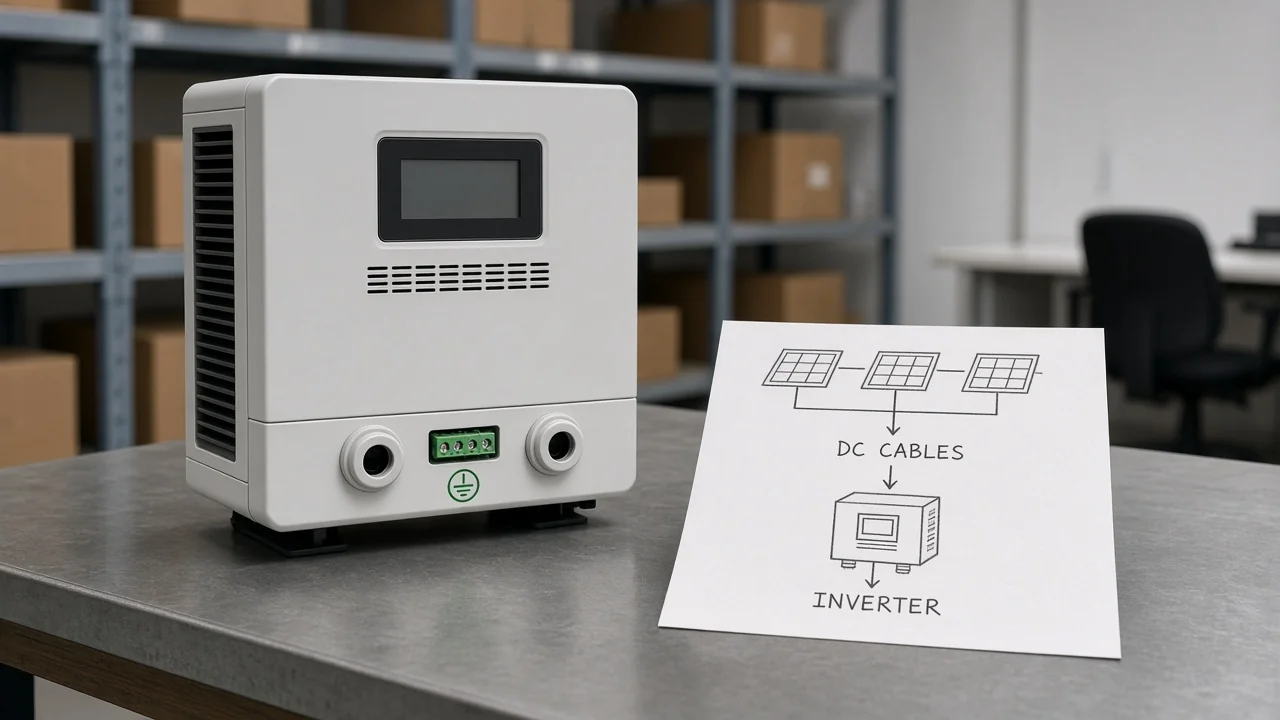
Conversion is the must-have solar inverter function. Monitoring, power routing, charging paths, and protection behaviours often ride in the same enclosure — especially on hybrid inverter/charger listings. Name the conversion role first.
| Job on the RFQ | Is it the core conversion role? | What to write down |
|---|---|---|
| DC → AC for loads or grid | Yes — primary | Voltage/frequency class the site expects |
| MPPT / PV input tracking | Accompanying | Printed MPPT window on the exact model |
| Monitoring / Wi‑Fi portal | Accompanying | Whether remote view is required on this quote |
| Battery charge / discharge path | Architecture-dependent | Only if the listing actually includes it |
| Grid sync / export behaviour | Architecture-dependent | Grid-tied framing vs no-export site |
| Outage backup / islanding | Architecture-dependent | Only if the product is designed for backup |
From the field: Forum readers still ask whether an “inverter” is just a transformer. Solar panels generate DC; households and most site loads expect AC; the inverter’s job is to change DC into the specified AC — active switching, not a passive coil. — sources: Physics Forums, r/solar
Community language also calls the inverter a “traffic cop” that directs energy among house loads, grid, and batteries. That metaphor helps buyer conversations. It still leaves efficiency percentages and surge multipliers to the printed datasheet.
Keep charge-controller role debates on the live comparison sibling when the RFQ mixes device names. Keep waveform class on its own comparison page when the load list demands it.
Write the intended Grid-tied / off-grid / backup framing before the price line. Grid-export and backup are related conversations, not interchangeable stickers.
A grid-tied (grid-interactive) inverter synchronises its AC output to the utility’s voltage, frequency, and phase so power can serve on-site loads and, where interconnection rules allow, export. Educational sources also stress Anti-islanding / grid disconnect behaviour.
Many grid-tied designs disconnect quickly when the utility goes dark, even if the sun is still on the roof. That shutdown protects line workers. It is also why a buyer who wanted “lights during a blackout” cannot treat every solar inverter as a backup box.
Backup or islanding behaviour only belongs on the quote when the product and the wiring design actually support it — for example a hybrid or off-grid architecture that can form or sustain an AC reference with storage. Solar-plus-storage systems can operate without grid support if they are designed to do so.
Off-grid or stand-alone framing means the conversion job serves a local AC network without relying on the utility as the sync source. That is a different commercial object from a grid-export string package, even when both boxes convert DC to AC.
If the inbound email only says “solar inverter for backup,” pause. Ask whether the site stays tied to the utility in normal operation, whether any critical panel must stay energised in an outage, and whether a battery path is already on the bill of materials.
Lock three fields that describe the conversion role itself. Leave the full PV↔inverter sizing worksheet on the sizing sibling.
| RFQ field | What it locks | What “good enough” looks like on the quote sheet |
|---|---|---|
| Continuous / surge class | Sustained AC capability vs short-peak language | Copy continuous and any printed surge/peak exactly from the model page |
| PV input window | Whether the array DC can enter this chassis | Absolute DC limits and MPPT voltage/current band as printed |
| Topology class | How conversion is packaged for the project | String, micro, hybrid, or off-grid (stand-alone) — pick one primary class |
Continuous class is the long-run AC output the unit is sold to deliver. Surge or peak language, when printed, covers short kicks. If the page only prints a power range without a separate surge line, ask for the datasheet line or leave the field explicitly open.
The PV input window is the DC acceptance band: MPPT range, current class, and any absolute maximum the listing states. That window answers whether this converter can talk to this array class. Cold-Voc string maths still belongs on the sizing checklist when the desk needs array matching arithmetic.
Topology class stops three quotes from looking identical on paper. A string conversion chassis, a microinverter package, a hybrid inverter/charger, and an off-grid stand-alone unit can all convert DC to AC while remaining different commercial objects. Pick the class that matches the site story before you debate brand SKUs.
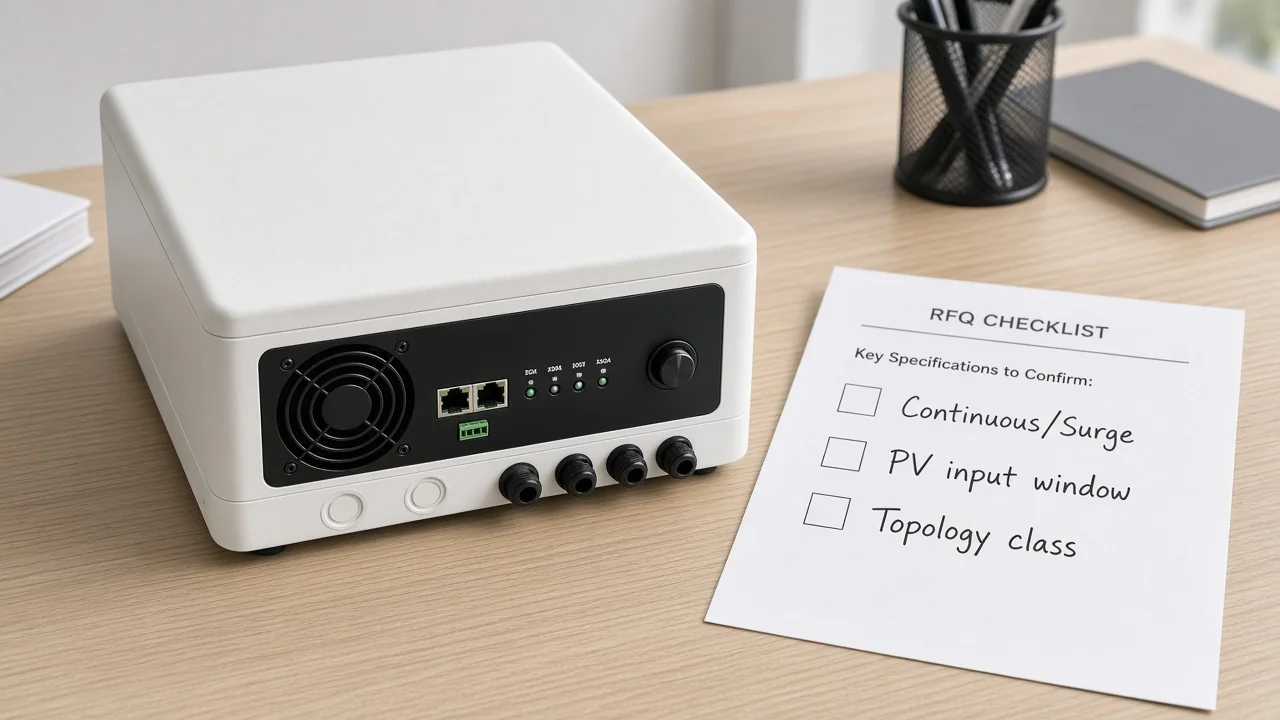
After the three fields are named, a live listing becomes a function example for one conversion chassis.
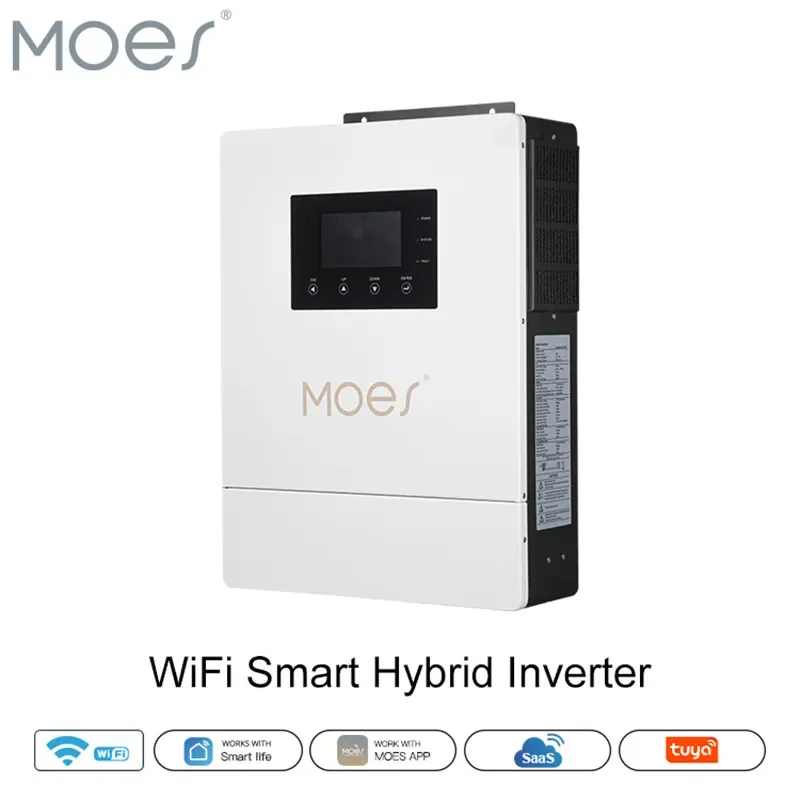
The MOES WiFi Smart Hybrid listing on the solar inverter hub describes a multifunctional inverter/charger that combines inverter, solar charger, and battery charger functions.
Printed lines on that page include a power range of 4.2KW / 6.2KW. The DC operating voltage is 48V. The AC operating voltage is single phase 176–253V.
The operating frequency is 50Hz / 60Hz. The built-in MPPT solar controller is listed as 80A / 100A. The MPPT voltage range is 60V–450V.
The listing also states pure sine wave output, operate without a battery, and Wi‑Fi monitor language. Read those strings as page-scoped evidence for this SKU.
If your RFQ needs a surge figure that this table does not print, ask for the exact datasheet line rather than inventing one in the email thread.
When the function fields and the listing URL are ready, send quantity, destination market, and voltage needs through Contact Us. Stay on live hybrid or off-grid SKUs that actually publish on the hub.
It converts direct current from a photovoltaic array into alternating current for site loads or a utility interface.
Panels produce DC. Most building equipment and utility service expect AC. Without conversion — or another engineered AC path — the energy stays in the wrong form.
No. A transformer is a passive magnetic device. An inverter uses active switching and control to create an AC waveform from DC — community technical threads stress that difference for a reason.
Maximum power point tracking holds the PV array near a useful operating point. It is an accompanying PV-interface function. It does not replace topology class or sizing maths.
Anti-islanding / grid-disconnect behaviour. Many grid-tied designs stop exporting when the utility is dark so line workers are not fed from the array. Backup needs a product and design that support islanding or storage paths.
Continuous and surge class as printed, the PV input / MPPT window, and topology class (string, micro, hybrid, or off-grid). Sizing arithmetic belongs on the sizing checklist sibling.
Use what is a solar inverter for the category noun and quote-language boundaries. This page owns what the device does.
Open the solar inverter sizing RFQ checklist for array STC matching, DC/AC ratio documentation, and Voc/Vmp checks. Keep this page on function and role fields.




OTHER SMART DEVICES
Jun 13,2026
OTHER SMART DEVICES
Jun 12,2026
TUYA SMART HOME PRODUCTS
Jun 12,2026
 +86 137 3639 3028



