


by NOVA

Sep 22, 2026
A what is zigbee question, for a channel about to quote, has a short answer: Zigbee is a low-power mesh wireless protocol for sensors and actuators that usually needs a hub or coordinator.
Lock Zigbee 3.0 versus legacy profiles, hub family, router density, sleepy end devices, and the Wi-Fi versus Zigbee path before you name a SKU. Then point at one live MOES module page for bounded radio facts.
The catalog home for these modules is Smart Modules. Finished device classes and deep radio-role maps stay on their own guides, linked once below.
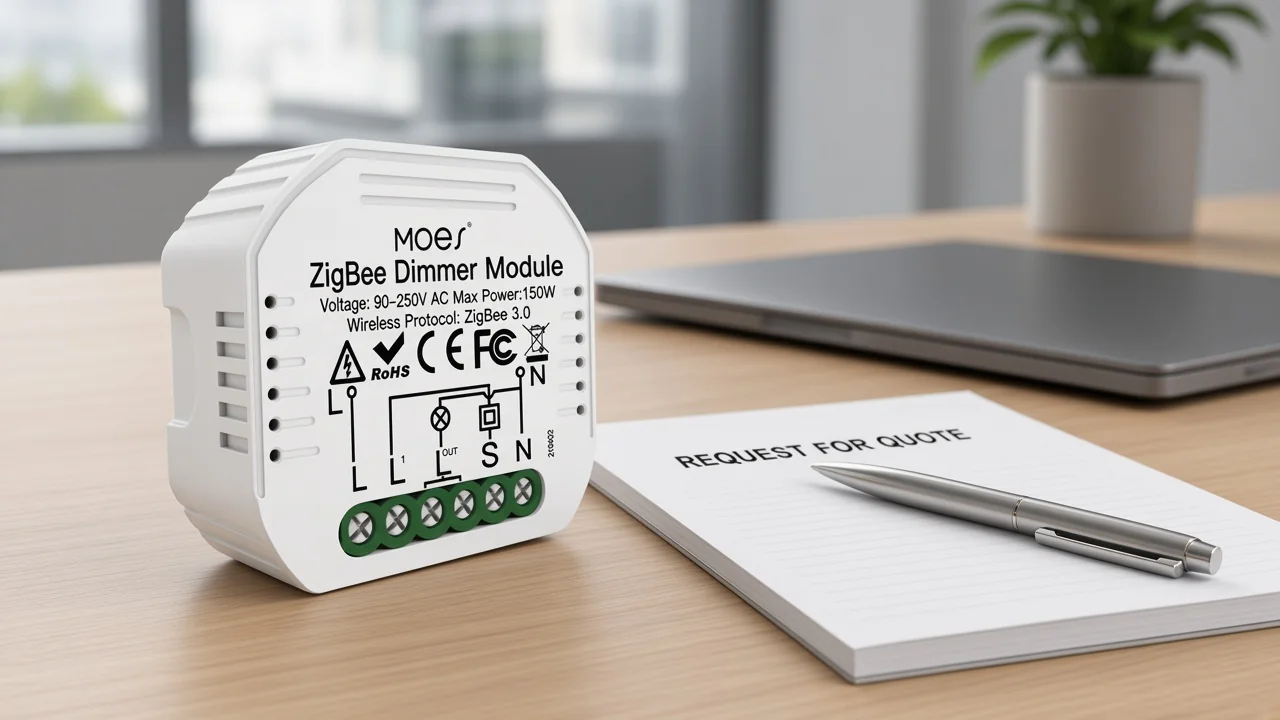
Zigbee is a low-power, low-data-rate mesh wireless protocol for sensors and actuators.
It sits on the IEEE 802.15.4 radio foundation and is maintained as a full-stack IoT mesh under the Connectivity Standards Alliance. Messages hop through intermediate devices when a direct hop is out of range.
The useful rate is modest—on the order of 250 kbps in the common 2.4 GHz band—so the stack is built for intermittent sensor readings and short control commands, not video.
Typical line-of-sight hops are short. The zigbee mesh is what stretches a project across rooms when always-on routers are placed with intent.
For a distributor, that definition already changes the quote sheet. You are not selling another wireless switch that joins the office SSID.
You are selling a mesh endpoint that expects a coordinator, a version line, and enough powered neighbors to keep sleepy leaves reachable. Deep finished-goods classes live on the types guide; deep radio-role classification lives on the radio-type guide.
Zigbee 3.0 is the version line a channel should print when it means a unified application-layer certification path.
Older catalogs still carry legacy profile names that were certified in separate silos. If a buyer and a supplier assume “Zigbee” means the same stack generation, pairing and hub-family expectations drift.
Lock the line on the RFQ the same way you lock voltage. Write Zigbee 3.0 when the SKU page prints it.
If a line card still shows an older profile family, say so instead of collapsing every Zigbee SKU into one interchangeable bin. That lock is definition hygiene, not a full interoperability audit.
Certification badges, private profiles, and Green Power edge cases stay off this page unless a live SKU page states them. MOES module facts in the recommendation below stay on the page that prints ZigBee 3.0.
Most commercial phone and app paths still need one coordinator, usually inside a hub or gateway.
The coordinator forms the network, holds security and joining jobs, and is the bridge between the mesh and the installer phone or cloud app. Community installers put it bluntly: without a hub-like coordinator, the phone has nothing to talk to on the Zigbee side.
From the field: Buyers who ask for “Zigbee control from the phone” without naming a hub family are not ready for a firm price. Put the hub brand or gateway model on the same line as the endpoints. — source: Reddit r/ZigBee and Home Assistant hub/coordinator user threads
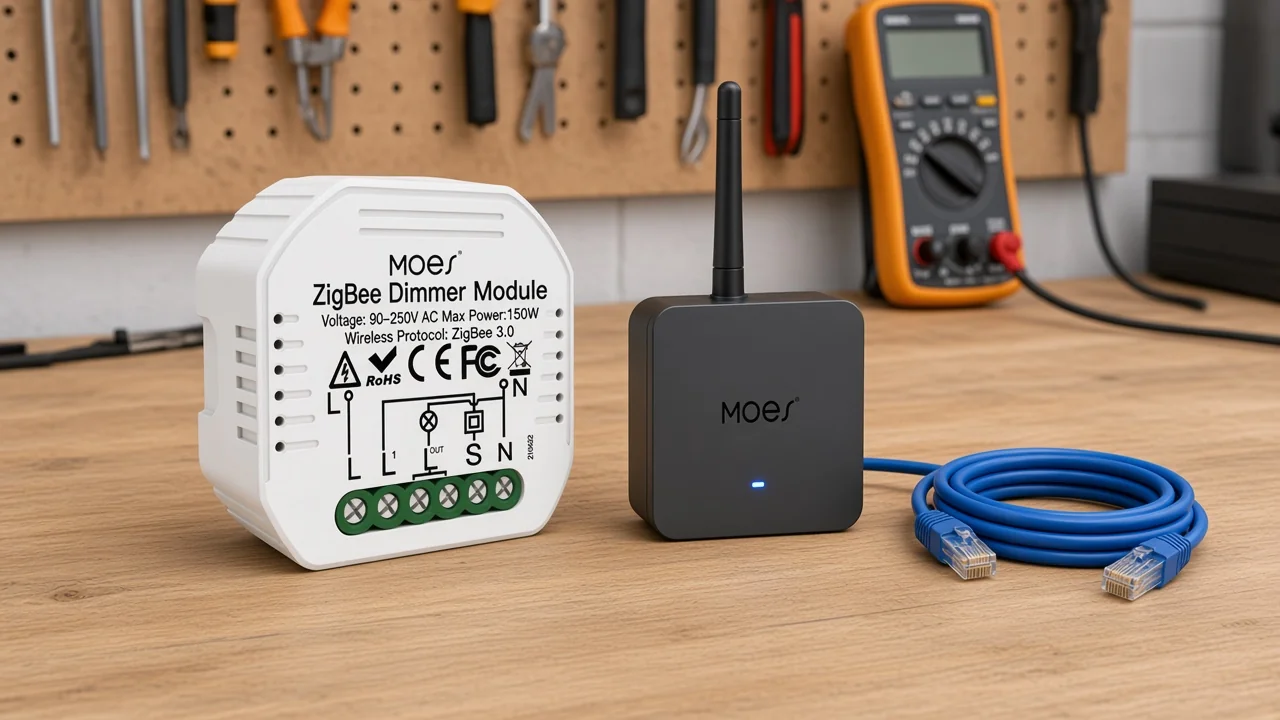
A network has one coordinator. That is a definition fact, not a stocking puzzle to solve here.
If your team needs the deeper radio-role map, use the live radio-type guide once and come back. This page only needs the quote field: which hub family pairs with the Zigbee endpoints on this order.
MOES’s ZigBee module example below states that a Tuya ZigBee hub is required for app and voice control on that SKU. Mirror that requirement on the quote instead of assuming a Wi-Fi SSID will carry the session.
Always-on routers extend the mesh and parent sleepy leaves.
Packing a carton with only battery sensors leaves the coordinator with nowhere to place children when walls and distance show up on the job.
Treat router density as a project input.
Ask how many mains-powered Zigbee routers sit between the hub and the farthest sensor. Ask whether the demo kit includes plugs or in-wall modules that stay powered.
Sparse router maps look fine on a table and fail in a corridor. This is not the place to classify every SKU into router or end-device buckets—that classification guide already exists.
The definition job is simpler: if the quote loads sleepy leaves without naming powered routers, the mesh plan is incomplete.
Sleepy end devices turn the radio down when idle and poll a parent for buffered messages. They do not route traffic for neighbors.
That is why a battery door sensor can go quiet when its parent plug is removed. A quote that only stocks sleepy leaves is a support ticket waiting for a demo day.
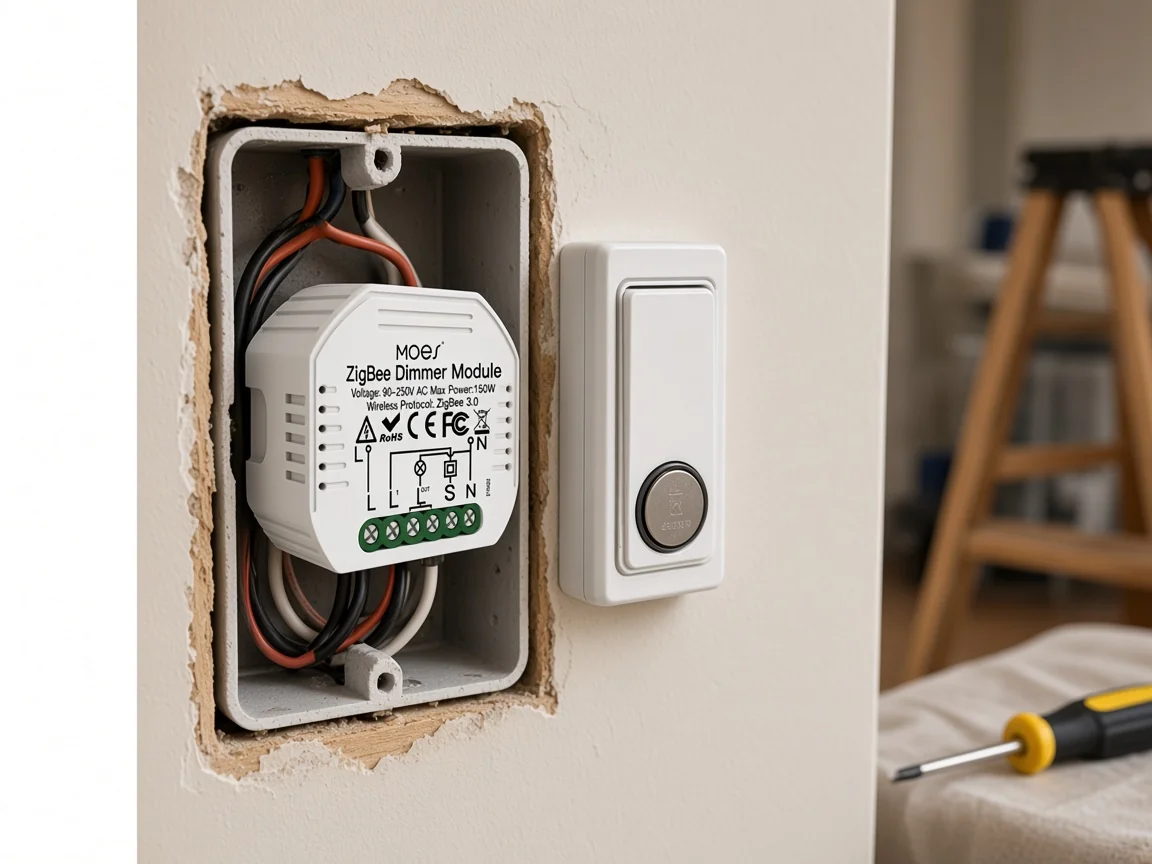
Mark sleepy leaves on the line card. Pair them with a stated parent strategy.
Keep the distinction short: sleepy leaves save battery; they do not build the mesh. Installers who understand that sentence stop blaming Zigbee range when the real miss was parent density.
A Wi-Fi SKU and a Zigbee SKU are different architectures on the same quote sheet.
Wi-Fi endpoints join an IP network the phone already speaks. Zigbee endpoints join a mesh that still needs a coordinator bridge for most app workflows.
Copying a Wi-Fi commissioning sentence onto a Zigbee module line is how channels create false delivery promises.
| Quote field | Zigbee path | Wi-Fi path |
|---|---|---|
| Network former | One Zigbee coordinator / hub family | Existing Wi-Fi access network |
| Coverage plan | Router density across the mesh | AP placement and band planning |
| Battery leaves | Sleepy end devices need parents | Usually stay on Wi-Fi direct |
| App bridge | Hub or gateway required on many SKUs | Often app-direct on the printed protocol |
If the team still needs a full hub-versus-Wi-Fi comparison for architecture selection, use the live comparison article once. This definition page only keeps the paths from collapsing into one checkbox.
Matter questions belong on the Matter definition and Matter-versus-Thread comparison posts. Zigbee remains a mesh radio stack; Matter is not a silent rename of every Zigbee card.
Only the live MS-105Z page may carry the MOES ZigBee module facts used here.
The MS-105Z ZigBee 3.0 dimmer module sits under Smart Modules and prints ZigBee 3.0 as the wireless protocol.
The same page states that a special Tuya ZigBee 3.0 hub is required and connected for Smart Life / Tuya app and voice control. It also states that the module can combine with a ZigBee gateway to form a home LAN when the wider network is weak or absent.
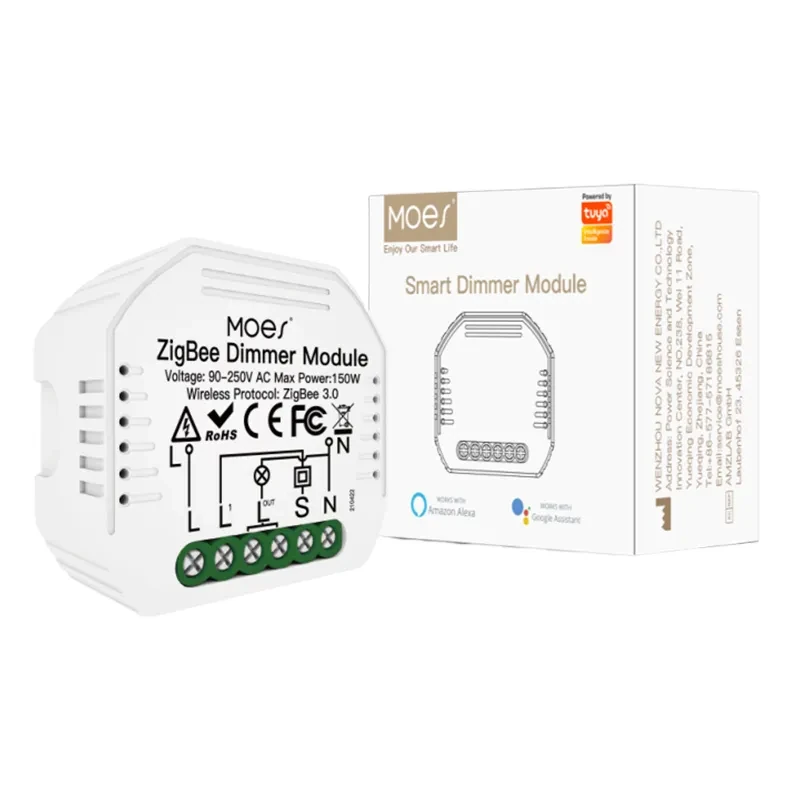
Page-stated electrical and radio lines for this SKU only: Voltage 90-250V AC 50/60Hz; Max. Power 75W at 110V / 150W at 220V; Frequency Band 2.400-2.483GHz; reset-switch only; mini housing sized for EU/UK wall boxes.
Do not copy those lines onto a Wi-Fi wall switch. Do not invent chip vendors or Green Power claims for this module.
| Lock before quoting | What to write |
|---|---|
| Protocol version | Zigbee 3.0 when the SKU page prints it |
| Hub family | Named hub / gateway that hosts the coordinator |
| Router density | Powered routers between hub and farthest leaf |
| Sleepy leaves | Mark battery endpoints that will not route |
| Path choice | Zigbee mesh path versus Wi-Fi SSID path |
| SKU evidence | Link the live page that prints the radio line |
Use sibling guides once when the job shifts: types of Zigbee devices for finished classes, Zigbee radio type for role classification, hub versus Wi-Fi for architecture selection, and what Matter is when the quote drifts into Matter language.
Usually yes for phone and app control. A Zigbee network needs one coordinator, and in commercial kits that role sits inside a hub or gateway.
Pair the hub family with the endpoints on the quote.
No. Zigbee is a low-power mesh path with its own zigbee hub or coordinator role.
Wi-Fi SKUs join an IP network the phone already uses. Keep the paths on separate quote lines.
Zigbee 3.0 is the unified application-layer certification line relative to older profile silos.
Print Zigbee 3.0 when the SKU page says it. Do not collapse legacy profile cards into the same interchangeable bin.
The coordinator forms the network and handles joining and security jobs. There is one per network.
In product language it is often the hub, bridge, or USB coordinator dongle.
The mesh can keep local control when the Zigbee gateway path is up.
On the MS-105Z page, the module is described as forming a home LAN with a ZigBee gateway for weak or absent wider-network conditions. That is a gateway-scoped claim, not a promise that every SKU behaves the same.
No. Matter is a separate application-layer story covered on the Matter definition and Matter-versus-Thread comparison articles.
Zigbee remains a mesh radio stack you still have to quote correctly.
Sleepy end devices do not route. Without enough always-on routers as parents, leaves lose their path even if the hub is powered.
Add router density to the quote before blaming Zigbee range.




OTHER SMART DEVICES
Jun 13,2026
OTHER SMART DEVICES
Jun 12,2026
TUYA SMART HOME PRODUCTS
Jun 12,2026
 +86 137 3639 3028



