

by NOVA

Aug 25, 2026
Asked plainly—what is pure sine wave power inverter—it is a DC-to-AC box that outputs utility-like AC: a smooth sine wave, not a stair-step or square wave. For buyers, that answer matters less as a slogan and more as a quote field: lock waveform class before you argue about watts, voltage, or which SKU to shortlist.
If you only need a one-line answer to what is a pure sine power inverter, it is a DC-to-AC converter whose AC shape tracks a sinusoid. The rest of this page is what thin definition pages usually skip: which fields belong on a quote, when motors and controls actually care, and where to continue on MOES without rewriting a full shopping comparison.
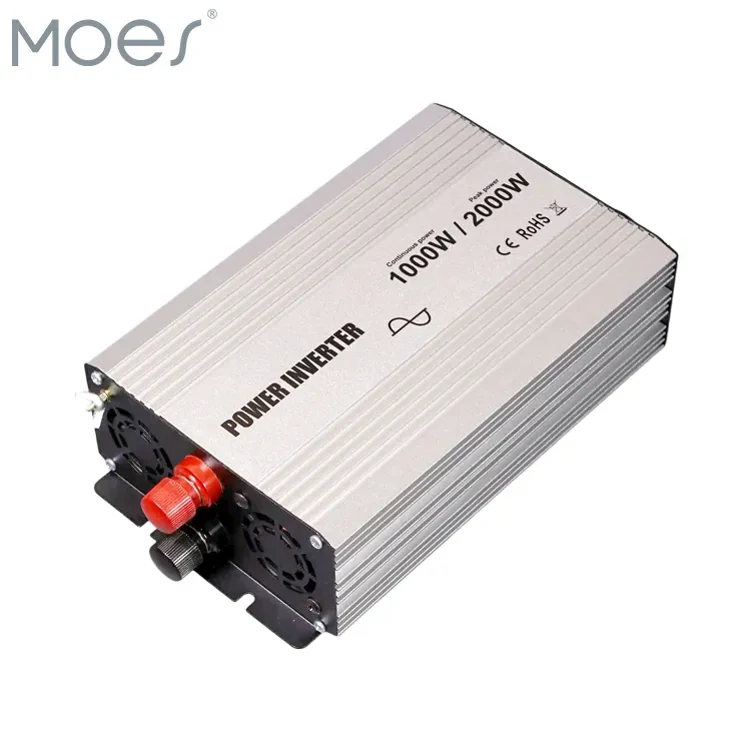
It converts DC into AC with a smooth sinusoidal voltage shape, similar to wall-outlet power. Batteries, PV storage, and other DC buses sit upstream; the inverter is the AC interface that loads expect when they were designed for grid-like frequency and voltage.
“Pure sine” (sometimes called true sine) names that shape. Continuous vs surge power, DC bus / battery voltage, and hybrid-versus-stand-alone architecture are still separate answers. Those still need their own lines on the quote even when the catalog already says “pure sine.”
For a broader map of what any power inverter is used for in B2B quotes, see what is a power inverter used for. This page stays on waveform class so those roles are not rewritten here.
List waveform, watts, surge, DC/AC ratings, and architecture as separate lines. Waveform class is not a substitute for continuous power, surge capability, or battery voltage—and none of those fields substitutes for the others.
A practical fridge-and-pump backup quote usually needs pure-sine class on one row, continuous watts on another, motor-start surge on a third, DC bus voltage on a fourth, and AC voltage/frequency on a fifth. If the site also needs PV charging or transfer logic, off-grid / hybrid architecture becomes a sixth decision after waveform is already locked.
| Quote field | What to record | Why it stays separate |
|---|---|---|
| Waveform class | Pure sine / modified sine / other | Decides whether motors and sensitive controls are in scope |
| Continuous power | Steady watts at the stated DC voltage | Sets running capacity; does not prove start capability |
| Surge / peak | Short inductive start headroom | Compressors and pumps fail quotes that only list continuous watts |
| DC bus voltage | 12 / 24 / 48 V (or stated class) | Wrong bus voltage breaks the SKU before waveform quality matters |
| AC voltage & frequency | 120 V 60 Hz or 230 V 50 Hz | Matches regional loads and site standards |
| Architecture role | Stand-alone PSW vs hybrid inverter/charger, HF vs LF topology | Changes size, surge behavior, and whether MPPT/charger functions are included |
Ask suppliers for motor-specific confirmation when the load list is inductive and the sheet only markets “works with most appliances.” That is ordinary channel diligence, not a delay tactic. Ask for the supplier’s application note when the sheet is silent on inductive starts—do not treat a wattage label as proof.
Architecture taxonomy beyond waveform—string, hybrid, off-grid roles—belongs in the types of solar inverters classification guide. Keep this checklist focused on waveform plus the companion electrical fields that prevent a wrong pure-sine pick.
Shape (and harmonic content) differ even when RMS voltage looks similar. Two inverters can show the same RMS reading while one delivers a smooth sinusoid and the other a stepped approximation.
Independent technical summaries treat total harmonic distortion (THD) as a measure of how far a wave departs from a pure sinusoid. Grid harmonic practice is often discussed against IEEE 519-2022 limits at the point of common coupling; that is system guidance, not a laboratory certificate for any MOES SKU. Encyclopedia summaries of inverter output classes also place square, modified sine, sine, and PWM near-sine outputs in one waveform family—different shaping strategies, not different marketing logos.
| Waveform class | What the AC looks like | Typical THD context (industry summaries) | Buyer takeaway |
|---|---|---|---|
| Pure / true sine | Smooth sinusoid similar to utility AC | Guides often cite roughly under ~3% THD for quality pure-sine designs | Default ask when motors, compressors, or sensitive controls are on the load list |
| Modified / stepped sine | Stair-step approximation of AC | Three-step modified sine still carries high THD (~30% at best in encyclopedia summaries) | May fit simple resistive loads; confirm motor and electronics behavior before promising |
| Square wave | Abrupt polarity flips | Roughly ~48% THD in the same encyclopedia summary | Rare for modern appliance quotes; treat as a different class, not a synonym for “inverter” |
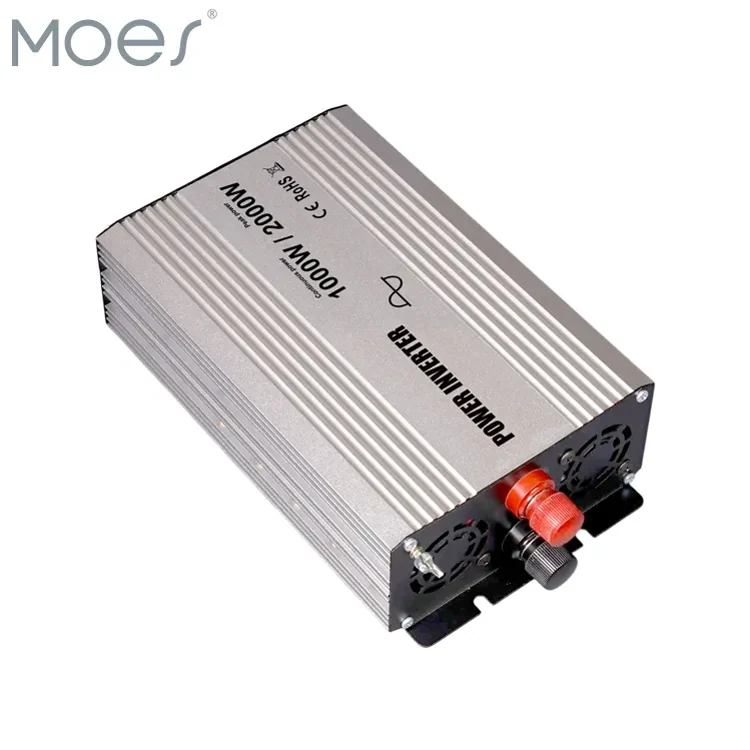
For a full dealer-facing comparison of pure sine wave vs modified sine wave, use the dedicated pure sine vs modified sine dealer comparison. The modified sine wave inverter category remains the parallel catalog path when the RFQ intentionally specifies stepped output.
Motors and some controls care; many switched-mode power supply (SMPS) loads care less. Fridge compressors, water pumps, and pedestal fans—typical asynchronous / induction motor loads—can hum, run hotter, or lose torque quality on non-sinusoidal AC.
Cost and risk usually arrive in the same conversation: pure sine costs more, while modified sine can buzz fans or struggle with motors. Treat that pairing as an RFQ prompt—ask for waveform class plus motor-start evidence—not as a price quote from this page. Suppliers often under-specify which motors will or will not run, so ask for load-specific evidence rather than assuming a wattage label is enough.
Laptop and phone chargers that use SMPS fronts often tolerate imperfect waves better than motor loads. That nuance does not make modified sine a universal bargain for mixed branch circuits; it only explains why some electronics “just work” while a pump fails the same weekend.
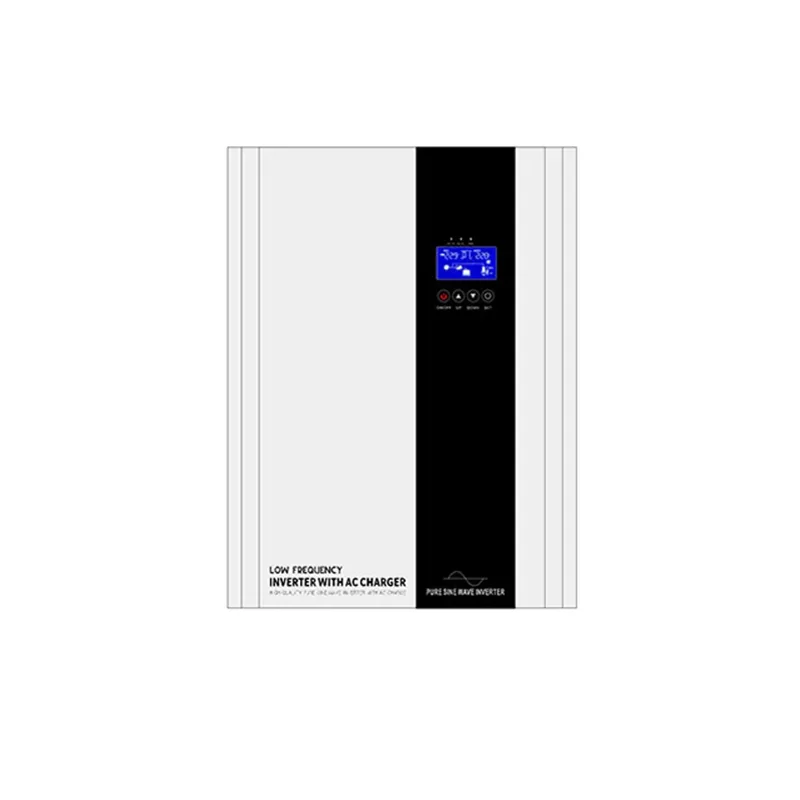
Important: Appliance and equipment manuals sometimes say only “inverter” without naming pure versus modified output. That gap shows up in the field when motors heat, buzz, or refuse to start. Treat unspecified “inverter” wording as incomplete—require an explicit waveform class (and motor-start evidence when inductive loads are present).
When the quote needs deeper matching of surge profiles to compressors and pumps, continue on the pure sine wave inverter load profile article rather than expanding a second full load-engineering guide here.
Rapid switching plus filtering shapes the AC wave from a DC source. The electronics reverse DC polarity at high speed; filters and control stages then smooth the chopped result toward a repeating sine usable by equipment built for grid-like frequency and voltage.
U.S. Department of Energy solar-integration materials describe the same idea for solar and storage systems: switching creates alternating polarity, and filters (or related electronics) produce a clean repeating sine wave so connected gear is not forced onto a crude square train.
Buyers do not need a firmware deep dive to quote correctly. They do need wave cleanliness as a field that sits beside wattage.
When a project records 48 V DC in, 230 V / 50 Hz out, and pure-sine class, the shortlist can move. When only wattage is listed, waveform quality is still undefined.
After waveform class and the quote fields above are clear, open the MOES pure sine wave inverter range to scan pure-sine lines. Two live examples illustrate different topology paths—not a claim that one SKU fits every job.
The MOES high-frequency pure sine power inverter family page positions high-frequency pure sine for stable, grid-like AC and lists protection features (over-current, voltage, temperature, overload, short, low-voltage). Published tech ranges on that page include DC 12/24/48 Vdc, AC 110/120/220/240 Vac, 50/60 Hz, and power from 300 W to 6000 W. Use those figures only for that product family; this article does not invent a THD percentage for MOES.
The MOES low-frequency pure sine hybrid inverter/charger page describes a transformer-based low-frequency design with pure sine output. Built-in MPPT is stated there as 80 A / 100 A, with battery classes including 12/24/48/96 Vdc, and power from 1 kW to 12 kW.
The same page states surge up to 300% peak for inductive loads, transfer under 10 ms, operating range −20℃ to 55℃, and efficiency above 90%. Scope every figure to that page when you quote. High-frequency vs low-frequency inverter topology is the architecture choice after waveform class is locked.
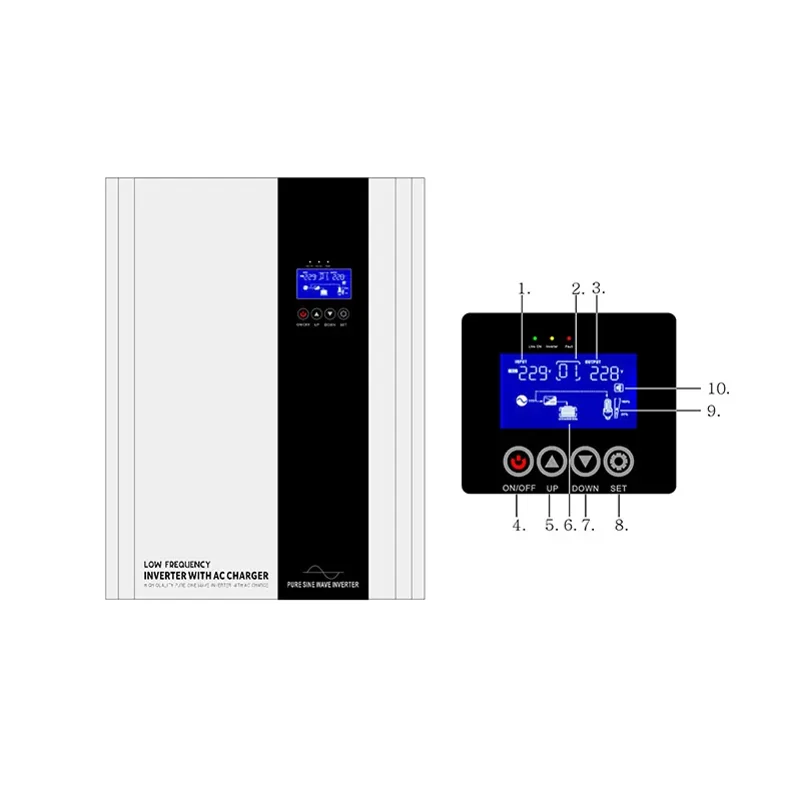
Compact HF units often fit documented mobile or space-constrained DC-to-AC jobs once continuous and surge needs are known. Heavier LF transformer inverter/chargers more often enter quotes when tough motor starts, hybrid charging, and PV MPPT sit in the same cabinet. Neither path replaces the checklist: waveform first, then watts, surge, bus voltage, and architecture.
Do not route a documented pure-sine requirement to the modified-sine category as the primary answer. Use modified sine only when the RFQ explicitly accepts stepped output for the recorded loads.
It is a DC-to-AC converter that delivers AC shaped like utility power—a smooth sinusoid—rather than a stair-step or square wave. Buyers use that definition to lock waveform class before they argue about brand or price.
A pure sine (or true sine) unit tracks a sinusoidal voltage; a modified sine unit approximates AC with steps. RMS readings can look alike while motors and some controls still behave differently because the shape is not the same.
No. Pure sine improves waveform quality for many inductive loads, but continuous watts, surge rating, and DC bus voltage still decide whether a compressor or pump starts. Ask for motor-specific evidence when the sheet is silent.
Record waveform class, continuous power, surge/peak, DC bus voltage, AC voltage and frequency, and whether the job needs stand-alone PSW or a hybrid inverter/charger (including HF vs LF topology). Keep those lines separate so one answer cannot hide another.
When the load list is mostly simple resistive gear and the buyer accepts stepped AC after reviewing motor and electronics risk. Mixed motor circuits usually push the conversation back to pure sine.
Inverters convert solar or battery DC to AC; pure-sine output is the waveform class many off-grid and hybrid loads expect. Architecture choices (off-grid stand-alone vs hybrid charger with MPPT) remain separate from that waveform decision.
Total harmonic distortion measures how much a wave departs from a pure sinusoid. IEEE 519 is commonly used as grid harmonic guidance at the point of common coupling; treat those numbers as guidance when you request a THD figure from a supplier, not as a MOES lab result.
Begin at the pure sine wave inverter hub, then compare the high-frequency pure sine power inverter family and the low-frequency hybrid inverter/charger example against the completed quote checklist.


OTHER SMART DEVICES
Jun 13,2026
OTHER SMART DEVICES
Jun 12,2026
TUYA SMART HOME PRODUCTS
Jun 12,2026
 +86 137 3639 3028