


by NOVA

Oct 05, 2026
A smart bulb vs smart switch choice is a control-location choice. The radio can live in the lamp, with the fixture left ordinary, or it can live in the wall box while the lamps stay replaceable. Load type, neutral, gang, dimming method, and who owns each object decide which class a zone belongs to.
Distributors hit this split on the same job: a showroom lamp that must travel with the booth, and a corridor whose paddle everyone already uses. The flipped wording smart switch vs smart bulb is the same split, read from the wall side. What a smart switch is, as a noun, is already answered on the smart switch clarification.
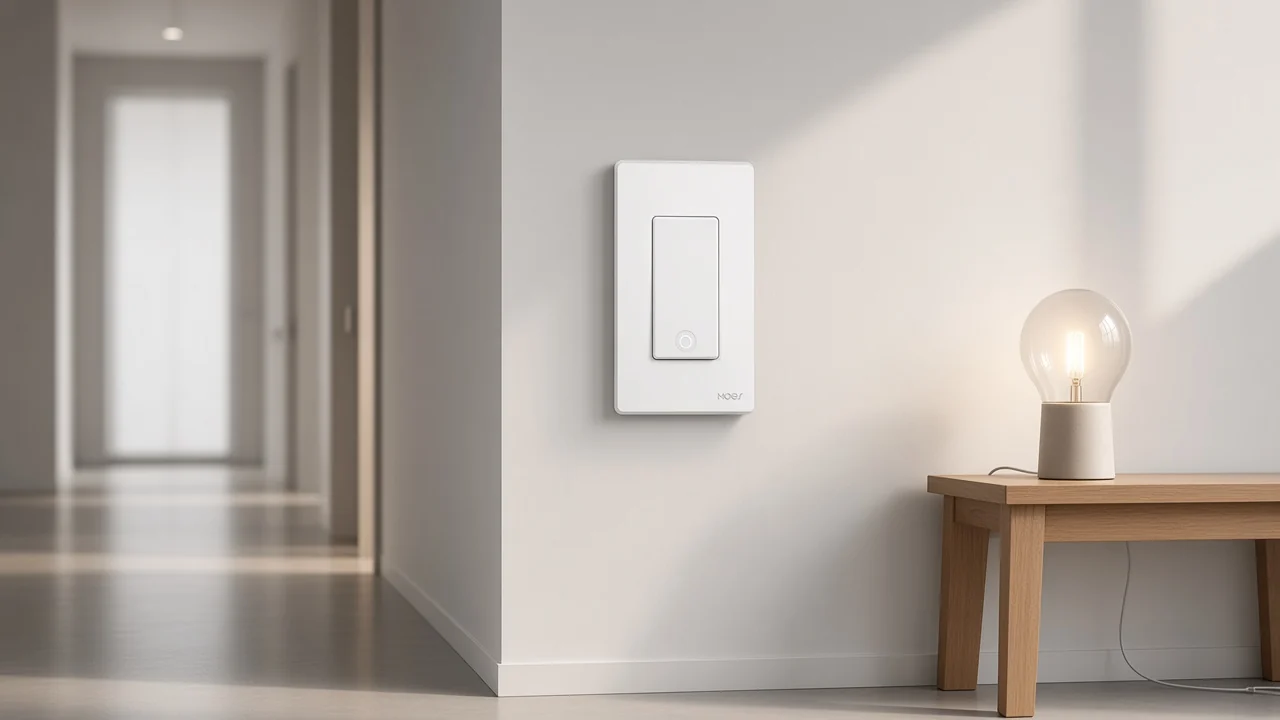
Put the radio in the lamp when the zone is a socket, a portable lamp, or a color effect. Put the radio in the wall when one paddle should run several ordinary lamps and people will still press that paddle.
A smart bulb screws into a socket that already has power. The wall device, if there is one, has to stay closed so the lamp’s radio never loses supply.
A smart switch replaces that wall device and switches the circuit. The fixture can keep a normal LED lamp, and the lamp can be swapped when it ages.
A smart plug sits in a third place. Wirecutter’s lighting split treats a plug as the control for a table or floor lamp, and an in-wall switch as the control for lights that already share a wall paddle.
A plug does not turn a hardwired ceiling into a portable lamp, and a wall switch does not follow a lamp that someone unplugs and moves. If the object is a loose socket accessory rather than this wall-versus-lamp decision, the light-socket checklist is the closer page.
The row that picks the class is the one that says where people touch the light, and whether each lamp must behave on its own.
| Zone fact | Specify a smart bulb class | Specify a wall smart switch |
|---|---|---|
| Everyday control | App, voice, or a remote, with the wall left on | The existing paddle, plus app or voice |
| Lamp count on one control | One lamp, or lamps that must differ from each other | Several lamps that should move together |
| Color or tunable white | Needed in that zone | Not needed; on, off, or dim is enough |
| Who may touch the wall | Almost nobody, or the wall is taped | Guests, staff, and cleaners |
| Building permission | Wall box stays closed | Wall box may be changed |
| What gets replaced later | The connected lamp | An ordinary LED lamp |
A six-lamp ceiling on one paddle is the clearest switch case. One wall device covers the circuit.
Six connected lamps would each carry a radio, and any person who opens the old paddle would knock them offline. A bedside lamp with no wall paddle is the clearest bulb or plug case.
There is no box to upgrade, and the lamp may leave with the tenant or the booth.
Price talk on consumer pages follows that same count. They do not publish a universal dollar winner, and this page will not invent one.
Ask the quote to count lamps on the circuit and count wall locations. The class usually falls out of those two counts before anyone argues brands.
They change which wall listing can be offered. They do not change the bulb class, because a bulb does not use the conductors in the switch box.
A mechanical paddle is only a gap in the live conductor. A wall radio has to stay awake while the lamp is off, so many listings need a neutral wire in that box.
Wirecutter’s in-wall examples say the same thing in product language: some dimmers need that return, and some other families are built for boxes that lack it. Elec-Mate’s UK note is narrower.
A switch-drop often brings an unswitched live and a switched live to the plate, and the neutral stays at the ceiling. Treat that as a site fact to confirm, not as a rule for every country.
A no neutral smart switch is a specific listing, not a slogan you can stamp on the whole catalog. On the MOES side, the Zigbee wall page is the one that describes both a neutral connection and a single-live version.
Other listings say neutral in the title. Match the title before the quote promises a box.
Next, count the gangs on the plate. A 1-gang body and a 3-gang body are different hardware even when the radio family matches.
On the Wi-Fi listing aimed at US plates, the title says 1–4 gang with outgoing ground and neutral. That title is the gang clue.
That title stops at this listing. The outgoing-wire layout stays on this page.
Two plates and one light make a 3-way circuit, with travelers between the boxes. SmartSMSSolutions’ body makes the practical point without a wiring lesson: one smart device plus one ordinary 3-way paddle often fails to stay coordinated, and many brands then ask for a companion at the second location.
Ask how many plates control that light. If the answer is two or more, the quote needs a listing that says 3-way or multi-control, not a single-pole switch and a hope.
How the radio and the relay actually pass a command is outside this matrix. That path is covered in how a wall smart switch moves power and radio commands.
The party who must replace the lamp should not be forced to buy a radio they did not specify. The party who owns the wall box should not be asked to leave a paddle that fights the lamp.
Rentals and temporary fit-outs usually leave the wall box with the building owner. A connected lamp can leave with the occupant.
An in-wall switch stays. That is why consumer pages steer renters toward bulbs, and why a distributor fitting a leased showroom should ask who is allowed to open the plate.
Owners and new commercial rooms often want the opposite. The wall box is theirs.
Lamps will be changed by maintenance for years. Forum buyers put the objection in plain language: they do not want the radio in the part that burns out, and they do not want a guest to kill a schedule by flipping an old paddle.
A wall switch keeps an ordinary LED lamp as the consumable. The radio stays in the device the channel actually quoted.
MOES can quote the wall-box side. The live smart switch hub is a wall and load-control catalog.
The hub showed 23 published listings when this page was checked, and a product-category search for a bulb returned nothing. If the RFQ’s connected object is the lamp, name the lamp maker, the base, and the color behavior as a specification class.
Do not attach a MOES switch SKU to that class just to fill a line.
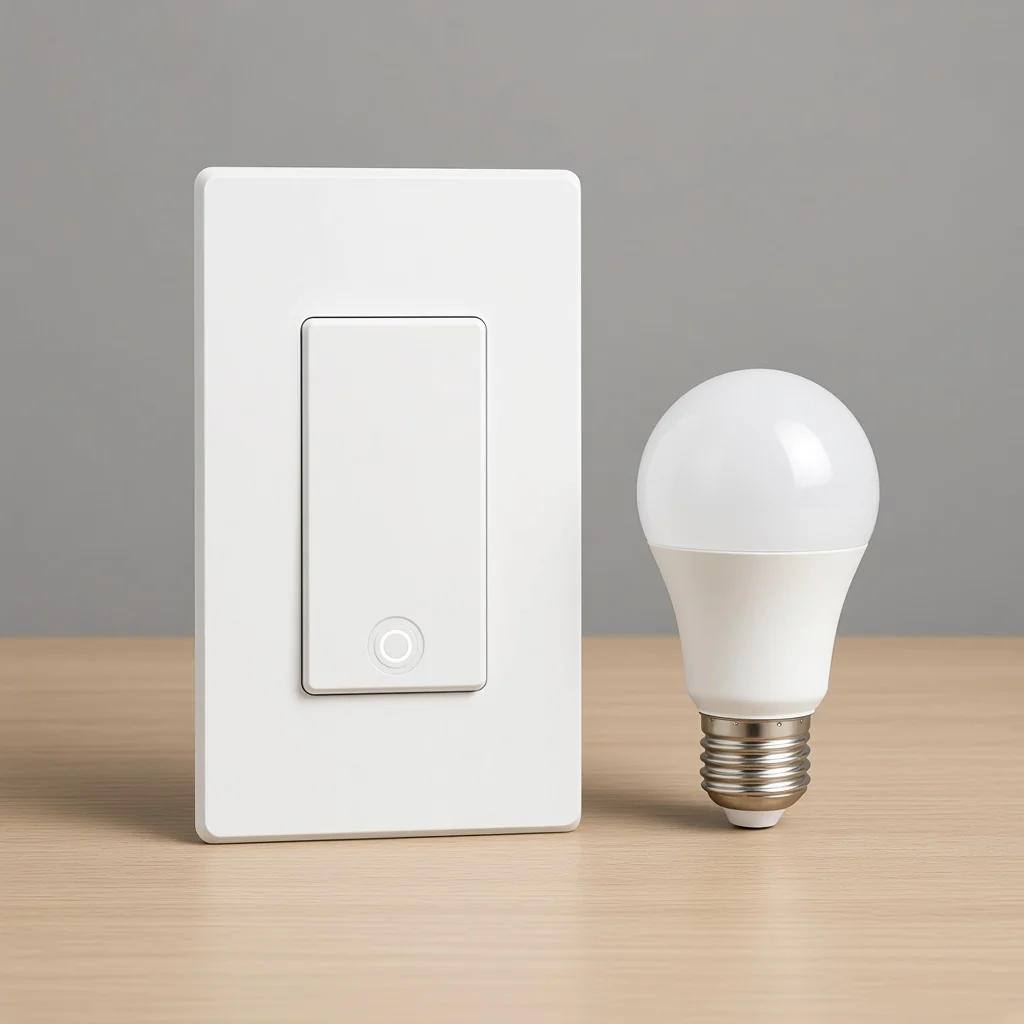
Specify dimming in the bulb when the zone needs color or a fade the lamp itself creates. Specify dimming at the wall when one dimmer must lower a set of compatible LED lamps together.
A smart dimmer vs smart bulb comparison is this method split. The bulb class dims inside the lamp, and it often should not sit downstream of an old wall dimmer.
The switch class dims by controlling power at the plate, and the lamps have to be ones that dimmer can drive. Prairie Electric’s comparison treats full color as a bulb trait.
A wall device that only opens the circuit cannot paint the room blue.
Efficiency is a lamp fact, not a reason to pick a radio location. The U.S. Department of Energy consumer guide says LEDs use up to 90% less energy and last up to 25 times longer than incandescent bulbs.
Most LEDs are also described there as dimmable, which still leaves the dimmer match as a listing check.
ENERGY STAR still lists certified downlights at 90% less energy than traditional models that use incandescent light bulbs. The same page says the mark has ended for the most common fixtures, and that not every LED works with every dimmer.
If the zone is a recessed downlight, ask for the fixture’s dimmer list. Do not hang an ENERGY STAR claim on a general bulb, and do not hang it on a MOES switch.
The FTC shopping note says a traditional 60-watt incandescent produces about 800 lumens, and an LED can make that brightness at about 9 watts. Use lumens and watts when the bulb side is a specification class.
Those figures are label language from the FTC. They are not ratings of any MOES wall device.
A retrofit has to live with the conductors already in the box. A new build can place a neutral at the switch before the wall closes.
On a retrofit, open the RFQ with three facts: is a neutral present, how many gangs share the plate, and how many locations control the same light. If the neutral is missing and the customer will not pull a new conductor, the wall-switch offer is limited to a listing that says so.
The bulb class remains available because it never needed that conductor. Color, if required, still belongs to the lamp specification, not to a switch title.
On a new build or a full rewire, the electrician can bring a neutral to the plate as part of the rough-in. Elec-Mate calls that out as the comfortable case for a wall switch.
The channel can then standardize on listings whose titles say neutral is required, and keep ordinary LED lamps in the fixtures. That is a cleaner maintenance story than a building full of connected lamps that each die on their own clock.
The two project stages still share one rule. Write the load type on the quote.
A dimmer or a no-neutral plate can be happy with a resistive lamp and unhappy with a small LED load. The Zigbee wall page is explicit about that window.
Other pages are not. Copy the window only from the page you are quoting.
Stacking fails because the wall device and the lamp then disagree about who is allowed to remove power.
A load-switching smart switch opens the circuit. A smart bulb on that circuit loses supply and drops off the network.
Sconce & Socket states the combined failure directly: you inherit both problems, and two apps can disagree about the room. The buyer version from a smarthome thread is the same warning.
Either use switches alone, or use a control that does not cut power to the bulbs.
From the field: People who already live with both devices say the same thing — leave smart bulbs on an ordinary paddle and someone will turn that paddle off. The schedule dies, the voice command dies, and the next person thinks the product is broken. A Home Assistant thread puts the same failure in one line: a wall switch that cuts the power leaves the bulbs with no supply.
There is a careful exception, and it is not “buy both and hope.” Some wall devices can act as a scene button and leave the lamps powered. That behavior has to be written on the listing.
It is not the default job of a relay that exists to switch a load. If the MOES page you are quoting describes a relay and a load, treat it as a load switch.
Do not promise scene-only behavior that the page does not describe.
Day-to-day use after a switch is already installed, including schedules and who presses the paddle, sits on the application guide. This comparison stops at the class decision.
Only pages that are live wall switches. The bulb side of this article stays a specification class because the catalog has no smart-bulb product to attach.
Start at the MOES smart switch listings. The hub groups touch wall switches, dimmers, fan-light switches, curtain switches, and US gang versions. Pick the row that matches the zone, then read that product page before the quote freezes a neutral or a load number.
The US 1–4 gang Wi-Fi switch is the gang example whose title includes outgoing ground and neutral. The US gang model WS-B-US is listed at 90-240V AC, 50/60Hz, with 10A per gang and 10A total.
Use it when the plate is a US gang layout and the title’s neutral wording matches the box. It does not add color to the lamp.
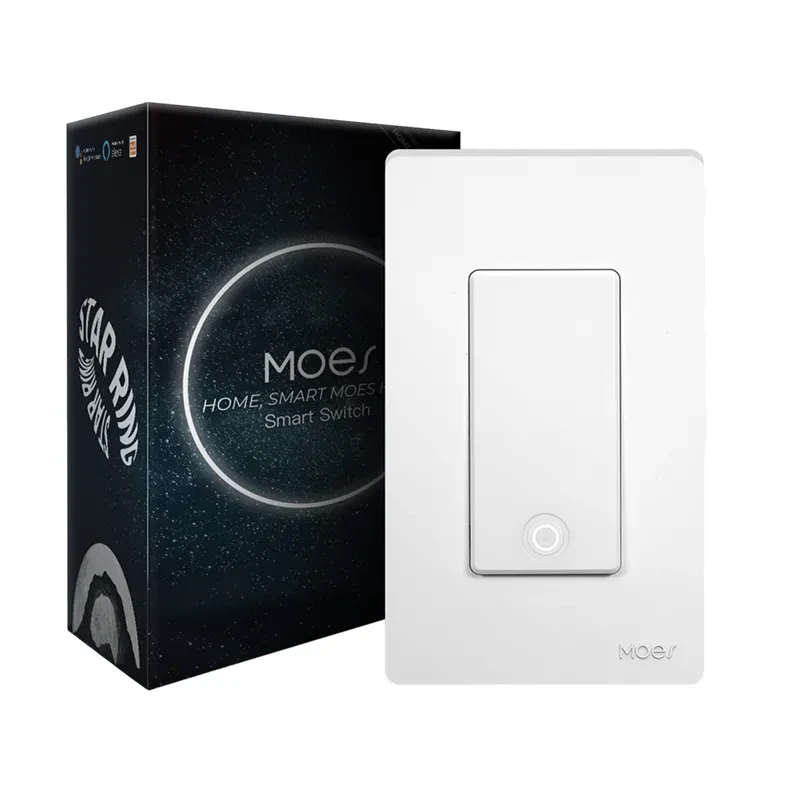
The Star Ring 3-way and single-pole switch is the neutral-present wall example. Its title says neutral wire required, and it offers 3-way or single-pole use.
Star Ring model WS-SR-US-T is listed at 100~245V AC, 10A, with standby power at or below 0.5W. That page also says no hub is required for this Wi-Fi model.
Keep that sentence on this model. The Zigbee listing says the opposite about a hub.
The Zigbee wall light switch is the page that allows neutral or no-neutral wiring and describes 2/3-way association in the app. That Zigbee wall switch page lists AC 100-250V, a 10A total, an LED and CFL window of 3-120W, and resistive windows of 3-300W at 110V and 3-600W at 220V.
It also says a Tuya Zigbee hub is required. Quote the load type against that window, and do not copy the window onto the Wi-Fi gang switch.
| RFQ field | Write this | Why it changes the quote |
|---|---|---|
| Control location | Lamp, plug, or wall box | Picks the class |
| Load type | LED, CFL, or resistive, with the watt window | Matches a dimmer or no-neutral listing |
| Neutral | Present, absent, or to be pulled | Allows or removes many wall listings |
| Gang and 3-way | Plate size and number of locations | Picks the body and the companion story |
| Dimming method | Inside the lamp, or at the wall | Stops a wall dimmer from fighting a smart bulb |
| Ownership | Who owns the lamp, who owns the box | Decides what the channel is allowed to leave behind |
| Project stage | Retrofit box or new-build rough-in | Says whether a neutral can be added before close-up |
Send the wall-box quote through the product page you actually matched, then use the contact form for quantity and destination. Leave lumen, color, and base on the lamp specification when the class is a bulb. MOES does not have a smart-bulb line to decorate that row.
Neither class wins every zone. A wall switch is the better fit when one paddle must control several ordinary lamps and strangers will use that paddle. A smart bulb class is the better fit when the zone needs color, a portable lamp, or a wall box that must stay closed.
No. Opening the wall switch removes power, and the bulb leaves the network until someone closes that switch again. App, voice, and schedules wait on that power.
Not as a load switch feeding connected lamps. The switch will cut the bulbs off the network. A scene control that never removes power is a different listing, and it has to say so.
Many do, because the radio stays powered while the lamp is off. Some listings are built for a box without a neutral.
Read the title. On this catalog the Zigbee wall page is the one that describes both arrangements.
The hardware count favors one wall switch once several lamps share a circuit, because the lamps can stay ordinary. A single portable lamp usually favors a bulb or a plug. This page does not publish street prices.
A wall listing that is actually made for two or more locations, if the boxes match that listing. Smart bulbs still go dark if either ordinary paddle opens the circuit. Ask for the location count before you promise either class.
The lamp maker’s line, written as a specification class. MOES quotes the wall device. Brightness, color, and base stay on the lamp paperwork, not on the switch page.




OTHER SMART DEVICES
Jun 13,2026
OTHER SMART DEVICES
Jun 12,2026
TUYA SMART HOME PRODUCTS
Jun 12,2026
 +86 137 3639 3028



