

by NOVA

Oct 15, 2026
A house quote uses the live hybrid listing or an off-grid listing on the solar inverter hub. Search pages talk about a string inverter or a microinverter, while the published solar inverter for home path on this catalog is the hybrid collection or the off-grid collection. The on-grid collection is empty, so the inquiry names a live URL before anyone debates roof shade.
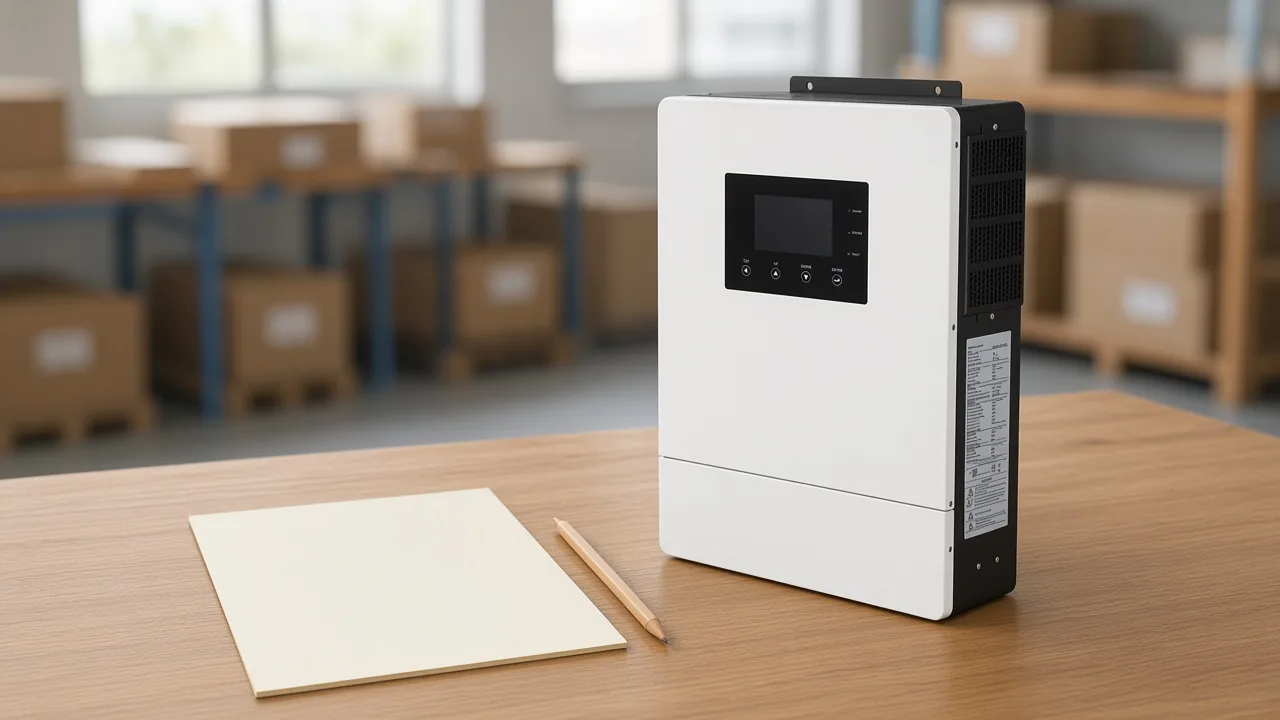
Open the collection that already has products, then copy the title voltage into the inquiry. The hybrid inverter collection currently shows one listing.
The off-grid inverter collection shows three. The on-grid inverter collection shows none.
| Live collection | What a house quote can attach | Example already published |
|---|---|---|
| Hybrid inverter | One charger page with a 48V DC table | WiFi hybrid solar inverter 4.2KW/6.2KW |
| Off-grid inverter | A low-frequency charger plus two power-inverter pages | Pure sine and modified sine children |
| On-grid inverter | Nothing to attach | Category text says no products were found |
A clean south roof on a consumer article often points to a string inverter. Shade on that same article often points to microinverters.
Those topologies explain a rooftop layout. They are not SKUs on this hub.
A distributor who pastes a string-inverter brand list into a MOES inquiry still has to pick hybrid or off-grid before the factory can answer.
The house can stay connected to utility power and still leave the on-grid collection closed. Utility presence describes the building.
The collection describes what is published. When the job is backup, battery charging, or a PV input note, the hybrid listing or an off-grid charger page is the page that already prints those fields.
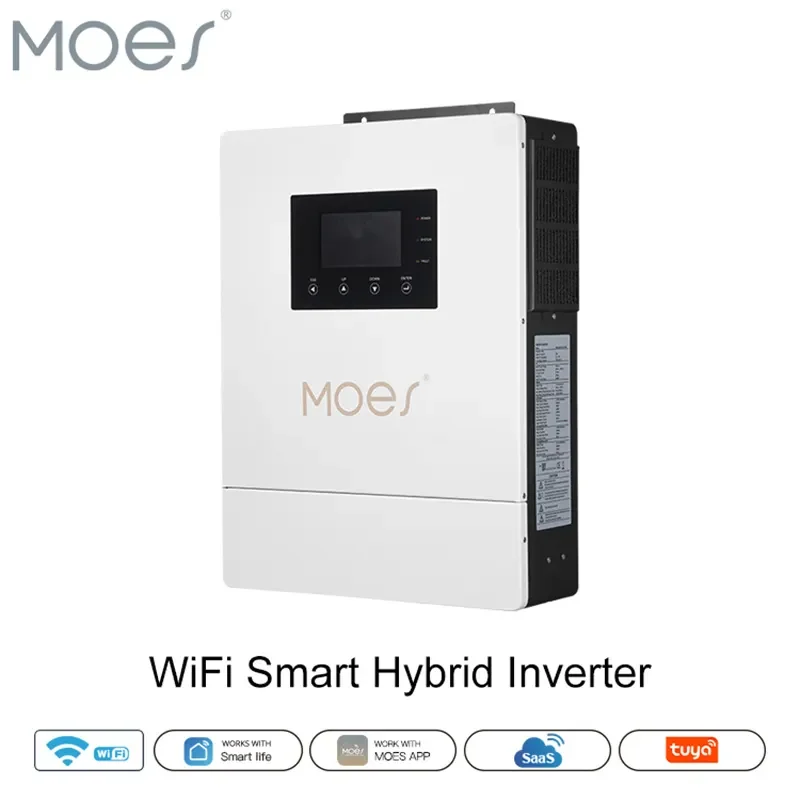
The hybrid collection’s only listing is the WiFi hybrid solar inverter, titled as an off-grid 48V charger as well. Its table prints DC operating voltage 48V, AC operating voltage single phase 176-253V, operating frequency 50Hz/60Hz, and a power range of 4.2KW/6.2KW. The same page prints an MPPT voltage range of 60V-450V and a built-in MPPT solar controller note of 80A/100A.
That page is a hybrid solar inverter in the collection sense: inverter, solar charger, and battery charger in one NVESS series description. A bullet also says it can operate without a battery.
A house that sometimes runs from PV and AC charging can send this URL. A house that needs 12V or 24V DC should leave this URL and read the off-grid tables instead.
The title says off-grid while the breadcrumb says Hybrid Inverter. Put both facts in the inquiry so the two words do not get treated as two products.
The side-by-side behavior of hybrid and off-grid designs is already written in the off-grid inverter versus hybrid inverter comparison. This page only decides whether the house quote is allowed to use the one live hybrid URL.
WiFi monitoring is printed on the same listing. It is a feature of this SKU, not a promise that every off-grid power inverter includes a radio.
Pure sine wave output is also printed here. Waveform still has to be checked again on the child page if the quote moves to a different URL.
The off-grid parent holds three listings, and they do not do the same job. The low-frequency unit is filed under Pure Sine Wave even though its title says hybrid.
That charger table prints DC operating voltage 12/24/48/96V, AC operating voltage single phase 170-275V, operating frequency 50Hz/60Hz, and a power range of 1KW-12KW. Battery voltage on the bullet list is 12/24/48/96VDC, with mains priority, battery priority, energy saving, and unattended named as working modes.
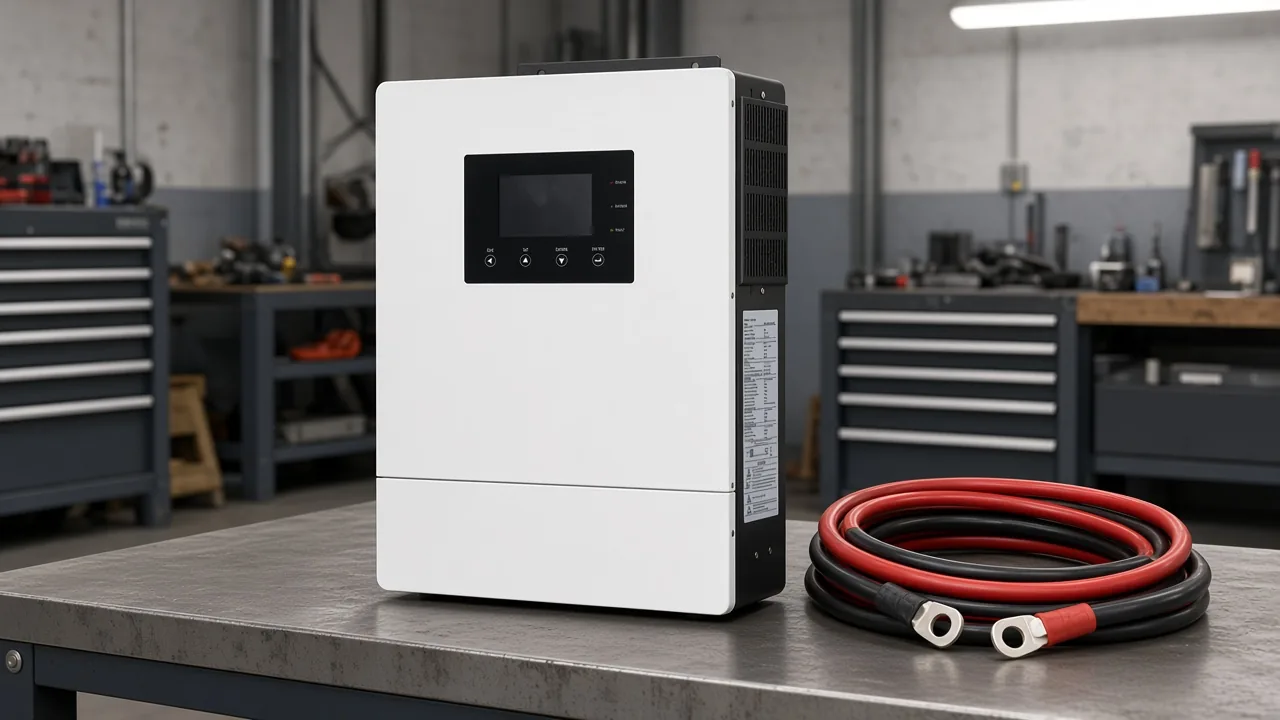
The other two listings are power inverters. Both power-inverter tables print DC operating voltage 12V/24V/48Vdc, output voltage 110V/120V/220V/240Vac, operating frequency 50Hz/60Hz, and a power range of 300W ~ 6000W.
The pure sine wave page is aimed at loads that need grid-like AC, including ordinary household appliances named on that description. The modified sine wave page says it suits resistive loads such as heaters and lamps, and that sensitive electronics are a poor match because of harmonic distortion.
A cabin or backup subpanel that only runs lights and heaters can attach the modified sine listing. A house circuit with computers, audio gear, or other sensitive electronics stays with a pure sine wave listing.
The parent off-grid noun, including how that class is described for buyers, is already covered in the off-grid solar inverter clarification. Use that page when the question is what off-grid means.
Use this one when the question is which of the three URLs belongs on a house inquiry.
An off grid inverter search often lands on the parent collection. From there, match the bank voltage to the table before talking about waveform.
A 96V bank is printed on the low-frequency charger only. The two smaller power inverters stop at 48Vdc in their tables.
The on-grid inverter category is visible in the menu and returns a real URL. The page body says no products were found in this category. There is no wattage, no AC window, and no battery note to copy, because there is no listing.
A homeowner phrase like “grid-tied solar for the house” still arrives in B2B inboxes. On this site that phrase does not open a product family.
If the house must export, ride through utility rules, or use a string inverter from another brand, that hardware is outside the live MOES collections. The quote either moves to the hybrid or off-grid URL that matches the printed job, or it stops.
Empty menu entries confuse catalogs. Send the collection URL in the email only to show it was checked, and state that no SKU was available on the day of the inquiry.
Counts on the hub can change later. The habit that matters is reading the category page before promising an on-grid line.
Once the collection is chosen, the inquiry is a short copy of the table that is already public. Kilowatt math for array and load is already written in the solar inverter sizing checklist.
Keep that worksheet on its own URL. Here, the fields are the ones printed on the page you attach.
| Page you attach | DC note to copy | AC and frequency | Power range | Battery or PV note |
|---|---|---|---|---|
| WiFi hybrid listing | 48V | single phase 176-253V, 50Hz/60Hz | 4.2KW/6.2KW | MPPT 60V-450V, 80A/100A; can operate without a battery |
| Low-frequency charger | 12/24/48/96V | single phase 170-275V, 50Hz/60Hz | 1KW-12KW | MPPT controller 80A/100A; lead-acid and lithium-ion named |
| Pure sine power inverter | 12V/24V/48Vdc | 110V/120V/220V/240Vac, 50Hz/60Hz | 300W ~ 6000W | No MPPT window on the table |
| Modified sine power inverter | 12V/24V/48Vdc | 110V/120V/220V/240Vac, 50Hz/60Hz | 300W ~ 6000W | Resistive loads; sensitive electronics called a poor match |
From the field: Installers on a public solar forum argued that a battery-based inverter still needed a battery bank even in a grid mode, because panels alone do not hold ordinary house loads steady. On the MOES hybrid listing the bullet says the unit can operate without a battery, so the inquiry should repeat that bullet or name the battery voltage the project will actually use. Source: Solar Panel Talk.
Add destination market and quantity in the same message. Those two items are commercial.
They are not a substitute for the voltage row. A 48V bank sent to the low-frequency page is coherent because 48V is inside 12/24/48/96V.
The same bank sent to the WiFi hybrid page matches that page’s single 48V row. A 12V bank matches the power-inverter tables and the low-frequency charger, and it does not match the WiFi hybrid table.
PV voltage belongs only where a range is printed. The WiFi hybrid page prints 60V-450V.
Quoting a string of panels above that window, or below it, is a mismatch with this listing. The power-inverter pages do not print an MPPT window, so a PV design for those URLs needs a separate charge-controller conversation rather than a guessed range.
For a house whose DC bank is 48V, whose AC supply sits inside 176-253V, and whose power need sits inside 4.2KW/6.2KW, attach the WiFi hybrid solar inverter on the hybrid collection. Say whether the project will use the printed “operate without a battery” arrangement or a battery on the 48V row. Include the MPPT window if PV is part of the job.
Choose the low-frequency pure sine charger when the bank might be 12V, 24V, 48V, or 96V and the power range needs room up to 1KW-12KW. Choose the pure sine power inverter or the modified sine power inverter when the job is DC-to-AC only and the load note matches the waveform page. Send the chosen URL, the copied table row, quantity, and destination through Contact Us.
A second URL in the same email is useful only as a rejected option. Example: “48V house backup, hybrid listing attached, modified sine page set aside because the loads are electronics.” That sentence tells the factory which class won.
No listing exists there to quote. A house that still uses utility power can be quoted from the hybrid listing or an off-grid charger page when that page’s AC window and battery note match the job.
The listing says it can operate without a battery. If the project has a battery, the DC row to copy is 48V on that same table.
The low-frequency charger prints 12/24/48/96V, so a 48-volt bank is inside that set. The WiFi hybrid page prints only 48V, which also matches that bank and excludes 12V, 24V, and 96V.
Use another listing when the house load is sensitive electronics. The modified sine page itself points those loads away and keeps resistive loads such as heaters and lamps in view.
Grid-following solar is built to switch off when the utility drops, so crews are not fed from a rooftop. Continued power needs an inverter arranged for that job and storage to steady the loads. The hybrid listing’s backup language is a prompt to ask which arrangement you want, not a whole-house outage test.
Array and load math stays on the sizing checklist. After the class is chosen, this inquiry only carries the power range already printed on the attached page.
Follow the collection and paste the URL. The WiFi unit is in the hybrid collection even though the title says off-grid. The low-frequency charger is in the off-grid pure sine collection even though the title says hybrid.


OTHER SMART DEVICES
Jun 13,2026
OTHER SMART DEVICES
Jun 12,2026
TUYA SMART HOME PRODUCTS
Jun 12,2026
 +86 137 3639 3028