


by NOVA

Sep 20, 2026
A solar inverter converts direct current (DC) from a photovoltaic (PV) array into alternating current (AC) that site loads or the utility grid can use — that is the straight answer to what is a solar inverter before any quote is priced. Without that conversion, panel DC stays on the wrong side of most wall-powered equipment.
This article stays on definition and quote language. It does not rerun sizing maths, efficiency curves, high-voltage fault trees, waveform class debates, or a full types taxonomy — those already have live pages you can open once.
The map is short: define the device, separate it from a charge controller and a generic power inverter, lock grid-tied / off-grid / hybrid on the RFQ, then look at one live MOES hybrid listing with page-scoped ratings only.
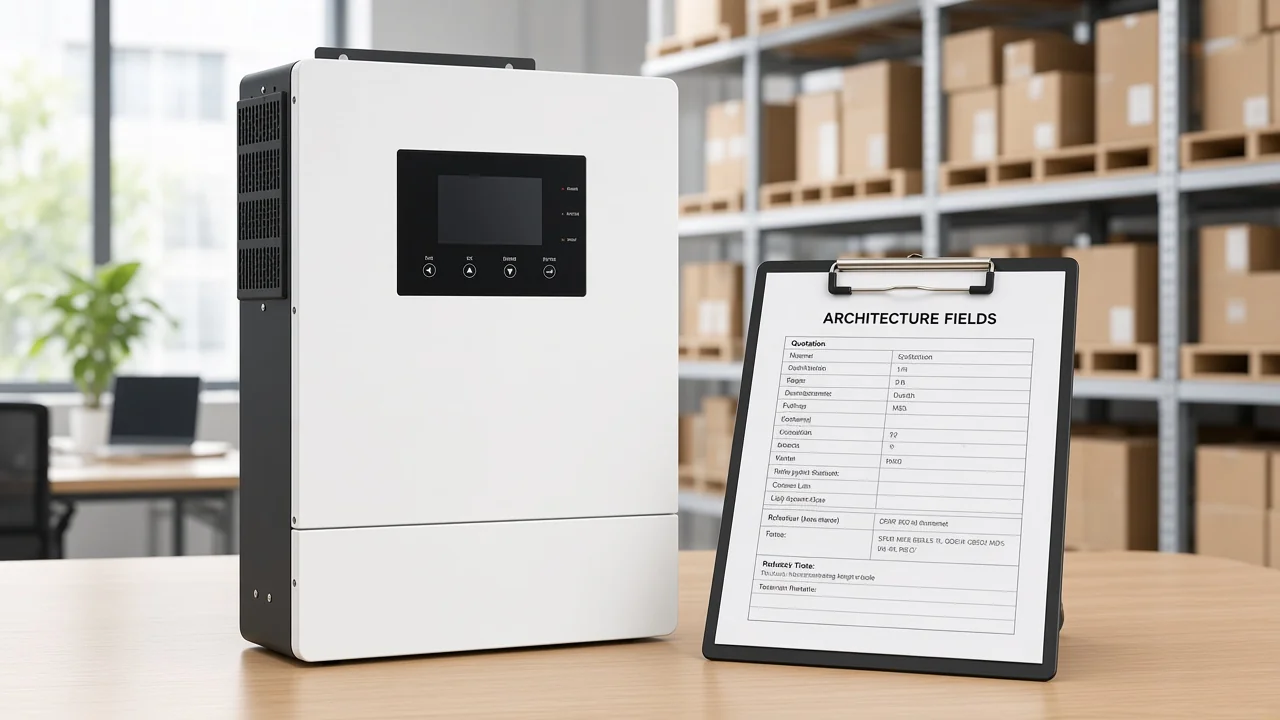
A solar inverter is the power-electronics box that turns PV-side DC into AC for loads or export. In plain terms, panels produce electricity that flows one way at a fairly steady voltage.
Most building equipment and the grid expect current that reverses direction many times each second. The inverter is the bridge between those two worlds.
Call it a solar power inverter when the RFQ language is looser — the job is still DC-to-AC on a solar project, not a vague “power box.” For how procurement teams classify string, micro, and related packages, use the live types of solar inverters page instead of expanding this definition into a catalog of topologies.
A useful mental model: the photovoltaic (PV) array is the source, the inverter is the converter, and the AC panel or grid connection is the destination. Batteries may sit on the DC side in many kits, but they do not replace the need for AC when the loads are AC.
Distributors see the same word used for three different buying moments.
One RFQ wants a grid-export string package. Another wants a cabin kit with batteries.
A third wants a hybrid chassis that can island a critical panel. The shared noun is “solar inverter,” but the commercial object is not shared until architecture is written down.
If the inbound email only repeats the focus phrase and a watt guess, pause.
Ask what AC destination exists, whether the utility must stay in the picture, and whether a separate charge controller is already on the bill of materials. Those three answers usually decide the class before anyone opens a price book.
Inside the unit, solid-state switches flip the DC polarity back and forth at high speed. Filters and control loops then shape that chopped signal toward an AC waveform equipment can accept.
You do not need a semiconductor lecture to quote the device. You do need to know that “invert” here means reverse and reshape the current path, not “invert the project.”
Authority explainers from energy agencies describe the same sequence: solar panels generate DC; the inverter produces AC for the grid or for appliances. Independent education pages add the same transistor-switching picture for non-engineers.
Maximum power point tracking (MPPT) often appears on solar-oriented units so the array can be held near a useful operating point. Treat MPPT as a function name on the datasheet, not as a substitute for naming the architecture class.
Channel language sometimes says “the inverter makes the power.” That is half true.
The array harvests energy. The inverter makes that energy look like the AC the building expects.
Confusing those two jobs is how a quote ends up with a charger-only line item and no AC path, or an AC box with no plan for the battery bus.
Keep the explanation at buyer altitude. If someone asks for efficiency percentages, curve comparisons, or cold-weather Voc maths, hand them the sibling pages rather than inventing numbers here.
Three names collide on RFQs. Keep them separate before anyone prices a line item.
A charge controller sits on the DC path between the array and the battery bank. It regulates charging. It is not the AC converter.
When a buyer needs the full cross-device comparison, open the live solar inverter vs charge controller article once — do not paste that matrix here.
A generic power inverter also converts DC to AC, often from a battery or vehicle DC bus. It is not automatically a solar-oriented package with PV input windows, solar charging, or grid behaviour. For use-case clarification on that broader class, use what is a power inverter used for.
A solar inverter is the converter named for a PV project. Many hybrid enclosures also include solar charging and AC battery charging in one chassis. That combination is still an inverter-led package, not a reason to erase the charge-controller concept from every kit.
When a salesperson answers “yes” to every device name on a messy RFQ, the warehouse ships the wrong box.
Force the desk to pick one primary device class first. Then decide whether other functions are integrated or separate.
Integration is a bill-of-materials choice. It is not permission to blur definitions.
| Device name on the RFQ | Primary job | Typical path | What to clarify before price |
|---|---|---|---|
| Solar inverter | DC → AC for loads or grid | PV (and often battery DC) to AC | Architecture class and AC target |
| Charge controller | Regulate PV-to-battery charging | Array DC to battery DC | Separate box vs integrated MPPT |
| Power inverter | DC → AC from a DC source | Battery/vehicle DC to AC | Whether PV functions are required |
Waveform class (modified versus pure sine) is a different question. Keep that on the live modified sine wave vs pure sine wave comparison when the load list demands it.
Before a “solar inverter” line can be priced, write one architecture field: grid-tied, off-grid, or hybrid. Those three labels change what the unit is allowed to do when the utility is present or dark.
A grid-tied inverter synchronises to the utility.
For safety, anti-islanding behaviour means many grid-tied designs shut down when the grid is dark, even if the sun is still on the roof.
If the project needs backup, that requirement must appear in writing — it is not implied by the word “solar.”
An off-grid inverter forms its own AC supply with batteries and the array. It does not assume a live utility reference. Remote sites and standalone kits live here.
A hybrid inverter packages solar conversion with battery charge and discharge behaviours, and may support both grid-connected operation and islanded backup depending on the model and the transfer equipment.
Deep disadvantage lists and on-grid versus off-grid decision matrices already exist — use difference between on-grid and off-grid and disadvantages of hybrid inverter once when the desk needs those debates.
Do not let marketing synonyms hide the field.
“On-grid,” “grid-tie,” and “grid-tied” usually point at the same class. “Standalone” usually points at off-grid.
“Inverter/charger” often signals hybrid behaviour, but still write hybrid or off-grid explicitly so purchasing does not guess.
From the field: In a SolarDIY discussion about hybrid worth, one installer boiled the vocabulary down to three classes — grid tie, off grid, and hybrid — and reminded readers that grid-tie units stop when the utility is down. That is the same lock a channel coordinator should force onto the RFQ before asking for a number.
| Architecture label | What the desk is buying | Outage behaviour to confirm | Sibling page when the debate grows |
|---|---|---|---|
| Grid-tied | Synchronised export/self-use with utility present | Often shuts down on blackout (anti-islanding) | On-grid vs off-grid comparison |
| Off-grid | Standalone AC with batteries | Designed to run without utility | Off-grid buyers guide / comparison |
| Hybrid | Solar plus battery roles in one package | Confirm island/backup scope in writing | Hybrid RFQ checklist |
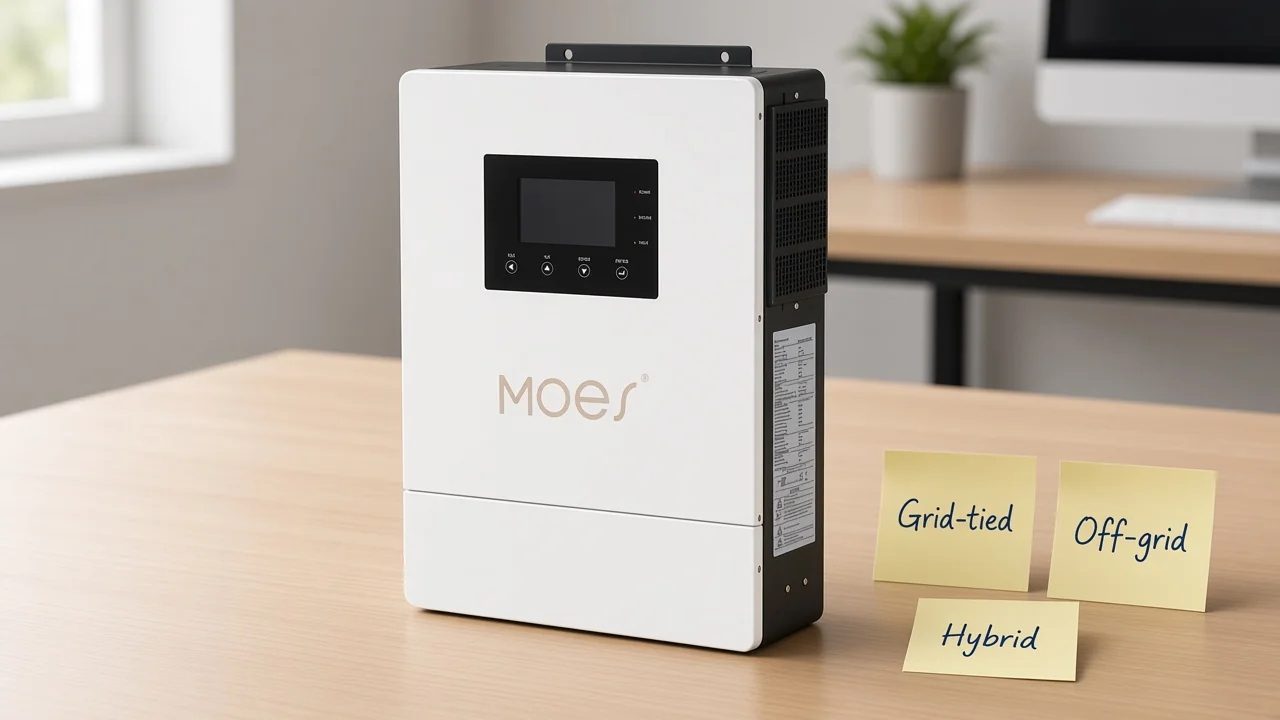
RFQ language that only repeats “solar inverter” is not enough. Add the fields that stop wrong-class shipments.
| RFQ field | What to write | Why it matters |
|---|---|---|
| Device class | Solar inverter (not “inverter” alone) | Separates PV projects from generic power inverters |
| Architecture | Grid-tied / off-grid / hybrid | Changes grid behaviour and battery expectations |
| AC target | Voltage and frequency the site needs | Prevents 50 Hz / 60 Hz and single-phase mismatches |
| Battery present? | Yes/no and nominal DC bus if known | Explains whether hybrid or separate controller language applies |
| Adjacent devices | Charge controller separate or integrated | Stops double-ordering or missing DC regulation |
| Outage need | Backup required or not | Forces anti-islanding honesty on grid-tied quotes |
Sizing continuous and surge watts is a different worksheet.
When the load list is ready, move to the power inverter sizing checklist.
Efficiency evidence belongs on the solar inverter efficiency comparison page.
High DC voltage symptoms belong on the solar inverter high voltage problem checklist. Do not paste those into this definition.
Upward links for the family: solar inverter, and when the architecture points that way, hybrid inverter or off-grid inverter.
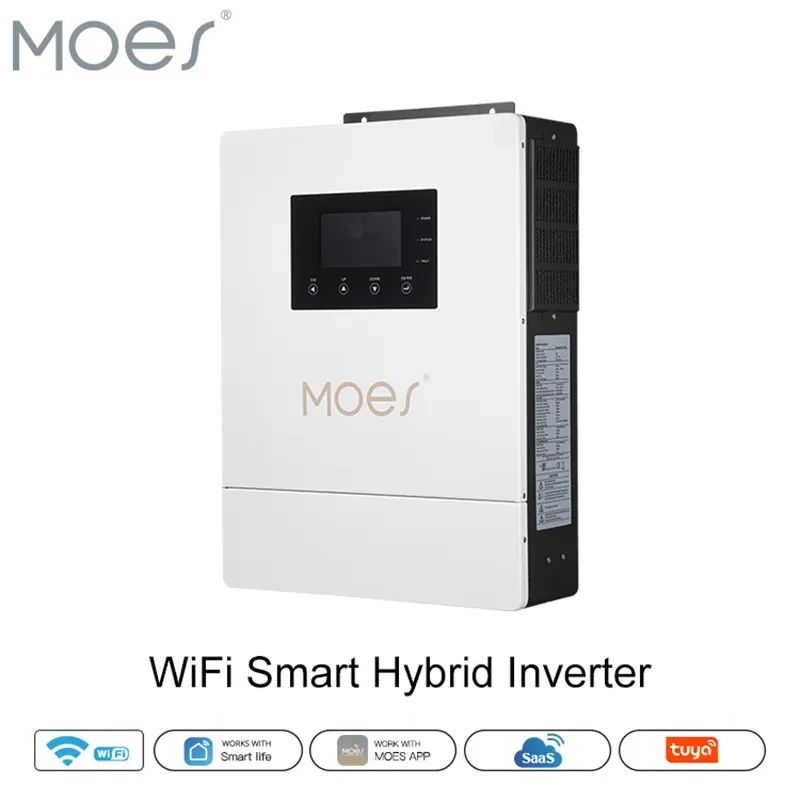
For a concrete, page-scoped example of a solar-oriented hybrid package, open the live MOES WiFi smart hybrid solar inverter listing.
The product page describes an NVESS Series multifunctional inverter/charger that combines inverter, solar charger, and battery charger functions.
Ratings quoted below come only from that listing, read on 2026-09-20. Do not transfer them to other SKUs.
| Parameter on the live page | Value shown |
|---|---|
| DC operating voltage | 48V |
| AC operating voltage | single phase 176–253V |
| Operating frequency | 50Hz/60Hz |
| Power range listed | 4.2KW / 6.2KW |
That block illustrates how a hybrid solar inverter listing should look on an RFQ: architecture language (hybrid / off-grid framing on the page), a DC bus figure, an AC window, frequency options, and a published power range. It is not a sizing calculator, not an efficiency curve, and not a warranty claim beyond what the page states.
WiFi monitoring language on the same page is a management feature, not a substitute for architecture. Remote alerts do not change whether the unit is meant to island or to shut down with the utility. Keep features and architecture on separate RFQ lines.
If the buyer still needs waveform class, open the modified-versus-pure comparison. If the buyer needs kit arithmetic, open sizing. Keep this page on what the device is and what must be clarified before anyone quotes it.
It is the device that converts DC from a photovoltaic (PV) array into AC for site loads or the grid. That conversion is the core answer to the definition question.
A charge controller regulates DC charging into batteries. A solar inverter produces AC. Deep comparison lives on the solar inverter vs charge controller article.
A power inverter converts DC to AC, but a solar-oriented unit is specified for PV projects and may include solar charging or grid behaviours. Use the power-inverter “used for” page when the RFQ is not solar-specific.
Those labels change grid synchronisation, battery expectations, and outage behaviour. Write one of them before pricing a solar inverter line.
Often no. Anti-islanding safety expects many grid-tied designs to stop when the utility is dark. Backup needs must be written as hybrid or off-grid scope, not assumed.
On the live 4.2KW/6.2KW WiFi hybrid listing: DC 48V, AC single phase 176–253V, 50Hz/60Hz, and the page-listed power range 4.2KW/6.2KW. Quote only that page’s figures.
Use the types of solar inverters classification page for taxonomy, and the power inverter sizing checklist for continuous and surge arithmetic. Keep this page on definition and quote language only.




OTHER SMART DEVICES
Jun 13,2026
OTHER SMART DEVICES
Jun 12,2026
TUYA SMART HOME PRODUCTS
Jun 12,2026
 +86 137 3639 3028



